
What happens when you take “The Hangover” and make it female, Filipino and family friendly? You get the fast-paced colorful fun that is “Forgotten Island.” Even if you’re not familiar with Filipino culture and Tagalog (lingo primer supplied below), you can still enjoy the basics including the introduction of a new menageries of Halloween horrors. Ultimately the story is about friendship and “Your best friendship is worth fighting for.”
Central to the action is Josephine “Jo” Yuson (voiced by Kailey Crawford.) who we first meet as an impressionable and imaginative young child sent to the principal’s office for her theatrical, but, according to her, historical presentation on an imaginary island: Nakalimutan, or Nakali for short. Jo’s heard stories from her grandmother, Lola Fatima (Dolly de Leon), who, when she was much younger was magically transported to the Forgotten Island by a magical sand dollar. Her classmate, Raissa Molina (Kayla Teruel), who defended her. Instead of seeing the principal, Jo leaves a “BRB” Post-It and the girls go off on adventure, leading to the two becoming besties.
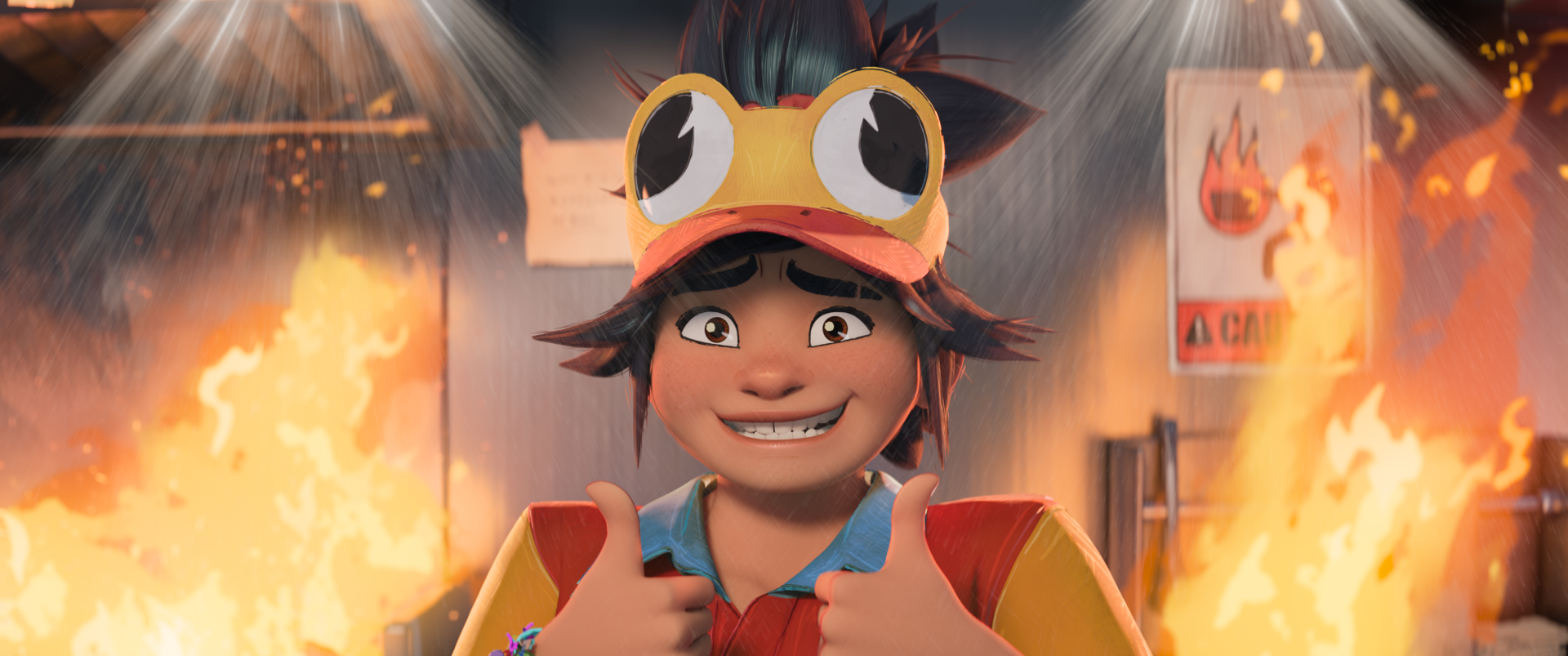
While Raissa’s father (Januel Mercado) enjoys having a captive audience for his karaoke renditions and Raissa’s mother enjoys the reflection of her daughter’s promising future, Jo leads Raissa on an escape to the beach where Jo finds a magical sand dollar. Although initially afraid, Raissa joins Jo as they jump through.
Flash forward and the two find themselves on a beach with no memory of how they go there and how Raissa got her crazy new hairdo. Worse, they have no way of getting back because they’ve lost the magical sand dollar. Then there’s the weird issues of wings. Raissa has them, but when did she get them and from whom?

Along the way, they meet the Tiyanak Bungi (Manny Jacinto) and conceited and deceitful Merman (Kevin McCann) named Mermahn and the cute, but fearsome Duwende led by Truffle Waffle (Ronny Chieng) and the wise Kapre led by Datu (Jo Key). There will be a happy ending although Raissa will have to give back those wings and no character is totally beyond redemption.
Writers/directors Joel Crawford and Januel Mercado have adopted and adapted many manga and anime conventions along with a colorful tropical color scheme for this journey into Filipino folklore. They don’t pander to the audience so you’ll have to relax and, if you don’t know the words, just follow along and embrace the visuals.
According to the production notes, Crawford and Mercado set the film in the 1990s, because Mercado explained, “It was a time before social media, smartphones and when friendships often felt more fragile and maintaining friendships took real effort.” Crawford added: “The 90’s were our formative years, and those memories we all make during those times shape us into who we eventually become.”
While Mercado of Filipino descent, Crawford married into a Filipino family. Crawford, Mercado, producer Mark Swift, production designer Ryan Carlson and art director Chris Grun traveled to the Philippines in the spring 2025 for a ten-day research trip through the islands. During this trip, Mercado’s relatives hosted a welcome party for the creative team and for Crawford’s visiting family. The gathering inspired the going-away party Raissa’s family throws for her in the film.
Crawford explained, “The culture was a huge part of what we wanted to celebrate in this movie. It is incredibly warm and welcoming, the kind of place where, if you are there, you are family. Everyone is singing, dancing, eating and drinking together. And the myths still feel very alive there. Everyone we met had a story about seeing Manananggal.”
Now you, too, can add the lore of the Manananggal to your treasury of vampire stockpile along with the many other creatures introduced in “Forgotten Island.”
There are some plot holes (like what about Jo’s other relatives) and the flash forward skips a lot of growing up in between, but over all this is a fun introduction to Philippine mythology, something long over due considering the long ties between the Americas and the Philippines and the Philippines and the US.
The Film’s Filipino Lingo
Aspin is not a term used in the production notes, but is used in the Wikipedia entry for “Forgotten Island” to describe the character of Raww. Aspin is short for Asong Pinoy and such dogs were formerly called Asong Kalye or abbreviated as Askal, meaning street dogs or strays according to Wikipedia. This is not a breed recognized by international kennel clubs.
Aswang is, according to the production notes, “the umbrella term for all shapeshifting, supernatural creatures.”
Mercado says. “They are essentially the Philippines’ versions of monsters, vampires, werewolves, ghouls, goblins and elves. The mythology is so rich that we are barely even scratching the surface with the creatures that are featured in our story.”
Batibat is also called Bangungot and is “a vengeful demon found in Ilocano folklore. These demons were blamed as the cause of the fatal nocturnal disease called bangungot” according to the “Myth and Folklore Wiki.” The Batibat:
…usually come in contact with humans when the tree that they reside in is felled and made into a support post for a house. This causes them to migrate into holes found in the post. The batibat forbids humans from sleeping near its post. When a person does sleep near it, the batibat transforms to its true form and attacks that person. It sits upon the chest of its victim until he suffocates. To ward off the batibat, one should bite one’s thumb or wiggle one’s toes. In this way, the person will awaken from the nightmare induced by the batibat.
The Batibat is Batiba
According to the production notes, the Batibat is a tree-dwelling demon from Ilocano folklore known for entering the dreams of its victims.
“Her design takes inspiration from the tarsier, the small nocturnal primate native to Southeast Asia, whose enormous eyes give Batiba an uncanny mix of sweetness and menace. She appears shy, delicate and almost harmless at first, but her softness conceals something far more complicated.”
“Our version of the Batibat is derived from a specific branch of that creature,” writer-director Januel Mercado says. “We took some liberties in our story by having her prey on memories, which ties directly to our themes of friendship, nostalgia and the way memories shape us.”
Duwende may be cute, but don’t tell them. The production notes explain:
As any Lola might tell you, the Duwende are tiny elves and goblins who live in the hills, guard their land fiercely and demand proper respect from anyone who crosses their path. In the forests of Nakalimutan, a traveler who stumbles upon their mounds is expected to ask permission before passing through. To ignore them is to invite a curse.
In Forgotten Island, the Duwende are led by King Truffle Wuffle, voiced by Emmy-winning actor and comedian Ronny Chieng. Standing just under two feet tall, Truffle Wuffle rules with an iron fist and the wounded pride of a leader who wants desperately to be feared. “Unfortunately, for King Truffle Wuffle, the Duwende are just about the most adorable creatures ever to exist,” writer-director Joel Crawford says. “And let’s face it, his name does not help.”
But there is one rule on Nakalimutan that everyone knows: never, under any circumstance, call a Duwende “cute.” Jo, being Jo, breaks this rule almost immediately. For King Truffle Wuffle, the insult is unforgivable, and his pursuit of the girls becomes one of the film’s funniest expressions of injured dignity. “They do not know that they are cute, and they do not understand why people think they are cute,” Chieng says. “It infuriates them.”
Kapre, are, according to the production notes “a community of towering tree giants who guard Nakalimutan’s sacred forests. The Kapre are wise, musical and deeply attuned to nature.” In “Forgotten Island,” the notes say “their design draws from the rainbow eucalyptus trees native to the Philippines, giving them a vivid, organic beauty that reflects both their strength and their connection to the island.”
The “Myth and Folklore Wiki” describes them as:
Philippine cryptid creature with the appearance of an phenomenally tall, long-legged, god type of hairy humanoid, that sits in big trees and smokes cigars. It is often seen waiting for people as they walk through a path. It scares away little children who play at night. If you’re stuck in a place and you keep going around in circles, you’re said to be played around by a kapre. To escape its control, you must remove your shirt/clothing, and wear it inside-out.
The term kapre comes from the Arabic word “kaffir”, meaning a non-believer in Islam. The early Arabs and the Moors used it to refer to the non-Muslim Indians who were dark-skinned. The term “kaffir” was also used for Papuan slaves brought to the Philippines by the Portuguese before slavery was abolished by Spain.
Kapwa is, according to the production notes, “a shared identity rooted in mutual respect, care and interconnectedness.” Kapwa Pilipinas defines it this way:
Kapwa is a recognition of a shared identity, an inner self, shared with others. This Filipino linguistic unity of the self and the other is unique and unlike in most modern languages. Why? Because implied in such inclusiveness is the moral obligation to treat one another as equal fellow human beings. If we can do this – even starting in our own family or our circle of friends – we are on the way to practice peace. We are Kapwa People.
Further, Kapwa Pilipinas notes “Kapwa is a core value of Sikolohiyang Pilipino or Filipino psychology, and at the center of our storytelling mission.”
Kataw is a merman who in “Forgotten Island” is named Merman. According to the “Myth and Folklore Wiki,” there are several types of merfolk:
In Visayan, Kataw was believed to be the highest ranking among the other merpeople or sea creatures, including the Sirena, Sireno, and Siyokoy.
It is believed that the Kataws are the reigning rulers of the kingdom Bantay Tubig, the guardians of the water. These marine creatures disguise themselves as fishermen asking for help. When approached by mortals, the Kataws drown them in the ocean depths.
According to old folks, Kataws have the ability to manipulate and control water-type elements and related forces such as pressure, tides, waves, bubbles and the likes. Also, they can change water to ice.
Lola is the Tagalog and general Filipino word for “grandmother.”
Manananggal is defined as a Filipino Aswang that can detach her torso from her lower half and then fly. The Manananggal is nocturnal and eats infants according to the “Myth and Folklore Wiki.”
The Manananggal is described as being an older, beautiful woman capable of severing its upper torso in order to fly into the night with huge bat-like wings and prey on unsuspecting, sleeping pregnant women in their homes.
Sunlight is deadly to the Manananggal when she is in her monstrous form. Should her two halves still be separated with the coming of dawn, she will be destroyed. According to legend, to destroy the Manananggal, one should search for the lower torso that she leaves behind during her nightly hunts. Salt, ash, and/or garlic should then be placed on the exposed flesh, preventing the monster from combining again and leaving it vulnerable to sunlight.
Small containers of salt, ash and raw rice, and the smell of burning rubber are said to deter the Manananggal from approaching one’s house.
In the film “Forgotten Island,” The Dreaded Manananggal (Manang) (voiced by Tony Award-winning Lea Salonga. According to the production notes:
Her name comes from the Tagalog word tanggal, meaning “separate” or “remove,” an apt origin for a creature that can detach her upper body from her lower half and take flight into the night.
Nakalimutan, or Nakali for short, is for the main character Jo, “the mythical island that becomes part of her imagination long before it becomes part of her reality.”
Sarimanok is, according to Wikipedia, “also known as papanok in its feminine form,[1] is a legendary bird of the Maranao people, who originate from Mindanao, an island in the Philippines, and part of Philippine mythology.” But it is also a regional symbol.
The Sarimanok is the legendary bird that has become a ubiquitous symbol of Maranao art. It is portrayed as a fowl with colorful wings and a feathered tail, carrying a fish in its beak or talons. The head is profusely decorated with scroll, leaf, and spiral motifs. It is said to be a symbol of good fortune.
“Tayo na,” is, according to the production notes, ” a Tagalog phrase that translates to ‘let’s go,’ with the specific meaning of ‘going together,’ symbolizes the narrative bond between all the characters in the film.”
Tiyanak is “a vampire-like creature said to take the form of a newborn to lure unsuspecting victims” according to the production notes. The “Myth and Folklore Wiki” describes the Tiyanak as “a small humanoid monster in Philippine mythology which pretends to be an innocent baby before attacking humans.”
It disguises itself as a baby abandoned in the forest or in the field. It wails loudly to attract a passerby and when picked up it sheds its disguise like a snake shedding its old skin, revealing its true form, and kills the victim by biting and mauling.
In “Forgotten Island,” the character Bungi Tiyanak (voiced Manny Jacinto) is an eight-foot-tall demon baby with three eyes, but he’s not a killer of people, but a 200-year-old baby who has never literally cut the umbilical cord to his mother. Having never ventured away from his mother’s protection in the Kakaiba Market, he’s incredibly naive, emotional but kind-hearted and artistic.
Weredog, is, the production notes, “Filipino mythology’s version of the werewolf.” The Wright State Guardian had this to say:
Since there are no wolves in the Philippines, the term weredog is more appropriate; although the term werebeast may, in some cases, be even more applicable,” The Aswang Project says. “A weredog is said to reside in a village and turn into a ferocious dog, boar, or large cat at about midnight.