
What is “narrative art” has been the question circling around Los Angeles like buzzards waiting for a fine dining experience. The SDCC presentation for the Lucas Museum of Narrative Art failed to clarify that as did the press released from the museum last month. After two days at the museum, I have the answer. This museum is more about ego than art.
I do understand where George Lucas is coming from when he mentions the separation between fine art and lesser works. Lucas is now now 82, born 14 May 1944, he at USC School of Cinematic Arts in 1964, after attending Modesto Junior College. By that time H.W. Janson had already published his “History of Art.” Decades later, this book by the Russian-born German academic, who became a US citizen in 1943, would be a staple in art history survey courses like the one I took. Janson taught at the New York University from 1948, the same year he was awarded a Guggenheim Fellowship.

The book didn’t contain the name or works of a single woman. It also had some questionable passages about Asia and the Pacific. All of these things angered me as an undergraduate in studio art. But I had already been told early on that women would not be artists.
Things have changed since then, but has the Lucas Museum of Narrative Art been sensitive to those changes?
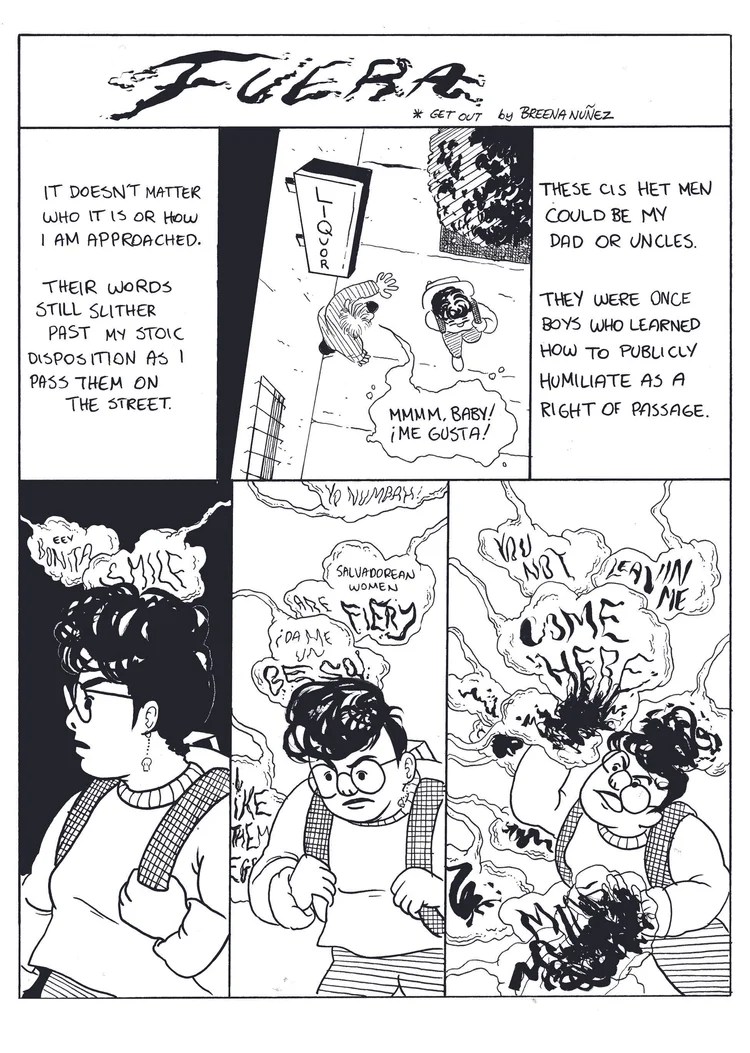
The installation of the works of art and the juxtaposition of that art with specially commissioned works that seem meant to serve as selfie-worthy moments makes for a disjointed experience. What are we here for? To learn? That might be hard. The highly polished chrome silver lettering that announces the themes of sections is in English and Spanish. Their reflective qualities that you can see on the floors serve no purpose. Secondly, the art labeling continues this bilingual approach, but only on the titles of the works. There are silly moments when the English title is in Spanish and repeated, but not translated into English (e.g. Joey Terrill’s “Chicos Modernos” is “Chicos modernos” in Spanish and Breena Nuñez’s “Fuera” is “Fuera.”)
The medium is not translated or explained. That might be fine for “Oil on canvas,” but I overheard one early viewer query what “Drypoint” was and decided it must be ink. It is indeed a process that involves ink, but that’s very different from “Ink and graphite on board.”
Drypoint is a type of intaglio printmaking by which the artists scratches directly onto a plate (zinc or the more traditional copper) with a sharp, long steel instrument or other tool. Traditional etching uses acid, and engraving removes the metal shavings. Drypoint raises a burr or ridge. When the design is complete, one spreads ink over the plate and when wipes off the excess ink. Printing is done using a printing press and running the plate with a damp piece of paper on it through.
I know this because I have tried this technique although I prefer etching with acid. My undergraduate emphasis in studio art was printmaking, specifically intaglio etching.
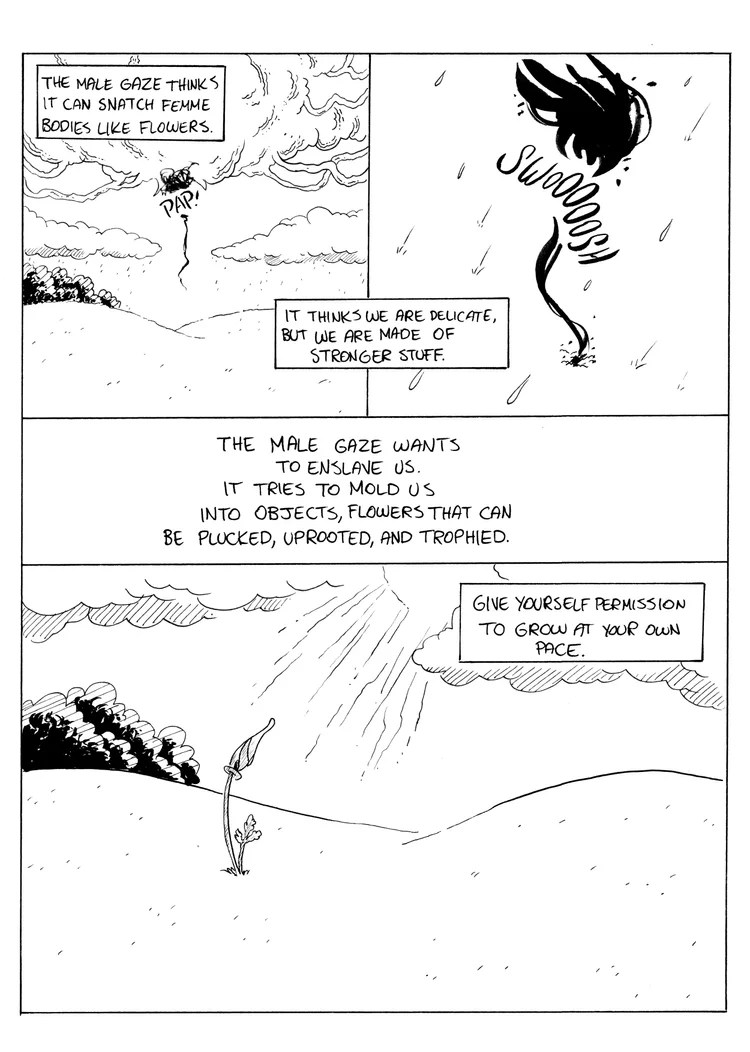
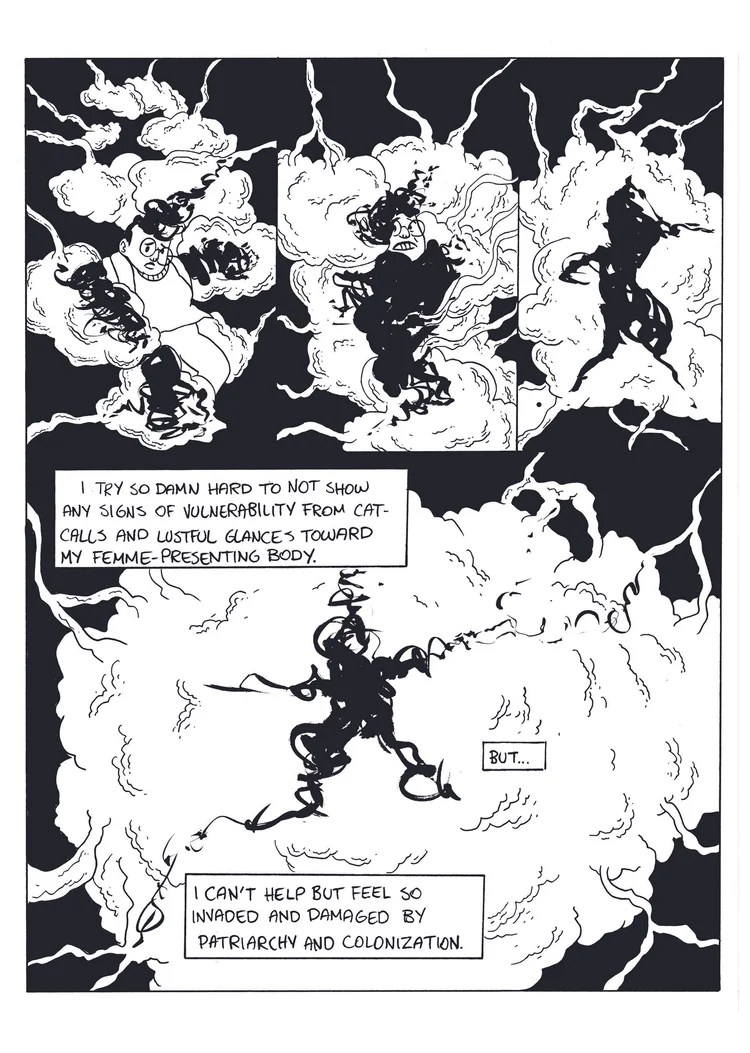
So the art labels should more clearly define the processes, but they could also contextualize each work through simple things like identifying the date the artist was born and died. Identify the nationality and sometimes ethnic background of the artist. Joey Terrill (b. 1955) is a US Chicano queer visual artist, born in Los Angeles. The Bay-are born Breena Nuñez identifies as Afro-Guatamalan-Salvadoran. “Fuera” means “out” or “outside.” The work “Fuera” is about sexual harassment on the streets and how Nuñez internalizes it. The three-panel piece is in English, but the title is in Spanish.

“Fuera” was published in the 2019 nonfiction graphic anthology “Drawing Power: Women’s Stories of Sexual Violence, Harassment, and Survival.” This was after the globally viral spread of the #MeToo movement. Although the hashtag began with Tarana Burke in Myspace in 2006, the hashtag went global after actress Alyssa Milano made public allegations against film producer Harvey Weinstein.
“Chico” in “Chico Modernos” should have probably been translated as well. Merriam-Webster defines “Chico” only as a geographical name. “Chicos Modernos” was a Spanish language comic that was used to raise awareness about HIV and AIDs prevention. Joey Terrill (b. 5 October 1955) is a Los Angeles-born and based Chicano queer visual artist.

The title “Persepolis” refers to the ancient city that was once the capital of the Persian empire, but in the works displayed, is deals with Marjane Satrapi’s childhood and youth in Tehran, Iran. Satrapi (21 September 1969 – 3 June 2026) studied in Austria, but later returned to Iran. She would marry and divorce, eventually leaving Iran again to stay in France where she died in Paris).
When I saw “The Ethiopian” by Hugo Pratt, I had no context. I wondered if Pratt (15 June 1927 to 20 August 1995) was Black or French. Hugo was Italian and of English, Jewish and Turkish descent. The original name of the story is “Le Etiopiche” which is Italian, but the text here is in French. Ethiopia was never formally colonized by a European power, but it was under Italian Occupation from 1936–1941. I feel we could interpret Pratt’s work differently if it were by someone who was Black and especially if it were by someone who was Ethiopian.


There is a whole wall of a Japanese manga that has no translation and no explanation. The label lists the artist as Tatsumi Yoshihiro (10 June 1935 – 7 March 2015), but it isn’t clear if the curator(s) made a conscious decision to list the surname first (as is Japanese convention) or just wasn’t aware of which was the surname (Tatsumi) and which was the given name (Yoshihiro). The work, “Shisha wa Miezu” (死者は見えず) , has its title translated into English “The Invisible Corpse” (Although Google Translate spits out “The Dead Are Unseen” which is closer to the grammatical construction) and Spanish “El cadáver invisible,” but none of the panels are translated. The story is about a low-income worker lost in the cold isolation of urban life in Tokyo. In his death as in life, he goes undiscovered and ignored. Singapore filmmaker Eric Khoo wrote and directed a 2011 award-winning film about the artist, “Tatsumi.”
On the Digital Guide (which assumes you have a smartphone) that I am viewing at home, I don’t see that this series nor the artist is listed.
The section features life-sized figures of two anime characters, but do they really represent anime and art or are they a selfie opportunity? The lack of Asian representation outside of anime in these galleries doesn’t help when one remembers the yellow face in the 1981 “Raiders of the Lost Ark.” There is an Indiana Jones bronze statue.
While the lack of any explanation for the Japanese manga might seem insignificant, more famous works such as the works of Norman Rockwell could also use more contextual clues. George Lucas has collected many originals and related works by Rockwell, and some of the displayed pieces are loans, but Rockwell often worked to illustrate covers or stories. He was influenced by current events such as the 1964 painting “The Problem We All Live With.”
Rockwell had ended his contract with “The Saturday Evening Post” by 1964 and this painting would be published in “Look” magazine. He used published news photographs of six-year-old Ruby Bridges being protected by four deputy US marshals as she walked to the William Frantz Elementary School on 14 November 1960. She was the first African American child to integrate into an all-White elementary school in the South. Rockwell received hate mail, some calling him a “race traitor.” Rockwell never met Bridges. The painting was installed in the White House from July to October 2011, at the suggestion of Bridges to then-President Barack Obama.
- The Lucas Museum Doesn’t Have a Narrative (3 September 2026)
- Lucas Museum CEO Responds to Departures: George Lucas “Has Always Been Chief Curator” (3 September 2026)
Some of this information is available on the Digital Guide which listed categories:
- Why was this made?
- Who made this?
- Rockwell on American ideals.
- More by this artist.
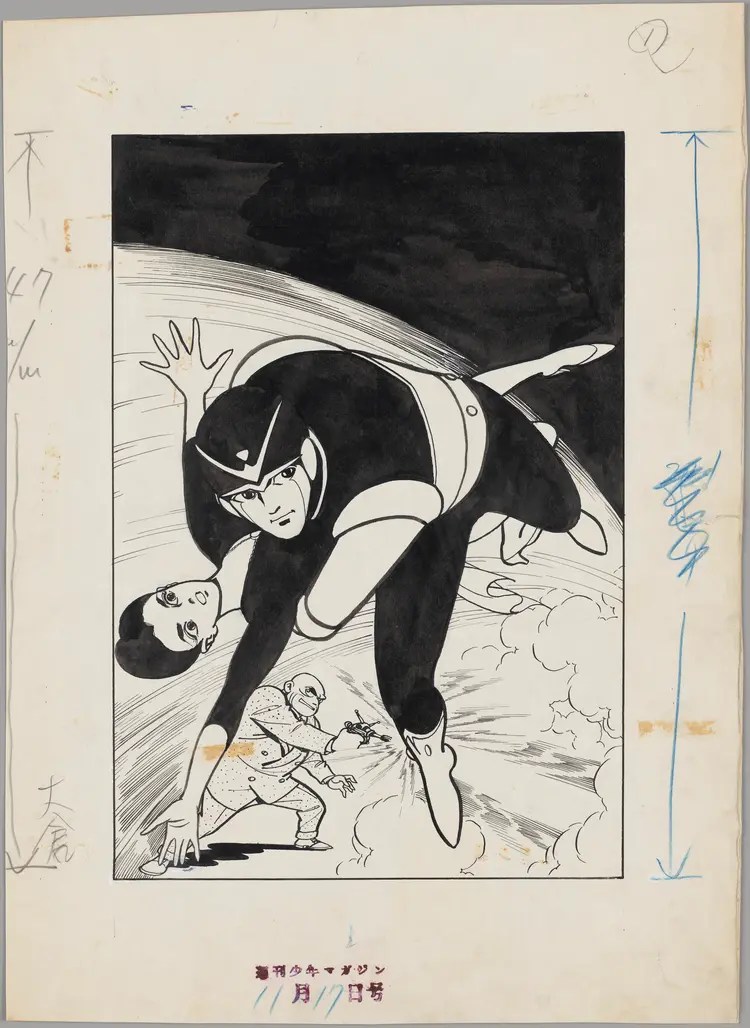 That looks promising, but that kind of information doesn’t seem available for every piece nor for the highlights of each section. The basic information about “Manga” highlight “8 Man” isn’t listed for Jiro Kuwata or for Noritsuna Maemura whose “Ultraman 80” (1980) is a highlight. Jiro Kuwata (桑田 二郎, Kuwata Jirō) was known for Shōnen genre. He was born 17 April 1935 and died 2 July 2020 at the age of 85. Maemura ((前村 教綱) ) was born in 1936 and passed away 19 October 2018. As I mentioned earlier, Naoyo Kimura’s “Pikachu” is a highlight, but we don’t know that she was born in 1960 and has been creating artwork for the Pokemon Trading Card Game since 1998.

There are moments of brilliance that show the influence of popular art on art, both popular and fine such as with the “Triple Self-Portrait” or as noted in the Art News article, the images of George Washington crossing the Delaware. Yet there are puzzling parts of the installation.
While the Art News article does point out problems that I saw:
The gaps of the Lucas’s collection are also glaring. Its holdings lean so heavily toward white male artists from the mid-20th century, it’s no wonder it made sure to publicize the acquisitions of works like Robert Colescott’s George Washington Carver Crossing the Delaware: Page from an American History Textbook (1975) and Judith F. Baca’s archive for the Great Wall of Los Angeles. The lack of didactics does these works a disservice as well: both take distinct approaches to reconceptualizing American history from non-white perspectives, forcefully asserting the experiences of Americans outside of those narrow demographics.
Women don’t fare much better. In the section dedicated to depictions of sports, I counted just one depiction of women athletes among 20 artworks, while the “Science Fiction” and related sections feature scantily clad women depicted by men. In terms of racial diversity, Black artists are the most prominently represented, followed by Latinx artists, though even these numbers can feel like rounding errors once you realize that some 1,300 objects are on view. Works by Asian artists are mostly relegated to the “Manga” gallery, though “Graphic Stories” does include pages from Marjane Satrapi’s Persepolis. The experiences of Native Americans are almost exclusively represented through the trope of “cowboys and Indians” in the “American West” gallery. I don’t recall a single work that deals with queerness, nor anything that addresses non-Christian religions.
From my viewing, I thought there was no female artist represented under the theme “Romance,” one of the major storytelling themes used to organize the permanent collection. And while the male gaze was well represented and perhaps the only representation given, I don’t believe there was a gay representation at all either.
I also found the representation of Asian artists troubling because much of the art was influenced by Asia, specifically Japanese art, such was Edmund Dulac. Dulac was one of the artists active during the “Golden Age of Illustration.” There is an illustration of Japan, but I’m not sure what the Helen Hyde (1868-1919) woodcut “Baby Talk” is meant to portray an unmarried woman since her sleeves seem so long.

Japonisme heavily shaped the works of illustration during that time and even influenced other areas of art such as the color scheme of Vincent Van Gogh. A work of Van Gogh is referenced in one digital print, Naoyo Kimura’s “Pikachu,” but not clearly identified. The Digital Guide repeats what is on the wall: “Naoyo Kimura, Pikachu inspired by ‘Self-Portrait with Grey Felt Hat,’ 2023.” It does not state that the work “Self-Portrait with Grey Felt Hat” (Zelfportret met grijze vilthoed) is by Vincent Van Gogh nor the approximate year (September–October 1887). I don’t think we should assume that people know these things. What I would have liked was a visual of the original painting so that one could make a visual comparison.
One of the best exhibit was centered around the 3D model of the Lucas Museum design. Ma Yansong of MAD Architects was the design architect, while Studio-MLA was the landscape architect. On the surrounding walls were photos of other similar buildings by MAD such as the Absolute Towers in Toronto, Canada, the Taichung Convention Center in Taichung, China, or the Changchun Airport T3 in Changchun, China.


As I looked through the Digital Guide, it doesn’t seem that every artist is covered, but rather there are “Gallery Highlights.” I only learned about the Digital Guide late in my second visit. During my first visit, the museum had already run out of the hard copy museum maps and layouts, only handing out the film programming which was also the only hard copy brochure available on Labor Day Monday. In the Gallery Highlights for the Manga section, Tatsumi wasn’t listed, so I guess further information would not be available. And the Japanese manga artists are listed in the Digital Guide are listed by given name and surname.

Will all visitors ask the right questions? After all, QR codes also use cellphones and that’s not new technology. In “The Journal of Museum Education, Virginia A. Dressler and Koon-Hwee Kan published an article: “Mediating Museum Display and Technology: A Case Study.” QR codes can be used to provide extended content (artist interviews, restoration videos or extensive essays), provide audio tours in different languages, direct people to associated purchases. QR codes help overcome the problem of limited wall space for text and can help track visitor engagement. The Lucas Museum attempts to go further by skipping individual QR codes, but still there aren problems as I noted.
After viewing the library and getting caught in a momentary elevator programming malfunction, I ventured out into the sculpture garden. The park also features ten monumental outdoor sculptures installed along accessible walkways. The park is free and open to the public, and is supposed to serve as “an extension of the museum’s galleries, presenting narrative sculpture that spans historical portraiture, contemporary global perspectives, and cinematic art.”
How this translates is that men are represented by three historical figures: David from the Bible after he’s defeated Goliath, Willis H. O’Brien (2 March 1886–8 November 1962), Eadweard Muybridge (9 April 1830–8 May 1904) and Emiliano Zapata (8 August 1879–10 April 1919). The women are all archetypes or fictional, a mother and child, Padmé from “Attack of the Clones,” Princess Leia from “Return of the Jedi,” Rosie the Riveter and selections from Prune Nourry’s Terracotta Daughters.
Sculptures include:
- “Maternity ” (2015, Bronze) by Colombian artist Fernando Botero depicts a nude mother and child.
- “David After the Combat” (1872, Bronze) by Antonin Mercié shows a triumphant David with his foot on the severed head of Goliath.
- “Padmé Fights Off Nexu (2026, Bronze) by Mark Newman depicts a scene from
“Star Wars Episode II: Attack of the Clones.”u - “Princess Leia Frees Herself from Jabba the Hutt” (2025,
Bronze) Mark Newman & Giovanni Nakpil shows slave girl Leia killing Jabba in a scene from “Star Wars Episode VI: Return
of the Jedi.” - “Eadweard Muybridge with Camera” (2025, Bronze) Lawrence Noble honors the pioneer of motion study photography and chronophotography.
- “The Introduction” (2025, Bronze) by Lawrence Noble shows Yoda and Grogu together.
- “Willis O’Brien” (2025, Bronze) by Lawrence Noble celebrates the stop–motion
animation visionary and creator of King Kong. - Selections from Terracotta Daughters (#1 Haoping, #2 Pan, #3 Huiyun, #4
Yindi, #5 Yue, #6 Ruixia, #7 Lizhou, #8 Jianwei) by Prune Nourry (2022, Bronze) is supposed to be a
contemporary commentary on gender, heritage, and identity. - “Emiliano Zapata en Cuernavaca” (2025) by Lucy Topete commemorates the revolutionary
Mexican leader. - “Rosie the Riveter” (2025, Bronze) by Benjamin Victor honors a “cultural icon of
American working women.”
I missed the statue of Emiliano Zapata. Lucy Topete is a sculptor from Mexico. Prune Nourry is a multidisciplinary artist who was born in Paris, France. She is based in New York. Wouldn’t a sculpture on the plight of women in mainland China carry more meaning if it was made by a woman who was born and raised in China?
While people visiting the Lucas Museum might have had Star Wars on their mind, elsewhere in Los Angeles there were a variety of activities focused on another science fiction franchise: Star Trek. The Tuesday after Labor Day Monday was Star Trek Day and that franchise was celebrating 60 years. There was nothing at the Lucas Museum which opens to the public on the 22 of September that showed any interested in Star Trek. When I interviewed him at SDCC, Rod Roddenberry had wondered if the museum would have room for something like the recently rediscovered model of the Enterprise. That is a question that remains open.Janson not only ignored women artists as was prevalent practice of art history for decades, he also ignored American regionalism of the 1930s. The movement which focused on rural Midwestern life produced one of the most famous and often parodied paintings: “American Gothic” (1930) by Grant Wood (13 February 1891 –12 February 1942). The two did know each other, teaching in the same department at the University of Iowa.
Star Wars and Star Trek can co-exist and there’s no evidence that Lucas bears any animosity toward Star Trek as Janson did toward Wood and Regionalism. Perhaps it was an oversight in the confusion of finally opening up. The Lucas Museum which had problems finding a home base. Co-founded by George Lucas and Mellody Hobson, the Lucas Museum first look to Chicago, then San Francisco before it came to Los Angeles’ Exposition Park. On onside, the Lucas Museum overlooks Natural History Museum of Los Angeles County (which served as the primary exterior filming location for the fictional Jeffersonian Institute in the TV series “Bones.”) and the museum is walking distance to the University of Southern California (USC), where Lucas studied, met and became friends with fellow student and filmmaker Steven Spielberg. Lucas earned a bachelor’s degree in 1966 and remains connected to USC. He donated $175 million to the film school in 2006 to fund new buildings and endowments. Moreover, the George Lucas Family Foundation continues to support student scholarships and diversity programs at USC. Being near USC makes sense in that respect. The Lucas Museum broke ground in 15 March 2018.
However, the museum’s initial director and CEO Sandra Jackson-Dumont left at the end of March in 2025. In May 2025, the Lucas Museum laid off 15 full-time employees and 7 part-time, on-call workers. Then in December 2025, chief curator Pilar Tompkins Rivas left. This month, financial questions were raised in a legal forum.
- Lucas Museum Director and CEO Steps Down, with George Lucas to Lead ‘Content Direction’ (28 February 2025)
- In the Latest Shake-Up, LA’s Lucas Museum Lays Off 14 Percent of Full-Time Staff (20 May 2025)
- Lucas Museum of Narrative Art Faces Lawsuit over Whether It Truly Is a Private Museum at All (9 September 2026)
Those departures were troubling and the museum seems to set up selfie stations. Some of the statues seem commissioned for just that and to remind people of the movies that made Lucas famous. Is that narrative art? Is that even art? I guess there is not better place for a Grogu and Yoda statue than a museum built by Lucas, but what is the narrative here? Hopefully, despite those departures, the museum will find its direction and a solid financial plan. In the future, one hopes there will be gatherings of fans of different aspects of arts and even a lightsaber celebration or two in appropriate areas such as the gardens.
The Lucas Museum of Narrative Arts is currently open for member previews. On Sunday, 13 September 2006, it will have a special Community Preview Day for people living in the museum’s 90037 zip code. Its grand opening is on Tuesday, 22 September 2026. For tickets or more information, visit LucasMuseum.org.