
If what you know about Richard II is based on Shakespeare’s “Richard II,” you’ll go into this film a little sympathy for the young teen who finds himself at the center of a national crisis. Yet the young key, while a key player, isn’t our main character. Instead, we’re in the thick of the Peasants Revolt, following a fictional farmer. As earnest as Andrew Garfield is as our POV character, writer/director Paul Greengrass doesn’t allow him to unleash his charm and instead contrasts a muddy, relentlessly drab England with the dark but opulent court as the common man and his fellows trods toward a London filled with treachery, broken promises and bloody rage.
The Richards

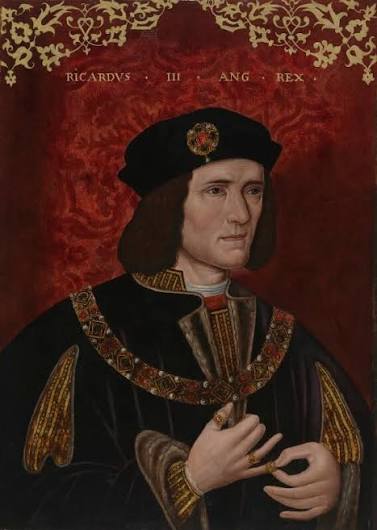
If you don’t know your Richards, Richard II is not Richard the Lionheart. That was Richard I of England who was king from 1189 until his death in 1199. This is also not the Richard who in Act 5, Scene 4 of William Shakespeare’s play said, “A horse, a horse, my kingdom for a horse!” That was Richard III who was King of England from 1483 to his death in 1485. That Richard was the last king of the Plantagenet dynasty and the House of York. His father was Richard of York and his brother was Edward IV. Richard III is the Richard with scoliosis and, in Shakespeare’s historical drama, “The Tragedy of Richard the Third” or simply “Richard III,” he is a scheming villain.
Shakespeare didn’t write a play about Richard I. He did write a tragedy about Richard II (“The Life and Death of King Richard the Second,” 1595) but that Richard is not a villain. He is a flawed, self-indulgent young king who is more fool than villain or hero.
In Act 3, Scene 2 of “Richard II,” realizing that his lineage that brought him to the throne cannot protect him from political defeat, he says:
For God’s sake, let us sit upon the ground
And tell sad stories of the death of kings—
How some have been deposed, some slain in war,
Some haunted by the ghosts they have deposed,
Some poisoned by their wives, some sleeping killed,
All murdered. For within the hollow crown
That rounds the mortal temples of a king
Keeps Death his court, and there the antic sits,
Scoffing his state and grinning at his pomp…
When Bolingbroke, now King Henry IV, learns of Richard’s death in Act 5, Scene 6, he declares, “I hate the murderer, love him murdered.”

There is an excellent adaptation of “Richard II” as part of “The Hollow Crown” series by BBC Two with Ben Whishaw as Richard II, Rory Kinnear as Henry Bolingbroke, Patrick Stewart as John of Gaunt (Duke of Lancaster), David Suchet as Edmund of Langley (Duke of York) and David Morrissey as Henry Percy (Earl of Northumberland).
The History
The Black Death had rolled through England several times, first reaching England in June 1348 and spreading throughout England by the summer of 1349. It returned to England in 1361 to 1362. All this before Richard was born, but in the time of his rule the effects were still felt and Black Death returned in 1369 where the estimated deaths were about 10 to 15% of the population. According to Britannica, the revolt began in Essex in May of 1381 and spread to Kent.
Yet in “The Uprising,” we meet Richard before the action in Shakespeare’s tragedy begins. Richard was born in France (6 January 1367) and his elder brother Edward, had died in 1370, leaving Richard heir to the throne.When his father, Edward the Black Prince died in 1376 (on June 8), Richard was only 10 years old. Richard II began his reign on 21 June 1377, but the play begins in 1398.
- Black Death in England, 1348 to 1349.
- Black Death in England, 1361 to 1362.
- 1367: Richard II born.
- 1370: Elder brother Edward dies.
- 1377: Richard’s father, Edward the Black Prince dies.
- 1381: Peasants’ Revolt
In the film there is much talk of the “Domesday Book” which has nothing to do with the end of the world. What the Domesday Book is, according to Britannica, is “the original record or summary of William I’s survey of England.” The Domesday Book was a description of England and the popular name “Doomsday” “was in general use by the mid-12th century” and:
The survey, in the scope of its detail and the speed of its execution, was perhaps the most remarkable administrative accomplishment of the Middle Ages.
The survey was carried out, against great popular resentment, in 1086 by seven or eight panels of commissioners, each working in a separate group of counties, for which they compiled elaborate accounts of the estates of the king and of his tenants in chief (those who held their land by direct services to him). From these documents the king’s clerks compiled a summary, which is Domesday Book.
In the film, the Domesday Book of 1086 was used by the peasants as legal proof of their serfdom and that the feudal dues or poll tax were a result of “modern” Norman impositions rather than native English lawful traditions. William I, or William the Conqueror, was from Normandy, France. In the film, “The Uprising,” the peasants are shown burning manorial rolls and legal records of their bondage.
The Film: The Uprising
 The film begins in 1381, when Richard II is struggling to assert himself against the council that has guided his rule since his father’s death.
Under the bleak gray skies and muted colors we first meet our Ploughman (Andrew Garfield), struggling behind a cow, trying to carve straight lines over an unpromising field. His hut has a floor covered with straw. His mattress is beside another empty one. He prays on his fields before three crosses, one bigger than the other two. He has lost his wife and two daughters to the Black Death.
Elsewhere in a dark castle, a young frightened 14-year-old Richard II, cannot appear before the council, too disturbed by the repeated nightmares of demons mobbing the streets, calling for him.
His mother, Joan, Countess of Kent, knew something about politics. Her father Edmund, first Earl of Kent, was executed in 1330, after Edward II was deposed. She was only two at the time. Their lot improved under the new King, Edward III, when he reached adulthood. At 12, Joan was secretly married to the 26-year-old Thomas Holland. But while he was away, her family married her to William Montagu, son of William Montagu, first Earl of Salisbury. But when Holland returned around 1348, he reclaimed his wife and Joan’s marriage to Salisbury was annulled. When Thomas Holland died in 1360, Joan was married to Edward in secret although by law, she needed the king’s permission. After some political maneuvering and four dispensation from the Pope, Joan and Edward would be married again (10 October 1361).
Joan of Kent was woman willing to defy kings and laws and yet remain alive and well-liked. Katherine Waterston’s Joan of Kent shows disapproval of both her son and his council, but wisely says little.
The kingdom needs money. The council, without the hysterical king, decide, under the guidance of Simon Sudbury (Stephen Dillane), former Bishop of London (1361 to 1375) and current Archbishop of Canterbury (from 1375 until his death) and current Lord Chancellor of England, that taxing the church would be ill-advised. Sudbury and Sir Robert Hales (Tom Hollander)–the Lord High Treasurer of England, decide that asking the rising merchant class would risk demands for merchants to have a place at the table. They don’t want to share power so they ask for more taxes from the powerless. The poll tax then falls upon the peasants, who have no hope of having their voices heard.
When the Ploughman comes into town to pay his taxes, he sees others complaining about the impossibility of surviving after the taxes are paid. He himself doesn’t have proof that he has paid death taxes and will be required to pay death taxes again. The tax collector’s soldiers are forcibly and publicly feeling the genitals of young girls to determine if they should be considered children or adults under this poll tax.
Historically this poll tax required four pence from everyone aged 15 and above. In 1381, four pence was could be a daily wage for a highly skilled worker, like a master carpenter or mason. The amount was the same for a rich man and for a peasant.
The Ploughman cannot tolerate the demands and the rough treatment of the tax collectors and in a fight, he kills a soldier. And so begins the revolt. We soon meet other men who can lead the masses, men with more worldly experience than the Ploughman: Wat Tyler (Cosmo Jarvis) and John Ball (Jamie Bell).
Wat Tyler had served under Richard II’s father in the military in France. He believes in the king. John Ball is a priest whose egalitarian views grate on the established powerful church authorities, including Simon of Sudbury. He had already been thrown into prison more than once. The rebels break him out of his Kent prison and he preaches to them. Ball sees signs of God in the right of kings. Another face we come to identify amongst the rebels is a woman, Alyce (Thomasin McKenzie) who keeps her hair short and her anger unleashed.
The rebels decided to march to London to petition the king whom they believe to be just and fair, but controlled by an unscrupulous council. The king’s armies are away, waging war in Scotland and France, the very wars that are creating a financial burden. The council advises stalling tactics until the armies can return, but the king has his own ideas.
For those familiar with British history, this will not be a spoiler. King Richard II meets with the rebels. He says he will grant them freedoms unheard of in those times. He will free them from the land and give them self-determination as well as clemency the next day and leaves them to mete out rough justice in the streets of London as the priests in London, urged on by The Scribe (Sky Yang) hurry to write all those bills of clemency and freedom.
Here in the film, the script shows the priest John Ball pushing the mob toward chaos with the demands he makes while the soldier warns that once they “draw blood, they open the gates of hell.” After a bloody night, with “the contagion of rage now spent,” the peasants move to meet with the king, but not at the appointed place. Instead they are told to meet at Smithfield, outside of London. The Scribe realizes that something is amiss and attempts to warn the peasants. Although Tyler is allowed to speak with the king, he is betrayed and flees, mortally wounded.
If most people know this history, then what’s important is the journey. Writer/director Paul Greengrass contrasts the opulence of the court and the dreary threadbare existence of the peasants. You can see this in the colors under cinematographer Pål Ulvik Rokseth and the costume design by Tóth András Dániel and Godena-Juhász Attila. Keep in mind that the art of culturing pearls to reliably produce fully round pearls did not exist until the 20th century. The cinematography employs shaky cam, something that is not uncommon in movies by Greengrass, often to give a feeling of documentary-like reality and a sense of haphazard chaos. While the shaky cam is used to contrast the unreined actions of the peasants compared to the controlled courtly maneuverings, I feel it is overused and prevents us from really following the emotional journeys of the named peasants: Wat Tyler, John Ball, Alyce and The Ploughman. Without a strong emotional connection and for those who don’t remember the last time a poll tax was enacted in England or the UK, the journey is unpleasant and bleak.
If times in the US weren’t so troubling under the current presidential administration, this film might have been better received. This is a dreary journey we’re on in the US and I don’t know that people need more doom in their entertainment. It might remind some of the 6 January 2021 resurrection. Having watched some recent World War II documentaries, when I saw the bloody horror of mob justice in London, I was reminded the reprisals against Germans and perceived collaborators after World War II in Europe. We can see is the universal: Mobs are hard to control and, therefore, dangerous.
And yet, you might wonder to what end was this Peasants Revolt? The peasants didn’t get their demands for an end to serfdom, but, the poll tax of 1381 was abandoned. The Peasant Revolt did, according to Britannica, prevent “further levying of the poll tax for more than 250 years” when the poll tax repaired in Britain in 1641 under the reign of Charles I (to finance armies to quell the Scottish and Irish uprisings).


For those who lived through the late 1980s and 1990s in the UK, this might be deja-vu. The last poll tax was called a Community Charge. It started in Scotland in 1989, then was enforced in England and Wales in 1990. There were widespread protests until the government abolished it beginning in 1991.
Although I found the casting of a person of East Asian descent jarring, I learned, as a result of this film, it wasn’t totally impossible. According to Britannica, there was a man called Rabban Bar Sauma (1220–1294) who was born in what is now Beijing, China in about 1220, more than a century before the events of this film. He became a Nestorian monk when he was 23 and traveled Baghdad where he took up residence. He was sent on a mission to Constantinople, Rome, Paris and Bordeaux. In Bordeaux, he met Edward I of England. Edward I of England was the great-great-grandfather of Richard through his father. Edward I was the father of Edward II who was the father of Edward III who was the father of Edward the Black Prince. Edward the Black Prince was the father of Richard II of England.
There was a brief moment this year when the film “The Uprising” was marketed in the US as “The Uprising: The Rise of Robin Hood.” There is a problem with the timeline. In popular folklore, Robin Hood was a supporter of King Richard the Lionheart. That would be King Richard I. Richard and Robin Hood’s enemy was the greedy brother, Prince John, who was ruling while Richard was abroad on crusade. The earliest ballads of Robin Hood do not mention King Richard at all. The connection between Robin Hood and Richard the Lionheart gained traction in the 16th Century. Just don’t confuse your Richards. This Robin Hood epilogue in “The Uprising” doesn’t give us a happily-ever-after ending and doesn’t really work. All I could think of was the wonderful work on Joan of Kent’s costume and how I wished to wash off The Ploughman’s face. The grim grime is almost a crime in covering up the boyish charm of Andrew Garfield. And Katherine Waterston’s elegant but wise Joan of Kent is likewise wasted as were the costume design by Tóth András Dániel and Godena-Juhász Attila. I did see Garfield’s costume in person on the day of the screening, but haven’t seen Waterston’s.
“The Uprising” was released in the US on 10 September 2026 and is scheduled to be released in the UK on 9 October 2026.