
 After viewing the portal for “Wildwood” at SDCC, I was looking forward to this film because I love stop-motion animation and I love furry things, even if they are made less furry by the nature of clay. I was unfamiliar with the book which the film is based on so I essentially went in blind–no unlike the first-time readers of a book series. Be forewarned: there is stop-motion animation gore–enough to earn a PG-13 rating, and a curious blend of lost White civilization fantasy and magical connections with a banned organic matter. This isn’t a light and airy fantasy; there’s darkness here.
The film begins with a suicide on a dark and stormy night. A young boy locks a door in Victorian-style mansion. Naked in the rain, he stands on the balcony stone rails as a woman frantically tries to open the locked door. The boy jumps to his death after pulling out what should be his heart. Instead of flesh, his innards are gears energized by black magic.
Flash forward to a modern day Portland and we meet our heroine, Prue McKeel (Peyton Elizabeth Lee), being lectured by her parents (voiced by Jake Johnson and Maya Erskine). They are going out and Prue is being left in charge of her baby brother, Mac. She’s warned not to take him out. They never take him out and even plan to homeschool him. They also remind Prue to water her plant and eat her questionable breakfast. There are our first clues.
Of course, as soon as her parents are out of sight, Prue gets on her single-speed bicycle and tows her baby brother on a wagon behind her. Both then are carelessly careening up and off the sidewalks without a care or helmets. Is that even legal? No, of course not. What could go wrong as she goes through the neighborhood of coffee shops and friendly people and even bumps into a potential friend, socially awkward nerd Curtis Mehlberg (voiced by Jacob Tremblay). He invites her to a multiplayer game; she’d be happier if this nebbish nerd went away. Yet, in a scene that seems straight out of Alfred Hitchcock’s 1963 “The Birds,” a murder of crows gathers. Think of the crows on the playground scene. Curtis is first to notice but it’s already too late and the murder abducts Mac.
Prue pursues them on her bicycle with Curtis hanging on in the wagon until they come to a bridge where, in a scene that seems like it came from the 1986 “Stand By Me,” they are caught on the bridge when a train comes behind them. The two bail in time but soon find themselves entering a place her father warned her about: The Impassable Wilderness. This is a place that is guarded by ivy, but the ivy curiously allows Prue and Curtis in.
In the woods, they discover talking coyotes. These coyotes are dressed in red military uniforms that don’t shout American Revolutionary lobsterbacks nor Canadian Mounties, but Victorian British military. They are not the good guys here. It’s almost as if they are replacing the big bad wolves of European lore. Similarly, the crows are just a lesser stand-in for ravens as messengers of death and war. This seems like a European interpretation which differs from the place held by coyotes and crows in Native American folklore and myths or at least the ones I’m familiar with which are, granted, mostly Southwestern in origin. The coyotes were not originally so prevalent in Oregon, but with the diminished numbers of wolves, they did experience an opportunity to spread.
Curtis heroically is willing to sacrifice himself to allow Prue to escape. The two become separated with Prue picked up by a postal carrier Richard (Len Cariou)and taken to The South Wood where the people wonder how Prue was able to enter their protected woods. Curtis is taken to the Dowager Governess, Alexandra (Carey Mulligan) who commans the coyote militia. What could Alexandra want with Curtis? And then, where is Mac and why was he taken to the Impassable Wilderness?
 Background
The film “Wildwood” is based on a 2011 fantasy novel by Colin Meloy (“Wildwood” The Wildwood Chronicles, Book One”) . It is the first of three books with the second being the 2012 “Under Wildwood” (“Under Wildwood: The Wildwood Chronicles, Book Two”) and the final novel, the 2014 “Wildwood Imperium” (“Wildwood Imperium: The Wildwood Chronicles, Book Three”). Meloy is the singer-songwriter of The Decemberists. His wife, Carson Ellis, illustrated all the books.
“The Wood” is a reimagining of Forest Park, Oregon. We slowly learn that The Impassable Wilderness or “The Wood” is divided up into four regions. The South Wood is a densely populated urban city that is covered from Pittock Mansion. It is the seat of the government under Governor Regent, Lars Svik. There is a real Pittock Mansion that was built in 1914 as the home of publisher London-born Henry Pittock and his wife, Georgiana Burton Pittock. The main was built in a French Renaissance Chateau style.
The French Renaissance Chateaus style, also known as Châteauesque, was a grand revival movement popular from the 1880s to about 1910. It was known for blending 16th Century Loire Valley chateau architecture, rising Gothic and Renaissance details, but benefiting from late Victorian American and European masonry craftsmanship. The Victorian era spanned the reign of Queen Victoria (1837-1901).
The Avian Principality is where the birds, except for the crows live since they have defected to serve the Dowager Governess.
The North Wood is more rural with small cottages and gardens and some wilderness. Its most notable feature is The Council Tree.
The titular Wildwood is where the Dowager Governess Alexandra has been exiled to from The South Wood. Wildwood is where the Bandits and wild coyotes live. The Ancients have long disappeared, but they have left behind The Ancients’ Grove. There’s an old basilica in the center of the ruins that is called the Plinth of the Ancients.
When I described this film to my husband, it reminded him of 1986 musical fantasy film “Labyrinth.” Instead of blending humans with puppets, in “Wildwood,” these are all puppets. “Labyrinth” takes place in a wasteland and a world separate from our own, a land of goblins. “Wildwood” takes place in Portland, beyond a real bridge, into a real forest, but farther into it where it is impassable to humans unless they are touched by magic.
I don’t think I would be as troubled if this film took place in somewhere like Europe. And now you might be asking exactly what that forbidden organic matter is. It’s not drugs. It’s not black magic. It’s something rather commonplace: English ivy.
The ivy in the text isn’t English ivy. In the text, the ivy is described: “On the autumnal equinox, when the ivy consumes the flesh and drinks the blood of a second born child, this will confer upon the ivy an inestimable power, the human blood coursing through its stalks, and it will render the plant in thrall to the command of the sacrificer.” This is why the Dowager Governess needs the innocent Mac.
While the ivy seems to be both protective and possibly malevolent, our heroine Prue in the film, is reminded by her parents to take care of her plant which I supposed might be a cutting from this magical ivy. So I’m not clear if the ivy is a malevolent presence in its own right or if that is determined by whom controls it.
I think the term Dowager Governess (Alexandra Svik) is problematic. In “governess” means something different than “governor” in American English. And because in the US and we have state governors but don’t call people in places of authority “govnor” or “guv’nor,” I think this adds to the confusion.
Technically, the world that Laika under Academy Award-nominated director Travis Knight (“Boxtrolls,” 2015; “Kubo and the Two Strings,” 2017; and “Missing Link,” 2020) and lensed by Academy Award-nominted Caleb Deschanel (“The Right Stuff,” 1983; “The Natural,” 1984; “Fly Away Home,” 1996; “The Patriot,” 2000; “The Passion of the Christ,” 2004; and “Never Look Away,” 2018) have created is wonderfully detailed. The set designs demand a rewatch and I’m sure I didn’t notice everything. The birds are beautifully rendered, particularly the stately Owl Rex (Richard E. Grant) and the giant golden eagle the General (Angela Bassett). I do feel the tragedy of the Dowager Governess, Alexandra (Carey Mulligan) and the ivy is both mysterious and frightful, yet not in a horror film way. The battle scenes are surprisingly violent and brutal. Someone’s head gets lopped off and we see it fly into the air. Another character gets stabbed in the eye. This is stop-motion animation so the blood is not terribly gloopy, but I’m not sure if stop-motion animation needed to go there.
“Wildwood” is Laika’s first film to receive a PG-13 rating from the Motion Picture Association. It is also the longest stop-motion animated film with a runtime of 131 minutes (2 hours and 21 minutes). If you’ve liked the screenplays of “ParaNorman” (2012), “Kubo and the Two Strings” (2016), “Missing Link” (2019), you’ll be familiar with Chris Butler’s sensibilities. He also directed as well as scripted “ParaNorman” (co-directed with Sam Fell) and “Missing Link” (where he also was a character designer. Yet, I feel the plan must be to follow up with the next two books so it’s hard to judge some of the themes that might be troubling until we get to the third part of the book series.
Diversity
There is diversity and I’m not talking about walking talking bears (omnivores), moose (herbivores) and coyotes (carnivores), and I wondered if the film reflected the Portland racial diversity. Then there’s the Portland stereotypes which we get from places like the TV series “Portlandia” (2011-2018) is:
- Tree Hugger: Flannel-clad upbeat people affecting beanies and vintage glasses while commuting using fixed-gear bicycles.
- Artisanal Consumer: This person frequents micro-roasted coffee and visits microbreweries.
- Portland Weird: These tattooed eccentrics are dedicated to an alternative lifestyle like urban homesteading by keeping chickens and/or goats in their backyard.
- Polite Progressive: Polite, left-leaning outdoorsy people spend their weekends hiking, camping, etc.
Does everyone ride bicycles? Of course not. Does everyone come under these four types? Of course not. But the film “Wildwood” embraces these.
Within the voice cast, there is Asian American representation with the lead character, Prue McKeel, voiced by Peyton Elizabeth Lee who is Chinese hapa (Her father is of Chinese descent.) and English, Irish and Italian on her mother’s side. Maya Erskine, a Japanese hapa whose mother was born in Japan and whose father is US-born musician Peter Erskine, voices her mother Mrs. McKeel. Jacob Tremblay, who voices Curtis Mehlberg, is Latino through his Chilean maternal grandmother.
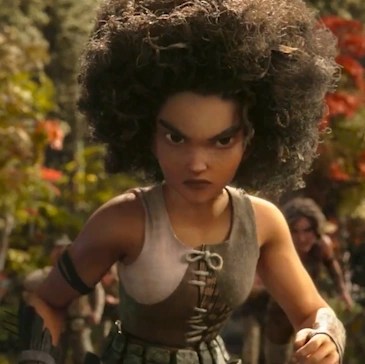
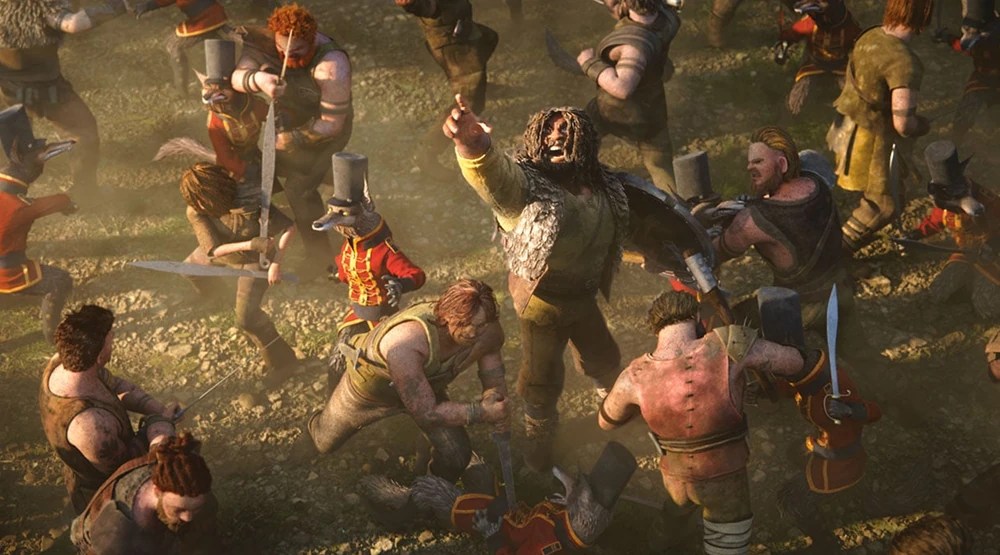 African American actor, Oscar-winner Mahershala Ali voices Brendan, the Bandit King and Amandla Stenberg voices Niamh, one of the bandits. Amandla Stenberg, Greenlandic Inuit (through her paternal grandmother) and African American (through her mother). Her father is Danish. The character Niamh did not exist in the original novel.
Angela Bassett is the voice of the giant golden eagle, General. In the actual novel, Brendan is a man with “a thick red beard” and long curly red hair. In other words, he is not Black.
Canadian actress of Cree and Métis heritage, Tantoo Cardinal, voices the mystic from North Wood, Iphigenia.
According to the Oregon 2025 demographics, there are slightly more “American Indian or Alaska Native” in the state than Black people (2.6% versus 2.5%).
With the change of race with Brendan that is reflected both in the puppet portrayal and the voice actor and the addition of Niamh and the voice casting, I feel that the production team behind the film has made an effort to make the cinematic version of “Wildwood” more reflective of the racial and ethnic diversity of Portland. Yet, considering the history of Oregon, it would have been nice to have prominent male figures of Asian descent (see below). That is still possible as this tale unwinds.

So about Portland…on Race
I have never been to Portland, but there are demographics to consider.
Portland is very White. According to the US Census, it is 68.1% White alone, but 65.8% White and not Hispanic or Latino. The largest minority is Latino at 12% while people of two or more races are 12.7%. After that are Asian (alone) who come in at 8.1%. Black (alone) are 5.7%. Native American or Alaskan Native are 0.8%. In 2013, only 2% of the Oregon population were Black people.
As of 2025, Oregon is 82% White, 2.5% Black, 2.6% American Indian or Alaska Native alone, 5.4% Asian alone and 16.2% Hispanic or Latino. White alone and not Hispanic or Latino is 69.8%.
Oregon did have anti-Black laws.
- 1844 Provisional Exclusion Law, also known as the “lash law.”
- 1849 Territorial Exclusion Law
- 1857 State Constitution Exclusion Clause (Article I, Section 35).
- Donation Land Claim Act of 1850
- 1862 Poll Tax
And there were anti-Asian laws.
- 1859 Oregon Constitution explicitly barred Chinese immigrants from voting and owning land or mining claims.
- Alien Land Laws were passed in several western states and prohibited immigrants ineligible for citizenship (primarily Asian immigrants) from owning or leasing real estate.
- Poll Taxes and Literacy Tests: Oregon enacted a $5 poll tax on “Negro, Chinaman, Hawaiian and Mulatto” residents.
- Federal Exclusion Acts
Lynchings?
Searching using the term “lynching of Blacks in Oregon,” I came up with the story of the 28-year-old Alonzo Tucker. He was murdered by a White mob (18 September 1902) in what is now known as Coos Bay. He had been accused of sexually assaulting a local White woman. There were also “mock lynchings” in the 1920s in Jacksonville and Oregon City.
Racial violence against Asians in Oregon includes the 1887 massacred of 34 Chinese miners at Snake River, the 1910 riot against Asian Indians in St. Johns, the incarceration of 4,000 Japanese and Japanese Americans, and the destruction and raids of Chinatowns and Chinese-owned buildings.
There are two reasons, I knew there was East Asian American history in Portland. The first is that I had read about the “Tacoma Method” which was a coordinated effort to force out the entire Chinese population from Washington (3 November 1885) by forcing the Chinese to walk to the railroad station and sending them to Portland, Oregon. Portland, Oregon has a Chinatown that was founded in the 1880s.
The second is because the first Japanese American lawyer admitted to the Oregon State Bar, Minoru Yasui, was the central figure of the legal case, Yasui v. US. Although Bhagat Singh Thind (1892-1967) ended up in Los Angeles at the time of his death, he worked summers in Astoria, Oregon. Thind brought the case US v. Bhagat Singh Thind in 1923 and became a US citizen as a World War I vet in 1935. It wasn’t until 1940 that all people born in India were able to become naturalized US citizens. It would take longer for people of Chinese descent and even long for people of Japanese descent to be allowed to naturalize.
On Flora
There is a question about ivy. Ivy isn’t native to Oregon according to Oregon State University. English ivy (Hedera helix) is native to the Caucasian Mountains (occurring from the Caucasus Mountains to Norway and south to Iran and northern Africa. It tends not to do as well north of the Alps. English ivy was introduced to the US as early as 1727 by colonists who wanted an evergreen cover for their gardens. That means, English ivy isn’t really that English or just English. Yet, unlike the English or depending on your socio-political stance, perhaps like the English, English ivy is considered “a serious threat in many ecosystems.”
In 2010 the Oregon Department of Agriculture placed English Ivy under noxious weed quarantine (OAR 603-52-1200). This ruling “prohibits the propagation, transport, purchase, or sale of H. helix and H. hibernica [in Oregon], regardless of the variety or cultivar.
English Ivy is considered an invasive weed.
I did once live near people whose front lawn wasn’t grass, but English ivy. It was a natural jungle and gave shelter to many slugs, snails and lizards. Defeating ivy, is a real gardening war. Washington added English ivy to the state noxious weed seed and plant quarantine list as of 9 August 2025.
In addition to shading out tree foliage, ivy can add weight to trees, increasing the risk of wind damage. It can also result in bark damage, making trees more susceptible to insects and disease. When the vine spreads on the ground, it can crowd out native plants.
There is an organization that hosts English ivy removal work parties: Whatcom Million Trees Project.
Of course, Western poison ivy (Toxicodendron rydbergii) is native to Oregon, but is primarily found in the eastern part of Oregon, not commonly found in Portland. Poison ivy is a low-growing shrub and not a climbing vine.
What you will find in western Oregon is Pacific Poison Oak (Toxidocendron diversilobum) which is a shrub or bush.
After reading about the “Wildwood” series (using wikis and I will probably read the series when and if a second film comes out), the designation of English ivy as an invasive week is intertwined with the themes of the trilogy and the final place of its Eurocentric leanings will be fully revealed later.
“Wildwood” had its world premiere at the BFI London Film Festival on 11 October 2026. It was the last film screened for the 2026 Animation Is Film Festival in Los Angeles and is the opening film for the 2026 AFI FEST on 21 October 2026.