
Bunny lovers may be hopping mad that a film named “Hoppers” doesn’t focus on rabbits and butterfly buffs will be bummed that their fluttering friends and their grubby before stagers don’t get better treatment, but if you like cute and cuddly and a positive environmentalist story, “Hoppers” is a great family-friendly movie. Of course, when it comes to animation, one expects safe and warm entertainment from both Pixar Animation and Walt Disney Pictures.
The movie’s title derives from scientific technology that allows a human being’s consciousness to be temporarily transferred to a robot built to look like a beaver and a bird. If you’ve seen the PBS Nature and BBC documentary series, “Spy in the Wild,” you’ll quickly get the idea because you’ve already seen spy crocodiles and monkeys getting up close and intimate in a variety of habitats. I’ve even attended an in-person demonstration and met these ultra cool cameras. Reportedly director Daniel Chong was inspired by these documentaries when he formulated the story for “Hoppers.”
Set in the fictional city of Beaverton, we meet a Japanese American skateboarding tomboy, Mabel Tanaka (voiced by Lila Liu), who is a mini animal liberator in the making. That gets her in trouble at school as does her boxing and biting fellow humans, but while her parents are frustrated, her grandmother takes her to a spot where she can commune with nature. Grandma Tanaka (Karen Huie), tells Mable, “It’s hard to be mad when you feel like you’re part of something big.”
Through a montage, we see Mabel and her Grandmother spending days and years observing the ecosystem of a local pond. Mabel is so close to her grandmother that when the rest of her family decides to move, she stays behind. Yet the 19-year-old Mabel (now voiced by Piper Curda) is still a tomboy with hair that looks like it was styled by random machete cuts in a bathroom and is left alone after her grandmother’s death. That’s when she finds her pond refuge threatened by the development of the Beaverton Beltway.
The slick mayor, Jerry Generazzo (John Hamm), unnervingly reminds me of a Hammy version of California governor Gavin Newsom, is the main man behind the beltway plan. And he’s not above some questionable tactics to get approval. Mabel attempts to get enough signatures to petition against the beltway. Her biology professor, Dr. Samantha Fairfax (Kathy Najimy), is frustrated with Mabel’s poor attendance to her Geobiology 235 course (Geobiology is the study of how life and Earth interact and co-evolve, both in the present day and throughout Earth’s history. Thus, this research includes investigations of the rock record, modern ecosystems including analogs of past environments, and laboratory-based experiments to examine mechanisms through which organisms interact with their environment.), but Fairfax also proves to be the key to saving the pond.
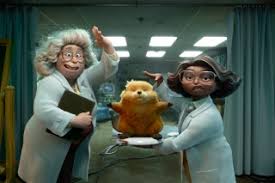 Fairfax along with her colleague Nisha (Aparna Nancherla) has developed a new technology which allows a human being to transfer their consciousness or “hop” into a robot. Fairfax has chose to study the beaver and that makes sense for a town called Beaverton, and Mabel has been looking for a beaver. Mabel impulsively “hops” into the robotic beaver and promptly escapes from the hopping lab determined to find a beaver to bring back to her pond. Mabel the Beaver soon saves another beaver, the easy-going Loaf (Eduardo Franco) from Ellen the bear (Melissa Villaseñor) but that has consequences. Mabel has broken the “pond rules” and has to see the mammal king. King George (Bobby Moynihan), is also a beaver, and he introduces her to the pond community of his beaver superlodge. Some of the inhabitants are refugees from Mabel’s beloved pond. Through them Mabel learns a fake tree emitting sounds at a frequency that only the animals can hear has driven all the animals away.
Mabel destroys the tree allowing the animals to return, but that leads the mayor of Beaverton to install more noise-emitting fake trees. King George then calls a meeting of the Animal Council to his superlodge, and while you know why a beaver is king, it’s not really that easy to determine why each ruler was chosen to rule over the Fish, Insect, Amphibian and Reptile kingdoms. Mabel impulsively speaks for the mammals, resulting in the insect ruler, a butterfly (Meryl Streep), they must have a “squish party” and exterminate the mayor. Mabel and King George are horrified, but that sets a chain of events into motion where the animal kingdoms are targeting the Beaverton mayor and the mayor is ready to exterminate animals.
You will see a literal fish-out-of-water when you meet Diane (Vanessa Bayer) as the shark assassin, but that makes you wonder what and who the Fish Queen (Ego Nwodim) is. The Reptile Queens are three snake sisters (Nichole Sakura), but what snakes and why? Surely there could have been more fun there with sisters being ssssnappy. The Bird King is a white goose (Isiah Whitlock Jr.) and the Amphibian King is a green frog (Steve Purcell). The Insect Queen is supposed to be a Monarch butterfly and that’s apparent with her son and heir Titus (Eman Abdul-Razzak as a caterpillar and Dave Franco as the butterfly Titus).
What’s disappointing is the development of Mabel as a kid. She’s interested in nature, but she doesn’t have a specific animal or plant at the pond that she favors. There’s not animal mascot which is a Disney formula that sometimes seem too connected with Disney’s merchandizing machine. Oddly, even a week before its opening, the Disney store doesn’t have any “Hoppers” related merchandise.
Athough it is always nice to see an Asian American protagonist, in “Hoppers, there seems to be very little besides her name that specifically places Mabel in the Japanese American community at a time of heightened political awareness. Yet perhaps the message is that Asian Americans are just like everyone else. That’s a valid choice as well.
What is nice is seeing scientists depicted as working as a team with an older woman, Fairfax, in the lead and a woman of color, Nisha (Aparna Nancherla) on board along with a grad student Conner (Sam Richardson). I don’t know how Mabel would survive in a science class without a study group or at least a friend to take notes and a lab partner. Science and activism rely on collaboration even though scientists are often depicted as lone wolves (although not literally).
Further, in a town named Beaverton, one would also expect the town mascot to be a beaver and there to thus be at least one organization devoted to the welfare of Beaverton’s beavers. There is a place called Beaverton in Oregon and they do have a Billie the Beaver mascot. The Beaverton High School mascot (see image) is a beaver with colors of orange and black like Caltech, whose mascot is also the beaver. 
The city of Beaverton is 62% White, 2.9% Black/African American, 12% Asian (alone) and 12% Hispanic/Latino as of 2020. There is no Beaverton College or University, but there is Portland Community College which has some facilities operating in Beaverton.
One also wonders if Mabel had a favorite animal and why she didn’t notice the animals leaving the pond? Yet we only have Mabel. While the script’s usage of social media is fun, it also makes one wonder why Mabel didn’t try that route instead of walking door-to-door.
I do appreciate the choice of beavers as a keystone species. In California, the sea otter is a keystone species that keeps sea urchins in check and wolves have been a keystone species in Yosemite, keeping the deer population down. It’s nice that an herbivore is spotlighted like this and I’m sure schools that actually have beavers as their mascots will approve.
The animals are heavy on the prey and light on predator representation, but the designs are cute and cuddly. There is no attempt to make the robotic avatars for the hoppers perfect to contrast the real animals. Look at the poster. See how the beaver Mabel’s front teeth aren’t perfectly symmetrical. Neither are the bear’s. I wonder if people at Caltech and MIT are looking forward to increased availability of beaver plushies. I thought it was an interesting choice that the human Mabel didn’t have an animal sidekick which is almost assumed for a Disney animated film. Mabel’s interests readily justify one, but with Disney, the cute or quirky animal mascot sometimes seems like a merchandizing gimmick. Surprisingly, even a week before the film’s release, the Disney store doesn’t list any animal plushies from this Pixar film.
Still the film has a great message for our times, working together and that everyone can be part of the solution (if one ignores the two insect regicides). There are deaths, but the script itself notes how common place the squishing of bugs is yet I wondered for kids who had survived a major fire like the 2025 January fires in Los Angeles, the fire scenes might be too triggering so be forewarned. Don’t forget to stay for the post credits scene.
“Hoppers” premiered on 23 February 2026 at El Capitan Theatre in Hollywood and will be released in the US on 6 March 2026. World Water Day is March 22. It’s often overlooked, but this film emphasizes how communities gather around water sources. This year’s theme is “Water and Gender,” focusing on the disproportionate impact of water-related challenges on women and girls. Women and girls should have equal roles in decision-making and although “Hoppers” was directed by a man (Daniel Chong), who created the story with another man (Jesse Andrews) and has a screenplay written by a man (Andrews), the film is from the point-of-view of a young woman, Mabel Tanaka, and does present two older women who guide Mabel against a dominant male.