
HBO Max’s “The A List: 15 Stories from Asian and Pacific Diasporas” begins with a disheartening statement: “A lot of America is never going to see me as American” (Kumail Nanjiani). That’s a sad statement when you consider the first Asian since the crossing of the Bering Strait to reach the Americas over 15,00 years ago were Filipino sailors (Luzonians) in 1587. That was in Morro Bay, California aboard a Spanish galleon.
That’s about 145 miles or, in good traffic, two and a half hours away from Watsonville, California where in 1930 White mobs attacked Filipinos in the 1930 Watsonville Riots. In the same year, a Filipino World War I veteran, Robert B. Martin, was lynched in Susanville (14 June 1930) and a Filipino newspaper reported two Filipino men were lynched in Lodi where a third man was burned to death.
- Emil Guillermo: Asian Americans Were Lynched too–Trump’s Offensive Lynching Remark (24 October 2019)
- Filipino Farm Workers (1 March 2015) Equal Justice Initiative
Of course, Filipinos weren’t the only people lynched in the West which largely targeted Latinos, Asians and Native Americans. The Los Angeles Chinese Massacred of 1871 was one of the largest lynchings in US history but came at a time when Chinese and other East Asians were being run out of towns or lynched in the West. Then there were the US federal acts: The Chinese Exclusion Act of 1882 and the Johnson-Reed Immigration Act of 1924. The latter heavily favored immigration from Western European countries and completely barred immigrants from Asia.
In 1999, sociologist Mia Tuan‘s “Forever Foreigners or Honorary Whites?” formally introduced the phrase “forever foreigner.” In 2023, the Pew Research Center investigated the problem Asian Americans have been facing for centuries.
About eight-in-ten Asian Americans (78%) have experienced at least one of the following incidents in their day-to-day encounters with strangers in the U.S.:
68% of Asian adults say people have mispronounced their name.
39% say people have acted as if they didn’t speak English.
32% say people have told them to go back to their “home country.”
22% of Asian adults who can speak the language of their Asian origin country say people have criticized them for speaking a language other than English in public.
While Asian Americans usually refers to people of Asian descent in the USA, that doesn’t mean Canadians of Asian descent haven’t experienced the same types of discrimination. Worse, some of the people experiencing discrimination are indigenous such as some Pacific Islanders. For this reason, there’s a sadness in these personal tales. While AAPI are classified as a group and May is supposed to celebrate and elucidate AAPI heritage, the documentary reminds us that: “We don’t have a universal language, a universal religion, a universal identity.”
For some, it is hard to understand why “Asian Pacific Islander” is a thing.
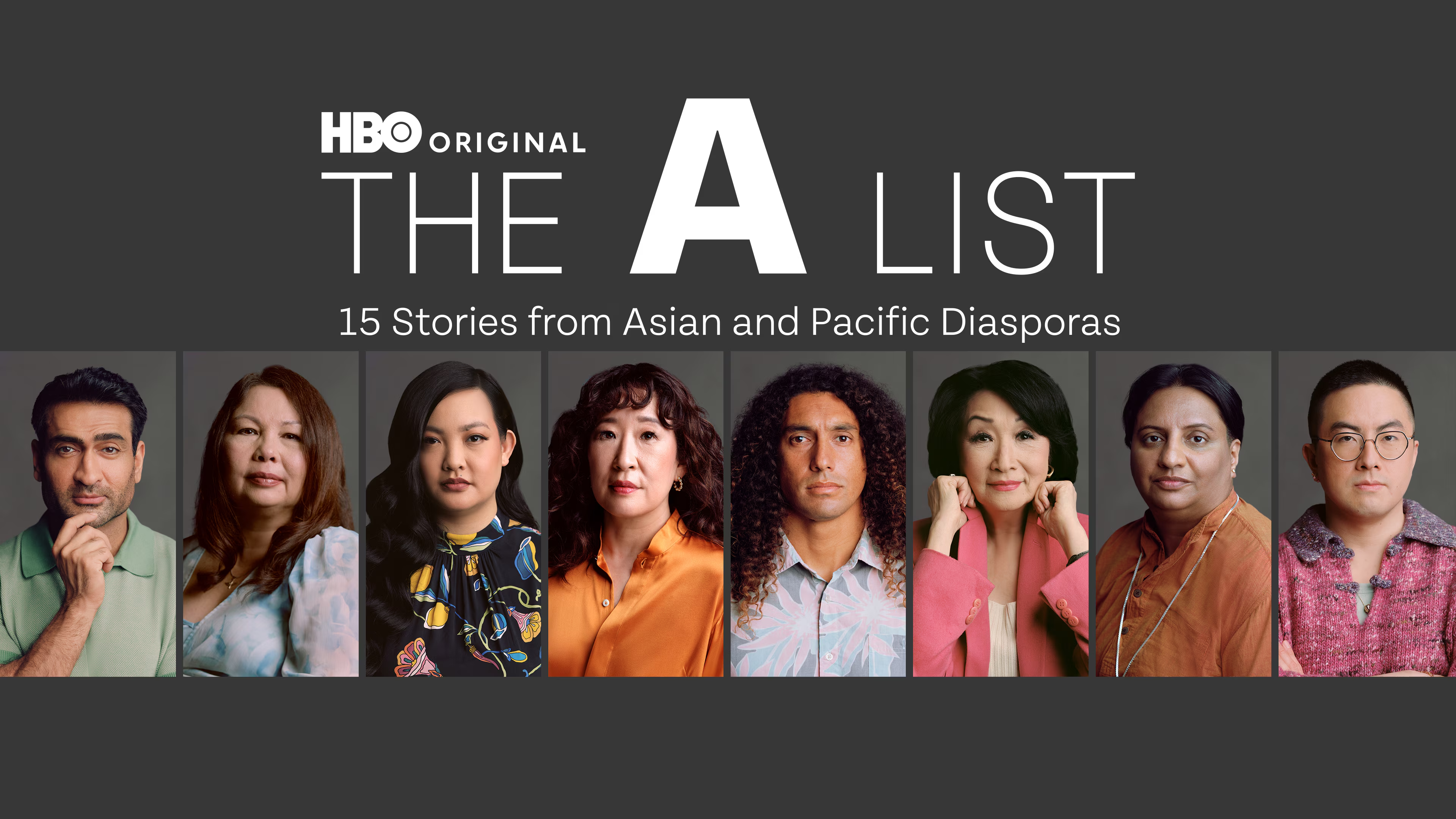
You will likely know some of the people on this A List. Sorry but that won’t include John Cho or Daniel Dae Kim or anyone named Lee or Li. but there are also people we all should know and their stories are touching and easily relatable. Who are the 15?
- Schuler Bailar: NYC-born Korean hapa transgender man who competed in NCAA Division I swimming. LGBTQ activist.
- Connie Chung: Chinese American news anchor and journalist.
- Manny Crisostomo: Guam-born Pulitzer Prize-winning feature photographer.
- Tammy Duckworth: Thai American hapa and US senator for Illinois.
- Cliff Kapono: Native Hawaiian professional surfer, journalist, and marine conservation scientist
- Kathy Masaoka: Los Angeles-born Japanese American activist who was co-chair of the Nikkei Civil Rights & Redress.
- Nergis Mavalvala: Pakistani American astrophysicist at MIT.
- Haroon Mokhtarzada: Afghanistan-born American technology entrepreneur. CEO and co-founder of Rocket Money (Formerly Truebill).
- Kumail Nanjiani: Emmy Award-winning, Oscar-nominated Pakistani American actor, comedian, writer and producer.
- Amanda Nguyen: Vietnamese American civil rights activist and commercial astronaut.
- Sandra Oh: Emmy and Golden Globe-winning Korean Canadian actress.
- DJ Rekha: London-born Asian Indian American musician DJ.
- Yia Vang: Hmong American chef based in Minneapolis who was a James Beard award finalist.
- Bowen Yang: Australian-born person of Chinese descent who is an actor and comedian.
- Madelyn Yu: Retired Filipina nurse in New Jersey and former president of the Philippine Nurses Association of America (2018-2020)
The first interview is probably the most recognizable face: Sandra Oh, who asks, “Who are you? How do you see yourself? What is your identity?” The Golden Globe-winning Oh is not a US citizen. She was born and raised in Ontario, Canada. Her parents immigrated from South Korea. She portrayed Hong Kong-born Chinese Canadian Adrienne Louise Clarkson who was the 26th governor general of Canada (1999 to 2005). Clarkson (née Boy) was many firsts. She was the first visible minority and refugee to be appointed governor, the first Chinese Canadian and the first without a military background.
Oh was also many firsts. She was the first Asian Canadian woman to host “Saturday Night Live” in 2019 (the third actress of Asian descent after Lucy Liu in 2000 and Awkwafina in 2018, the first actress of Asian descent to be nominated for the Primetime Emmy Award for Outstanding Lead Actress in a Drama Series and the first woman of Asian descent to win two Golden Globes. Oh’s battles and identity are as “an Asian woman in White society.”
Yia Yang addresses the childhood wish that many AAPI people have: He didn’t want to be Hmong. His life was bifurcated between his mainstream live at school and his Hmong life at home. The motivation wasn’t just generational; his father encouraged him to assimilate.
And while in 2026, Asian food is now more acceptable, and for many people of non-AAPI descent the most they know and find acceptable about AAPI culture is the cuisine, Yia Yang recounts the childhood rejection of the cultural foods brought to school as lunches.
Like many women of AAPI descent, the California-born Amanda Nguyen remembers that the cultural ideal for a woman was “to be obedient.” That strikes a chord in my heart. Without access to the cross-section of women in the AAPI countries, that’s easy to believe. When I traveled to Japan, I learned that wasn’t true for Japan in general, for the island I was from in Japanese lore and specifically from my paternal family lineage. Nguyen found that this wasn’t true either and the problem was who people chose to focus on. In 2014, a year after her sexual assault, founded a non-governmental civil rights organization for implementing a sexual assault survivors’ bill of rights. The Sexual Assault Survivors’ Rights Act, a bill she drafted, was passed unanimously in Congress in 2016. That’s over four decades after the late Susan Brownmiller’s 1975 “Against Our Will: Men, Women and Rape.”
Nguyen also was part of the stop violence against Asian American movement in 2021 and in 2022 was named one of Time Magazine’s Women of the Year.
DJ Rekha notes that identity shifts depending upon who is asking. That’s true for many of us, particularly if you choose to be something your parents wouldn’t approve of. Post-9/11, being a DJ who serves the South Asian community isn’t just about a party. It is also about having a safe space and taking up space.
Chung walked into the newsroom, a world ruled by White men, and destroyed the “little Lotus Blossom” image not just with her “potty” mouth, but by being unstoppable. Of her nine siblings, she was the only one born in the US.
Schuler Bailar recounts coming out as a transgender man and finding support at Harvard so he was able to transfer from the women’s swim team to the men’s. He’s in a good position to compare the difference between the fetishization of women of Asian descent as opposed to the emasculation or invisibility of men of Asian descent.
Screen Actors Guild Award-winning (Outstanding Performance by an Ensemble in a Comedy Series for “Only Murders in the Building,” 2025) and Emmy-nominated Kumail Nanjiani recounts being mistaken for “the other guy,” from Kal Penn in “Harold & Kumar” fame to Kunal Nayyar of “The Big Bang Theory.” He recounts how the “conception of manhood for me was very damaging.” In ways, he ties together an aspect of toxic masculinity as found in both Pakistani and US culture.
Asian Americans were recruited in waves. Madelyn Yu recalls that in the 1970s and the 1980s there was a huge nursing shortage in the US and administrators from all over the US went to the Philippines to recruit nurses. That’s how Madelyn Yu came to the US, leaving her job as a head nurse, her husband and her first-born baby behind. She and her husband would eventually have four children and they would join her in the US. In 2019, after serving as a nurse for 46 years, she retired. In 2020, she had planned to travel with her husband, but in March 2020, the pandemic began. Her husband and Madelyn Yu both contracted COVID-19.
Haroon Mokhtarzada was born on the day that Russia invaded Afghanistan. His father was imprisoned and once released, left. In the US, a family of eight were packed into a two-bedroom apartment. His father’s family had been well-off. In the US, they struggled financially. Technology was how he and his family found success, but he’s also giving back to the community.
If one is not from Illinois, an Iraqi war vet or AAPI, does one know who Tammy Duckworth is? Besides being a vet, a double amputee, Duckworth is a multilingual US Senator with a PhD and a US story to tell that dates back to George Washington’s Revolutionary Army.
Bowen Yang (杨伯文) found comedy through Austen Powers and that eventually took him from Australia, to being a staff writer for “Saturday Night Live” in 2018 and then to a cast member for seven seasons (2019 to 2025). In a full-circle of happenstance, Yang was inspired by Sandra Oh’s portrayal on “Grey’s Anatomy.” Yang was recurring on Awkafina’s “Awkwafina Is Nora From Queens” as her cousin before SNL.
Manny Crisostomo reminds us that Guam is a part of the US (unincorporated territory) and that the people born in Guam are US citizens who can live and work anywhere in the 50 states (although they cannot vote in presidential elections while residing in Guam). While he left Guam and got his Pulitzer for work he did in the US for the Detroit Free Press in 1988, he returned to Guam to document life there.
Cliff Kapono challenges stereotypes of scientists, Hawaiians and surfers. I love that he has a connection to San Diego where he earned his PhD at the Skaggs School of Pharmacy. Sadly, in California, he found surfers are not always cool with outsiders, including native Hawaiians from whom surfing comes. Yet surfing brought him scientific, nerdy celebrity.
Nergis Mavalvala grew up in Pakistan, recalls a life with a constant juxtaposition of faith. Mavalvala moved to the US in 1986 when she enrolled at Wellesley College where she earned a BS in physics and astronomy (1990). In 1997, she received her PhD from the MIT physics department and is a faculty member at MIT since 2002.
There was a time when I thought Japanese Americans needed to move past the topic of the incarceration in concentration camps, but over the years there’s been repeated suggestions of interning whoever looks like the enemy and last year, for the first time since World War II, the Enemy Aliens Act has been invoked. People seem not to understand that this targets legal residents. Being an immigrant doesn’t mean one is here illegally. Kathy Masaoka talks about what she didn’t know and what she wasn’t told and in doing so, mentions what all Canadians and US citizens and residents should know. Legal residents and citizens lost their jobs, their prized possession, their dignity and even their lives, spending years in concentration camps without being formally charged with a crime other than being on the West Coast and being of Japanese descent. With the inclusion of a clip of Republican president Ronald Reagan speaking, director Eugene Yi reminds us that it wasn’t always Republicans versus Democrats.
Using photos and family films, Yi brings us the personal journeys of 15 people of AAPI descent. All worth knowing because AAPI heritage goes beyond take-out, martial art movies and North American and European stereotypes. Eugene Yi previously co-directed with Julie Ha the 2022 documentary “Free Chol Soo Lee” and directed the 2023 “The Rose: Come Back to Me” about the South Korean indie rock band, The Rose.” He previously edited videos for The New York Times and Al Jazeera.
The A List: 15 Stories from Asian and Pacific Diasporas premiered on HBO Max on 13 May 2026.