
“The Odyssey” has many lessons, but not all of them surely intended by the director/screenwriter Christopher Nolan. In the end, it is less a Greek tragedy and more a what not to do on a boys night out.
If you’ve been following this blog, you’ll already know that I was not a fan of 2023 “Oppenheimer.” Nolan presented an extremely whitewashed version of California culture of the 1940s and I was angry enough to offer a few blog entries filled with historical truths from an Asian American perspective..
- ‘Oppenheimer’: A Compartmentalized White-Jewish Male POV
- ‘Oppenheimer’ and the Communist Connection
- ‘Oppenheimer’ and the Obvious
For “The Odyssey,” Nolan has embraced diversity so much that his “white-armed” Helen is not White. Homer describes Helen in the “The Iliad” as “white-armed” in Book III. Juno is, in another version (“Thus did she speak and white-armed Juno, daughter of great Saturn…”), described as “white-armed,” meaning not exposed to the sun as in these women are not peasants or slaves, but women of a leisure class.
She is played by the Oscar-winning Mexico-born Kenyan Lupita Nyong’o. As I was going to the all-media press screening on Monday, I was wondering how many people would have heard of this film if not for the controversial casting choice and that while people were debating if she could play the supposed most beautiful woman in the world. I also remembered what the statistical information from dating apps told us about Black women versus East Asian women.
- Odds Favor White Men, Asian Women on Dating App (30 November 2013)
- Key Findings About Online Dating in the US (2 February 2023)
- Racial Preferences in Dating Apps: An Experimental Approach (17 June 2023)
The Pew Research 2023 study didn’t look at race and the OKCupid article is currently offline. That’s too bad. The conclusions are that Black men and Black women receive the fewest responses. East Asian women receive the most. That agrees with my own anecdotal experiences from decades ago when as a newly single woman, I re-entered the dating world and found that if I identified myself as Asian American, even without a photograph, I received more responses than if I listed the identical profile without race or misidentified myself as White or Black. And yet, I received a significant more responses if I identified myself as Japanese American. Yellow fever was a thing then and I suspect is is now.
Nolan’s diversity casting which includes many Black faces and some East Asian faces forces this question upon an audience when in a more traditional casting might have left out the question of East Asia. Yet diversity casting didn’t include any actor of Greek descent in a primary role?
I was surprised and disappointed that Christopher Nolan’s “The Odyssey” doesn’t have any Greek actors in major roles and didn’t take Greek culture into more a more collaborative creative manner. It’s worth nothing what Greek people thought.
- What the Hellenic! Why is Christopher Nolan’s New Greek Epic Entirely Devoid of Greeks? (3 June 2026)
- Christopher Nolan’s “The Odyssey” and Hollywood’s Lack of Mediterranean Representation (2 October 2025)
I was also shocked to learn that there were no Greek actors cast in any leading roles, on top of this Greek epic being put into the hands of a non-Greek director. For a film that is adapted from an ancient Greek text, one would expect Greek actors (or at least, actors of Greek descent) to star in the movie. Even if that was out of the question, considering the lack of Greek stars in Hollywood, it would at the very least be possible to cast Mediterranean actors. This would not only allow for the movie to appear more ethnographically accurate, it would also help avoid criticism of the lack of Mediterranean representation in Hollywood. By not casting actors that represent the diverse Mediterranean countries through which Odysseus passed by before returning to Greece (Tunisia, Italy — specifically Sicily — and Spain), such countries lose the chance of being represented in a piece of art rooted in the Mediterranean region.
But really the first lesson we get from “The Odyssey,” is via Hagen-Renaker, a Southern California fixture that once sold fine ceramic merchandise at Disneyland. If you’ve seen this movie’s version of the Trojan Horse, you’ll instantly see the mistakes made. It’s the legs. Anyone who has shipped a porcelain horse can tell you this and wood would only make this problem slightly less predictable. Seeing the prop horse in person at Universal City Walk while in line for the film didn’t dissuade me from this argument and I have worked with wood (carving), clay and metal fabrication on a much smaller scale. As the story goes on, my husband pointed out there were more problems, but we’ll get to those later.
Christopher Nolan’s The Odyssey
The film begins in a dark hall, only illuminated by fire for we are in the Bronze Age of Greece. There are men, hungry and restless, eating and listening to a story told by a bard (Travis Scott) about the Trojan Horse and the both the onscreen audience and the audience at the theater are transported back in time. We see the Trojan Horse being found, half-buried in the sand and lapped by ocean waves as a single Greek soldier, Odysseus’ cousin, Sinon (Elliot Page), is caught and killed by Trojan soldiers.
The tale of the fall of Troy has made it home to Odysseus’ castle where his wife Penelope (Anne Hathaway) still awaits his return, nearly two decades after he left. The men in the darkened hall are the hundred-odd suitors , led by Antinous (Robert Pattinson), all eager to replace the absent Odysseus. Odysseus’ son, Telemachus (Tom Holland), knows of his father only through legend. The Trojan War itself was a decade and another decade has passed. Other kings of Greece such as Agamemnon and Menelaus had already returned and while Menelaus lives, Agamemnon is already dead.
Behind a wooden screen, Penelope weaves a a burial shroud for Laertes, Odysseus’ father, as Penelope’s suitors enjoy the hospitality of the absent Odysseus. In flashbacks, the dedicated love of Odysseus and Penelope is quickly established. Even at the start, as Odysseus was leaving his wife, he knew Agamemnon (Benny Safdie) was trouble. Odysseus tells his wife that Agamemnon sacrificed his first-born daughter (Iphigenia who is portrayed as barely more than a toddler here) to make the journey to Troy. Agamemnon’s reason for setting out against Troy is to gain control of the trade routes that Troy governs. We later learn that Menelaus (Jon Bernthal) is a loathsome, abusive lout. The lesson here is: Be careful of the friends you keep. Yet Odysseus had to join the war: If he didn’t fight against Troy, his kingdom of Ithaca would be threatened and ruined by these frenemies.
Where is Odysseus, now? The man we know to be Odysseus (Matt Damon) doesn’t know who he is and can hardly remember his life as he is cared for and drugged by the beautiful nymph Calypso (Charlize Theron) on the isolated island of Ogygia. He is haunted by the image of a young woman that seems to be Athena (Zendaya), the goddess of wisdom and warfare. He asks Calypso about his memories and she attempts to comfort him but she also obviously is more attached to him than just as a nurse.
Through these two separate timelines the full story of the fall of Troy and Odysseus’ long journey home are slowly revealed until they converge over the course of two hours and 52 minutes. The fall and sack of Troy is sanitized for modern sensibilities, stripping it of the hubris necessary for Greek tragedy. As for Odysseus’ journey home, it’s like a series of bad choices on a boys’ night out.
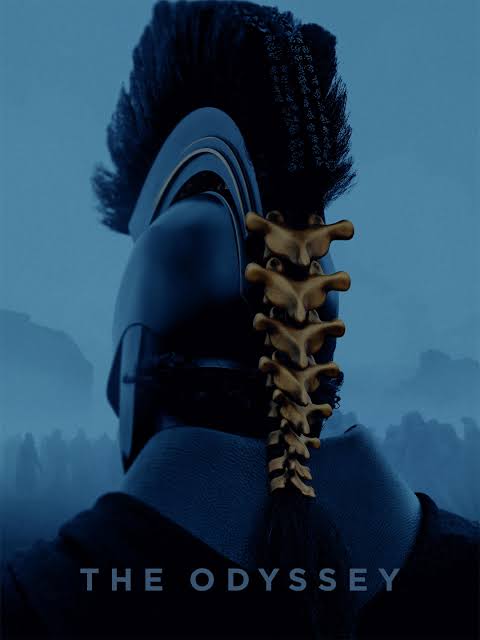 First, Odysseus is tired of this long beach party and doesn’t need loot. He doesn’t even need provisions. We can pick up stuff on some island on the way home. he tells his first mate, Eurylochus (British Gujarati Hindu actor Himesh Patel). Moreover, he’s tired of the company of Agamemnon. He doesn’t want to follow him any more. Kings being ordered around by other kings must be an egomaniacs convention of chaos or an alpha dog free for all. We don’t know much about Agamemnon either. The cinematography and the costume design make him an enigmatic image. He’s the guy withe the helmet that has the golden vertebra hanging down. That must be heavy, but if your ego is big I guess the ensuing headache is worth it.
Odysseus reasons, the three ships of his fleet can pick up food at unknown islands on the way home. Isn’t this like taking the scenic route home without a map and trusting one’s health and sanity to gas station sushi or tuna fish salad sandwiches?
Unfortunately, there are no 7-Elevens or gas stations in these times. It’s either time on the real row machine or depending upon the capricious winds to get you where you want to go. Odysseus not only didn’t have GPS, he didn’t have maps. The first island they stop at the people run, deserting their village. They are afraid of the marauding people from the sea. Throughout, the Greeks are warned against the people from the sea.
Next, they unwisely all disembark on another island and follow a single sheep into a cave. The sheep is soon joined by the rest of its flock and a Cyclops, Polyphemus (Bill Irwin). Polyphemus has a taste for raw meat, starting with human heads, spitting out the helmet like the hard shell of a sunflower seed. The Cyclops seems unaware of Zeus Xenios, or the moral obligation of hospitality toward strangers as Zeus is the protector of guests. Since any stranger at your door could be a god in disguise like Zeus so one must be courteous. Zeus Xenios bound Ancient Greeks to feed, bathe and protect strangers. Here, in this film, it’s called “Zeus’ Law.”
In this scripting, Polyphemus is like a lonely incel. There’s no fellow giants and Odysseus doesn’t engage in witty, manipulative banter. The men blind the Cyclops and escape, but as Polyphemus is the son of Poseidon, the sailors are in for some bad times at sea. It is a hard to believe that a blinded Cyclops could run through a forest tracking down the fleeing men with such accuracy.
 Another stop will bring the men to the Land of the Giants, Laestrygonia, and this is what is shown in the publicity materials. I thought this was a take on the alien architects of advanced civilizations science fiction because the armor looked like steel and almost robotic in its articulation. Ian thought that this jump in technology was forgivable because these were giants (the Laestrygones) and not human men. Ian also thought there were few shields in these fight scenes compared to the Cyclops’ segment, but he also thought the number of men suddenly increased on the beach scene.
Most of the men and ships are lost here. In the book, the fleet of a dozen ships shrink to one, and in the film, two ships are lost to leave one vessel. The surviving crew’s next stop is Aeaea, where the men, believe Odysseus bears some type of curse, ask him not to go with them as they search for food. This reconnaissance crew sees some amazing sights, ones that mix Africa and Asia by introducing big cats like a tiger, panther and full-maned lion. Then they come upon a shack where food is being prepared. Ready to help themselves, they meet a frumpy woman Circe (Samantha Morton) who encourages them to eat. This version of Circe seems to imagine her as the crazy (big) cat lady. In reality, I thought big cat hoarders were usually men, but I digress.
While the food looks better than gas station tuna fish sandwich, it is even more deadly. One of the best CGI effects in this film involves Circe’s transforming the men into swine. Odysseus will come to their rescue, and Circe will advise Odysseus on how to break the curse of Poseidon.
The remaining boat will journey to hell and back, but only Odysseus will return to Ithaca.
During this time, Antinous plots to have Telemachus assassinated. Telemachus secretly slips away in a ship to get news of his father, ending up in the home of Menelaus and Helen on the very day their daughter is to be wed. Yet even as the son of Odysseus, Telemachus is barely welcome. Menelaus and Helen’s marriage is hardly happy and one can easily guess why Helen ran away with Paris. Menelaus recounts how for several days, the men hidden in the Trojan Horse suffered. Some drowned. Some were killed by swords poked in.
My husband’s point that I mentioned above is this. Death stinks and so does urine and defecation that comes with the living and the sudden release associated with death. We know the Trojan Horse is neither watertight nor airtight. Decomposition begins immediately and if there are holes, insects will find their way in. Fans of “CSI,” “Bones” or a host of coroner dramas already know this. Yet no Trojan notices the smell as they haul the statue over parallel wooden rollers. When righting the wooden horse, no one noticed the smell and weird shift of weight?
Back to Telemachus, when he takes leaves of Menelaus, Helen embraces him and whispers an apology for all the men whose lives were messed up or ended because of her. On his return journey, his path crosses with both his father and the assassins. No spoilers from here on how Odysseus and Telemachus get their happy ending.
The Odyssey (Emily Wilson translation) and More
At the launch of a thousand ships, the fleets quickly stall at Aulis. Homer doesn’t mention Aulis in “The Odyssey.” And this means, he doesn’t mention Iphigenia. Iphigenia is the first-born and the oldest daughter of Agamemnon. At Aulis, the Greek fleet has gathered, including both Agamemnon and Odysseus in support of Menelaus.
Euripides’ “Iphigenia at Aulis” sets up the further tragedy of the cursed House of Atreus in relation to Troy. Because Agamemnon’s men have slain one of the sacred deer of Artemis, a sacrifice must be made and that is Agamemnon’s eldest daughter.
While Agamemnon doubts and agonizes over offering his daughter as a sacrifice, Odysseus is portrayed as forcing his hand. Menelaus feels “Odysseus cannot possibly hurt us,” Agamemnon warns, “He was ever shifty by nature, siding with the mob.”
Menelaus then agrees, adding that Odysseus “is enslaved by the love of popularity, a fearful evil.”
In the film, Nolan includes the sacrifice of Iphigenia at Aulis to villainize Agamemnon and distance the hero, Odysseus from the House of Atreus. While Nolan’s Odysseus warns that if he stayed home, their kingdom of Ithaca would come under threat by Agamemnon and his fleet, in “Iphigenia at Aulis,” it is Odysseus who is considered a threat.
Bethink thee the, will ne hot arise among the Argives and tell them the oracles that Calchas delivered, saying of me that I undertook to offer Artemis a victim, and after all am proving false? Then, when he has carried the army away with him, he will bid the Argives slay us and sacrifice the maiden; and if I escape to Argos, they will come and destroy the place, razing it to the ground, Cyclopean walls and all. That is my trouble. Woe is me! to what straits Heaven has brought me at this pass! Take one precaution for me, Menelaus, as though goest through the host, that Clytemnestra learn this not, till I have taken my child and devoted her to death, that my affliction may be attended with the feast tears.
The mob mentality of the fleet warriors is clearly delineated in the 1977 Greek film “Iphigenia.” While her father Agamemnon waffles and her mother rages, it is Odysseus who forces the action. The Greek film also sets up the strife between Agamemnon and Achilles.
The thought that the soldiers were earnest honest souls in Nolan’s film sharply contrasts the portrayal of the common soldier as a mob. Nolan’s film makes food the only motivation for the first food supply stop on the journey home. In Homer’s version, when Odysseus’ fleet of 12 ships leave Troy, they end up in the land of the Cicones where they rape and pillage. They kill the men. They enslave the women. They sack the city. Then they drink and instead of leaving, they tarry. The Cicones stage a counter attack and lives are lost before the fleet again sets sail.
Wilson notes that while the Cicones were allies of Troy, “the passage does not suggest that Odysseus’ piracy is motivated by any particular military objective.”
When the fleet disembarks on the island of the Cyclopes, the Cyclops Polyphemus may live alone as a shepherd, but there are other Cyclopes on the island. Odysseus resists the suggestion to dine and dash and insists on staying to meet the shepherd. Because of his cleverness, when they do escape by clinging to the bellies of the sheep, the other Cyclopes do not some to Polyphemus’ aid. I imagine that means big sheep. I think the solution in the Nolan film isn’t that plausible.
In the text of “The Odyssey, proud of his scheme, Odysseus taunts Polyphemus and gives Polyphemus his name, resulting in Polyphemus appealing to his father, Poseidon. This is hubris.
Later in the land of the giants, Laestrygonia, all but one of the ships is lost as I mentioned above, but Odysseus divides his fleet. Eleven ships anchor in a harbor surrounded by cliffs. His ship remains outside. He then sends three crew members to check out this land. One is eaten by a giant while the other two flee in terror. Before they can warn their fellow warriors, the giants have trapped the 11 ships, sinking them. Only the 12th ship escapes. So Odysseus and his men never meet the army of giants in battle in the original text.
Nolan makes a major change in the portrayal of Circe. She is not the lonely (big) cat lady. Odysseus describes her as “beautiful” and yet “dreadful.” She lives in a palace, “a beautiful tall house of polished stone.” Circe is lovely with braided hair and Odysseus only escapes her enchantment with the help of the god Hermes. To regain his men who have been transformed into pigs, he has sexual relations with her. He and his men stay with Circe for a year until Odysseus, persuaded by his men, begs to leave. Circe tells Odysseus he must visit Hades and consult with a dead prophet Tiresias.
Yet because of how little we know of Agamemnon and how little of the actor’s face is visible, we can’t really feel that much sympathy for him. Further, Nolan’s decision to portray Menelaus as a loutish man when Odysseus’ son Telemachus meets him widens the gap between the heroic earnest Odysseus to the House of Atreus. When Telemachus meets Menelaus and Helen, domestic violence is implied by Menelaus against Helen instead of Menelaus forgiving of Helen.
The script reduces Helen to a face instead of a powerful intelligent woman. In Emily Wilson’s translation of “The Odyssey,” Helen tells Telemachus that his father stole into Troy disguised as a beggar and she recognized him. “He was too smart to talk, acting evasive,” and she “washed and scrubbed him with oil and dressed him, and I swore an oath that I would not reveal him to the Trojans before he had got back to his own camp.” Why would she do so? It is likely that by this time, Paris was dead and she had been forcibly married off to Paris’ brother, Deiphobus. She further relates:
He told me all the things the Greeks were planning. On his way back, he used his long bronze sword to slaughter many Trojans, and he brought useful intelligence to tell the Greeks. The Trojan women keened in grief, but I was glad–by then I wanted to go home. I wished that Aphrodite had not made me go crazy, when she took me from my country and made me leave my daughter and the bed I shared with my fine, handsome, clever husband. (p. 160)
I will stop here to avoid spoilers and because my reading of Wilson’s translation was done quickly, but I feel that the moral center of the Nolan film is Odysseus realizing how he has himself and the other Greeks caused the coming of dark times. He feels guilty about his lack of honesty, particularly with Sinon. He has tried to be an honest man; he tries to be honorable, particularly by strictly adhering to Zeus’ Law.
The Trojan War itself was started by a violation of Zeus Xenia because the guest, Paris, abducted or seduced the wife of Menelaus, his host. Yet this scripting also delineates the treachery of presenting a gift like a Trojan Horse as a breaking of the Zeus Xenia. Invited in and set up as a present to Athena, the Greek men emerging from the Trojan Horse are murderous guests in the city of Troy.
Odysseus is not portrayed so earnestly honest in Homer’s version. Emily Wilson’s Book 9 is titled “A Pirate in a Shepherd’s Cave” and characterizes Odysseus as “wily” and calls him “the lord of lies.” Yet this film also doesn’t portray the truth about men in wars.
While we all should be horrified at what happens at the temple of Athena. It isn’t the senseless murder, but in Homer’s “The Odyssey,” during the fall of Troy, Cassandra, daughter of Priam and Hecuba and sister of the Hector, is dragged violently from the temple, knocking over a sacred statue by the Greek warrior Ajax and raped in the temple. This was sacrilege and Athena supposedly convinces Poseidon and Zeus to punish the Greeks as they sail home.
After we conquered Priam’s lofty town, a god dispersed the ships of the Achaeans. Zeus planned a bitter journey home for us, since some of us had neither sense nor morals. Gray-eyed Athena, daughter of the Thunder, became enraged and brought about disaster. She set the sons of Atreus to fight each other. Hastily, they called the people at sunset, not observing proper norms. The men arrived already drunk on white; the brothers told them why they called the meeting. Then Menelaus said that it was time to stain back home across the open sea. But Agamemnon disagreed entirely. He wanted them to stay and sacrifice to heal the sickness of Athena’s wrath–pointless! He did not know she would not yield. The minds of the immortals rarely change. So those two stood and argued angrily, and with a dreadful clash of arms the Greeks leapt up on two opposing sides. We slept that eerie night with. hearts intent on hatred against each other–since Zeus meant us harm. At dawn one group of us dragged down our ships into the sea piled high with loot and women, while half the army still remained there, stationed with Agamemnon, shepherd of the people.
The ending of Nolan’s film wraps up the murders of the failed suitors too nicely with Odysseus waiting to kill the leader Antinous. In the text, Odysseus starts by killing Antinous first. Further, in Homer’s version, Odysseus orders his son to kill all the female slaves that slept with the suitors and Telemachus defies Odysseus not by refusing, but by methodology. The angry families are assuaged by Athena who with Zeus agrees that Odysseus should be king of Ithaca.
After watching a variety of Greek films (and one Greek American film), I think the problem of Lupita Nyong’o’s casting is that it attracted more attention than the actual written role deserves. Moreover, although she is Black, she also is a body type that Nia Vardalos as Toula Portokalos opines against in “My Big Fat Greek Wedding.”
When I was growing up, I knew I was different. The other girls were blonde and delicate, and I was a swarthy six-year-old with sideburns.
Toula isn’t small-boned and fine featured and grows up to be Vardalos. Further, Nyong’o’s Helen can’t compete with Greek actress Irene Papas, whose performance has stuck in my mind from before I knew she was Greek or before I wrote about films. I feel it’s a shame that more Greek, Greek American or MENA actors weren’t used in this film, especially for the principal characters. I also feel it is a crime that, after seeing John Stamos at the Hollywood Bowl, that he was never cast in a major Greek myth movie.
My husband and I had other problems with Nolan’s “The Odyssey” such as the cinematography and lighting as well as the ending which doesn’t seem earned or logical. My husband would give this a 3/5. This is a boys having a bad night or two out and not Greek tragedy.
“The Odyssey” premiered on 6 July 2026 in London and was released in the US on 17 July 2026. I saw the film in IMAX at Universal City Walk.