
If you’ve watched Netflix’s documentary, My Octopus Teacher, you’ll already been sensitive to the very possibility of intelligence in these creatures and that will partially prepare you for Weston Gaylord’s “Octopus’s Garden” currently playing at Boston Court in Pasadena. While two of the main characters are scientists, researching celapods, and there is some science talk, the play quickly veers into science fiction yet the resulting dialogue involves universals for all.
The Octopus
The octopus has been the stuff of nightmares, inspiring monsters like the Nordic Kraken or Japan’s Ainu yōkai, Akkorokamui. For the Hawaiian’s, the octopus was used to represent a major diety, Kanaloa.
Yet in the films, we’ve also had octopus as aliens in comedy as in “Resident Alien” where the titular alien’s cousin, “42” was an octopus voiced by Nathan Fillion or the recurring aliens in “The Simpsons,” and in more serious science fiction like the 2016 “Arrival” which had heptagons, seven-legged creatures.
The plural of octopus is “Octopuses.” Octopi is accepted but problematic because “octopus” is not Latin like “fungus” which becomes “fungi” or “cactus” which becomes “cacti.”
- Fungus -> Fungi
- Radius -> Radii
- Nucleus -> Nuclei
- Cactus -> Cacti
However, “cactuses” has become acceptable in English. The word “octopus” is Greek. In Greek, the correct plural would be “octopodes.”
Notably, the Britannica AI-generated article on the kraken uses “octopi.”
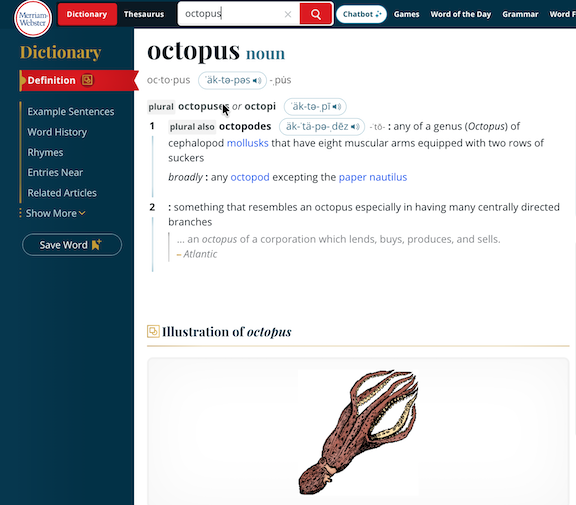 What is an octopus? “any of a genus (Octopus) of cephalopod mollusks that have eight muscular arms equipped with two rows of suckers.”
What Is an Octopus’s Garden?
The title of the play is obviously an allusion to the 1969 Ringo Starr (Richard Starkey) song “Octopus’s Garden” which is about a “little hideaway beneath the waves” where friends would meet to “sing and dance around because we know, we can’t be found,” a plated where “every girl and boy” would be happy and safe.
Yet Starr was inspired by a real thing, a place that octopuses decorate “a favorite spot, a cave or crevice that makes it feel protected” and “pretty rocks and shells are arranged in an almost jenga-like formation outside their hiding spot,” but it is also what PBS notes is “both a mating site and a nursery where newborn octopuses develop faster than expected.”
- Why Nesting at ‘Octopus Garden’ Helps Female Octopuses Give their Young a Better Short at Survival (24 August 2023)
- An Octopus’s Garden–More than just a Song (28 August 2017)
- An Octopus’s Garden (1 October 2023)
- Here’s Why Thousands of Octopuses Gather at the ‘Octopus Garden’ (4 March 2024)
Can Octopus Hear?
Someone asked this question in 2012 and the StarNewsOnline.com, got the answer from the NC Aquarium at Pine Knoll Shores.
This eight-armed wonder has a highly developed nervous system and excellent eyesight, but the scientific community has long debated whether it has an auditory sense. Today there’s proof, at least for the octopus and squid, that they can indeed hear.
To register sound, an octopus uses a sac-like structure called a stratocyst. The stratocyst contains a mineralized mass and sensitive hairs that allow detection of sounds of certain frequencies. Squid can hear an even wider range of sounds.
Having determined that octopuses can hear, what do they listen to? The ocean is a raucous realm. Even though humans can’t hear much underwater, noisemakers range from fish vocalizations and dolphin clicks to whale whistles and boat engine roars.
Scientists theorize octopuses may listen for sounds of predators, such as seals, large fish, eels or sharks, or perhaps eavesdrop on prey.
These intelligent animals may even communicate with each other. Studies to solve this fascinating mystery continue
There is research into hearing of cephalopods. At the Woods Hole Oceanographic Institution, T. Aran Mooney, and associate scientist in the biology department has a web page addressing this in a specific squid (Doryteuthis pealeii, found in New England waters).
Here are more articles on cephalopods and hearing.
- Accoustically Evoked Potential in Two Cephalopods Inferred Using the Auditory Brainstem Response (ABR) Approach (July 2009)
- Octopuses Keep Surprising Us – Here are Eight Examples How
- The Story of My Octopus (3 December 2019)
The Play
This Circle X Theatre, Outside in Theatre and Boston Court Passadena production is a world premiere and presents three human beings who interact with a cephalopod, Sylvia, in a research lab. Lucas (Vincent R. Williams) is a young man who meets up with a cephalopod researcher, Tara (Kacie Rogers). Lucas asks all of layman questions such as what is the appropriate plural for an octopus, but he also has a certain expertise that becomes crucial to this research. He’s a musician, one that doesn’t understand his father’s enduring love for a tune he finds trite, but also one that is making a living at making music commercially.
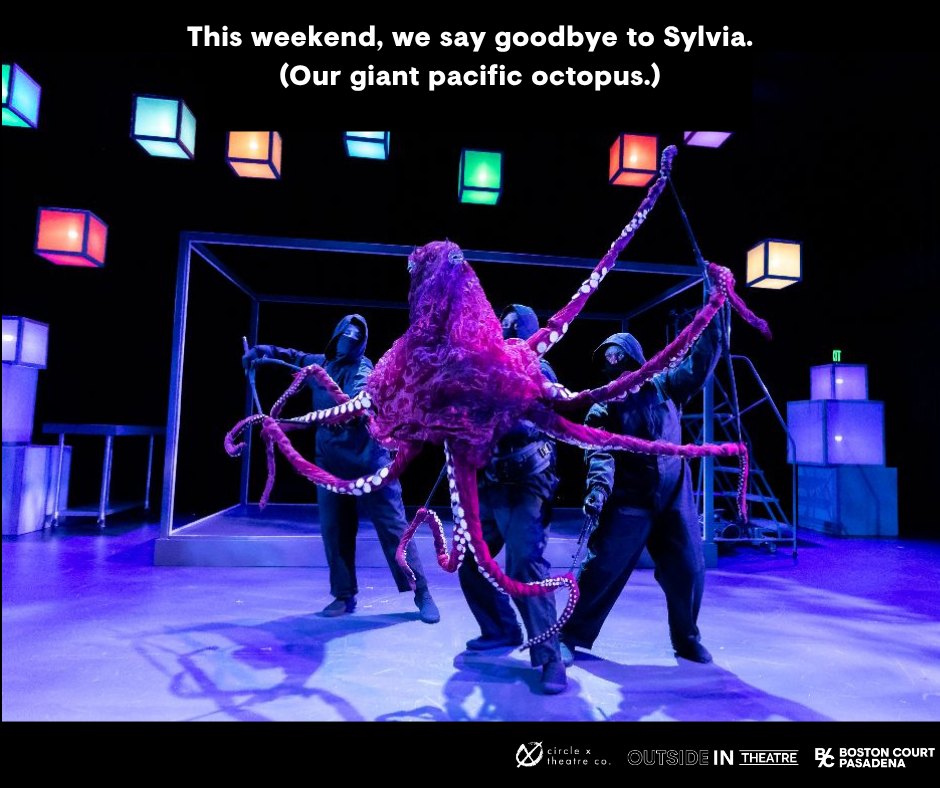
Tara has bonded with Sylvia, a Giant Pacific Octopus and one of several subjects in the cephalopod lab, but Lars, the elder researcher in the lab, was the one who found and brought Sylvia in. As the 90-minute intermission-less play progresses we learn that there’s more to the difficult relationship between Tara and Lars than just generational or methodology differences. When Tara borrows a musical instrument from the well-funded dolphin lab (Sorry…we never see any dolphins), and Sylvia produces music, the composition profoundly changes how Tara, Lars and especially Lucas perceive the world they used to know.
Sylvia is a puppet manipulated by three people: Zachary Bones, Perry Daniel and Danielle McPhaul. The puppeteers are dressed in black, essentially kurogi. Daniel is a faculty member at UCLA’s Department of Theater where she teaches courses in puppetry. Why did I now take such courses when I was at UCLA?! The puppet itself is a product of several various experiments that were explained during one of the after-show talks where the problem of the eyes was duly noted. Since Sylvia doesn’t talk and cephalopods don’t have eyebrows (and neither do horses), the eyes would be particularly important and that will hopefully be fixed in other iterations. Still, for puppetry fans, it is fascinating to hear how it was made and watch is being worked.
At its heart, Gaylord’s play is about understanding the other, beyond our stereotypes or anthropomorphic sentiments. That can apply to humans and non-humans and certainly the socio-political atmosphere of the US could use more empathetic impulses. Director Jessica Kubanzansky gives us an octopus we can love and humans that are deeply flawed in their quest to understand the music of nature and our own human condition.
“Octopus’s Garden” continues until 5 April 2026 at Boston Court Pasadena. For tickets or more information, visit BostonCourtPasadena.org
 Age of the Geek