
Since the rise and fall of the Nazi Regime, Nuremberg has become a word associated with both anti-semitism and crimes against humanity. The 1961 legal drama “Judgment at Nuremberg” was my first cinematic exposure to the Nuremberg Military Tribunals (although I saw it on TV), but the 2025 “Nuremberg” takes a different tact, perhaps more pertinent to a younger generation, more removed from the survivors of World War II and the film is, sadly, pertinent to the US today. On a cautionary note, archival footage of the death camps is shown in both films.
Judgment at Nuremberg ⭐️⭐️⭐️⭐️
When the film “Judgment at Nuremberg” came out, the horrors of World War II were still vivid. In 1961, people who had fought during World War II were still alive. They had families. It was only 16 years, less than a score, after World War II had ended. Those twenty-somethings were now in their late thirties or mid-forties.
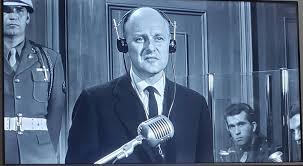
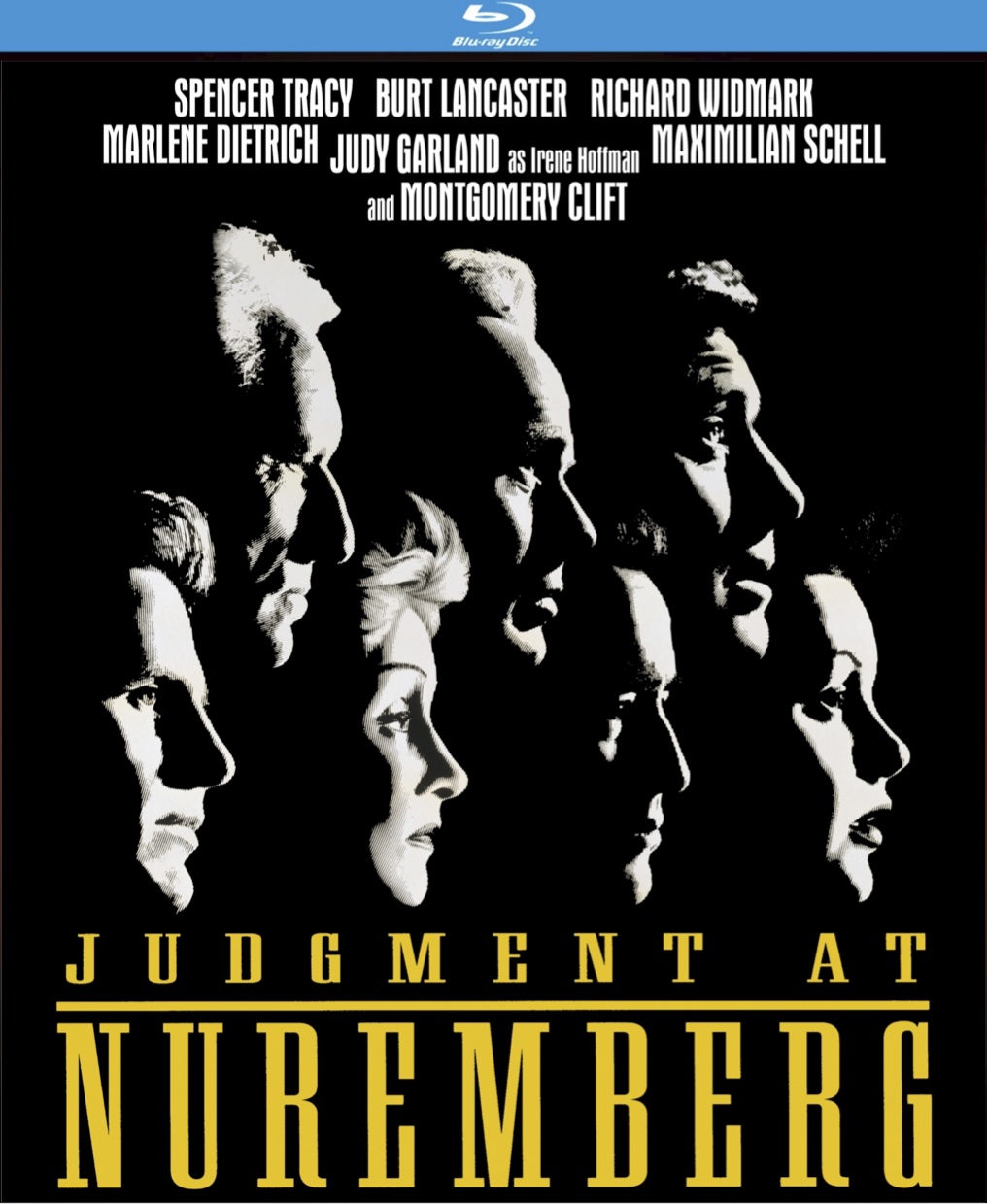
Directed by Stanley Kramer (1913–2001) and written by the son of Russian Jewish immigrants, Abby Mann (1927–2008), the film featured Spencer Tracy, Burt Lancaster, Richard Widmark, Maximilian Schell, Werner Klemperer, Marlene Dietrich, Judy Garland, William Shatner and Montgomery Clift. Kramer often made message films such as “The Defiant Ones,” “Guess Who’s Coming to Dinner” and “On the Beach.” Lancaster had served during World War II in a Special Services Division as an entertainment specialist. Widmark had a perforated ear drum and was turned down for World War II service. The Austrian-born Swiss actor Schell had fled with his family from Austria to German when he was a child in 1938, the year Austria was annexed by Nazi Germany. Klemperer was born in Cologne Germany to a Jewish father and Lutheran mother. His family emigrated to the US in 1933. He served in the Special Services unit in the Pacific during Wold War II. Dietrich renounced her German citizenship in 1939, becoming a US citizen. She was active in raising funds to help Jews and dissidents escaping Germany. During World War II, she helped sell war bonds and performed in USO shoes for the Allie troops in North Africa and Europe. Of the people featured in the cast of “Judgment at Nuremberg,” only William Shatner is still alive.
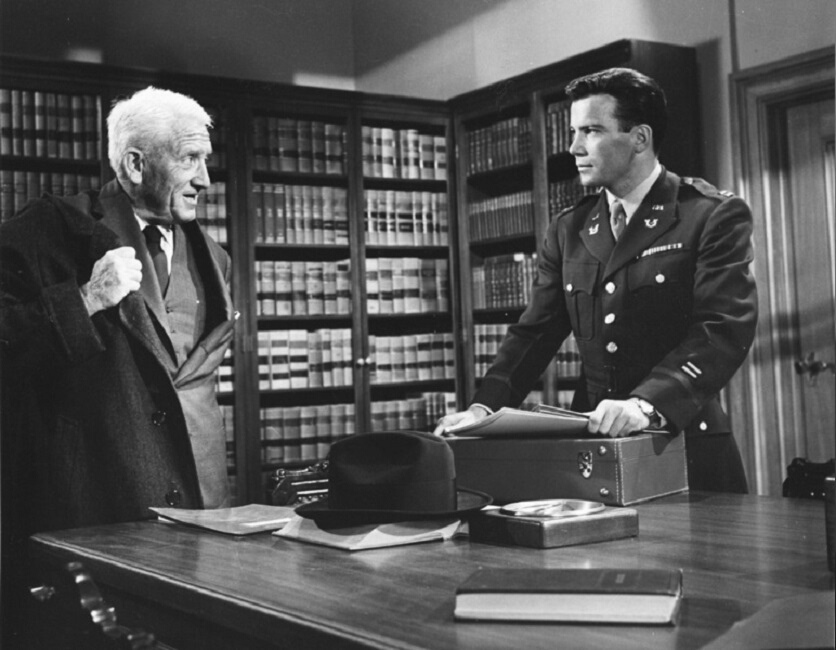
While you might know the name of the stars, you won’t know the names in this fictionalized version of the Judges’ Trials of 1947. In the timeline of this film, the “stars” the Nazi Regime have already been tried and sentenced. Four German judges and prosecutors are accused of crimes against humanity for enforcing the Nuremberg Laws. Because of their senior roles in the Nazi government’s judicial system, they supported and enforced unjust laws and thus bear some responsibility for the European Holocaust. The fictional Chief Trial Judge Dan Haywood (Tracy) is not famous and not even currently a judge, having not been re-elected. He’s a widower without any particularly political prominence. Hayward is embarrassed by the grandeur of his new digs and the formality of the military. He asks Captain Harrison Byers (Shatner) who has been assigned to assist the US judges hearing the case to call him by his first name, Dan, or his occupation, judge.
 Haywood is set up at a spacious mansion that once belonged to a German general who was executed by the Allies. The general’s widow, Frau Bertholt (Garbo), has been removed and now stays in a much smaller apartment without servants. Haywood befriends her and even becomes romantically inclined. As the head of the Allied panel of jurists, Haywood is particularly interested in one defendant, Ernst Janning (Lancaster), who is a legal scholar. Haywood wonders how he could have sentenced innocent people to death. Janning feels that these legal proceedings are just a post-war victors’ showcase. He doesn’t believe there is any justice to be found. Jannings at first refuses to participate at all, until he becomes to impatient that he chooses to testify as a witness for the prosecution. During which time, he admits he condemned a Jewish man to death for “blood defilement” charges, accusations that he had sex with a Gentile German woman even though there was no evidence except gossip to support such a verdict. (This is based on a real case, the Katzenberger Trial).
Yet the German defense attorney Hans Rolfe (Schell) notes that the US Supreme Court Justice Oliver Wendell Holmes Jr. supported the first eugenics practices and that Stalin was part of the Nazi-Soviet Pact of 1939 which removed a major obstacle to German’s invasion of Poland and that the US committed crimes against humanity for the atomic bombings of Hiroshima and Nagasaki. There are decisions made and they don’t make the US citizens in Germany popular, cooling the possibilities between both Haywood and Frau Bertholt and Byers and his girlfriend, Elsa Scheffler (Jana Taylor).
“Judgment at Nuremberg” was about the causes and effects of fascism. The real Judges’ Trial took 16 judges and prosecutors to trial for enforcing laws that included compulsory sexual sterilization, the imprisonment and execution of people for their religions, racial or ethnic identifies, political beliefs and physical handicaps or disabilities. In 1961, there were still some very racist laws accepted in the US and that’s worth considering.
The film was nominated for 12 Academy Awards and won Best Actor (Spencer Tracy), Best Screenplay based on Material from Another Medium (Abby Mann) and the Irving G. Thalberg Memorial Award (Stanley Kramer). Maximilian Schell was also nominated for Best Actor. He won a Golden Globe for Best Actor in a Motion Picture – Drama. Karmer won Best Director. The film has been abducted into the National Film Registry.
Nuremberg (2025) ⭐️⭐️⭐️⭐️
This film is based on a book, “The Nazi and the Psychiatrist: Hermann Goring, Dr. Douglas M. Keller, and the Fatal Meeting of Minds at the End of WWII” (by Jack El-Hai) and might tempt you to search for another book, “22 Cells in Nuremberg,” which Keller wrote and published in 1947. Unless you have considerable disposable income, you’ll want to get the former and not the latter which in hardback is priced at $349.95 on Amazon and from $285 to $691.17 on AbeBooks.com (paperback and hardcover). If the question arises, yes, they’ve had paperbacks since the 1930s.
The film begins in what was Nazi Germany. A US soldier pees on a symbol of the Nazis who have been defeated as downtrodden people trudge along a road when a black luxury car annoyingly beeps to lear its way. The soldiers demand the people get out. Göring surrenders (Russell Crowe), but this was part of a plan. What isn’t clear in the film but later alluded to is that Göring preferred to surrender to the US rather than the Soviets and prior to the death of Hitler, Göring’s rival Martin Bormann had convinced Hitler that Göring was attempting to take over. Göring had been under house arrest, first in Obersalzberg (in Bavaria, Germany) and then in Mautenerdorf (in what is now Austria). In the film, the arrogant and well-dressed Göring was taken into custody near Radstadt (Austria) while fleeing with his second wife, Emmy Göring (Lotte Verbeek) and his only child, daughter, Edda (Fleur Bremmer).
 Göring is first take to a temporary prisoner-of-war camp, Camp Ashcan, at the Palace Hotel (Mondorf-les-Bains, Luxembourg). This is where, these top Nazi officials first meet the psychiatrist who will evaluate them: Dr. Douglas M. Kelley (Malek). Kelley doesn’t speak German so he’s assigned an interpreter, Sgt. Howie Triest (Leo Woodall). Of course, there’s a story there about just how this soldier knows German and that will eventually come out and become part of an emotional turning point for Kelley. Kelley eagerly meets with Göring and gives some medical advice about Göring’s addiction (to a morphine derivative) and fools Göring. Göring understands and speaks English but at this time, is pretending not to, allowing Göring to glean information made the careless US and British military men around him.
 Oscar-winning Rami Malek portrays Kelley as an alert and ambitious man. He has yet to become an alcoholic, a problem that the real Kelley suffered from later in life. Kelley works with Burton C. Andrus (John Slattery) who will become the commandant of the Nuremberg Prison that is being built, and reports to John Amen (Mark O’Brien), the Nuremberg Prison Chief Interrogator. Kelley also evaluates other Nazi leaders. Rudolf Hess’ (German actor Andreas Pietschmann) journey to Nuremberg provides some dark humor. But Robert Ley (Tom Keune), the former head of the German Labour Front (DAF) will bring a slap of reality to the imprecision of psychological evaluation against fanaticism on the brink of desperation. Ley commits suicide on 25 October 1945, before the official beginning of the trial.
Besides the military men entrusted with the care of the prisoners, there are also the civilian lawyers. Robert H. Jackson (Michael Shannon) understands that should he fail, his career will not recover. He had hoped and been promised the position of Chief Justice on the US Supreme Court until this career detour. Jackson is highly aware that as the prosecutor of the Nuremberg Trials, he is making new international law and finds an ally in his British counterpart, David Maxwell Fyfe (Richard E. Grant), a man who seems to be a functioning alcoholic, taking spirits in a teacup.
Jackson will need psychological insight to Göring, but for Kelley to give it, Kelley must betray doctor-patient privilege and the friendship he has formed with both Göring and Göring’s family. Kelley has enabled the Görings to remain in contact. Kelley’s relationship with Göring and his family forces the military leaders to call in another psychologist, Gustave Mark Gilbert. Gilbert would also write a book, the 1950 “The Psychology of Dictatorship” which was an attempt to profile Adolf Hitler via insights provided by his generals and commanders. Prior to that, he published “Nuremberg Diary” (1947).
The real Gilbert was born in New York State and the son of Jewish-Austrian immigrants and fluent in German. He had served as a translator. I might have missed this point, but I don’t remember Colin Hanks’ Gilbert as being characterized as fluent in German. That would have certainly provided better insight since Gilbert would not have to rely upon the interpretation provided by a translator like Triest who might have his own prejudices. Some of what psychologists conclude also depends upon body language which might differ from culture to culture. Even with this point aside, James Vanderbilt’s script sadly under utilizes Hanks’ Gilbert. Hanks, who impressive as the police officer who redeems himself after leaving the force and working as a mail carrier in the TV series “Fargo,” isn’t given enough screen time to give the audience what it wants: a psychologist’s impression of a psychiatrist as they evaluate the same men.
Vanderbilt wrote and directed the 2022 “Scream” and the 2023 “Scream VI.” For “Nuremberg,” Vanderbilt’s scripting does give Kelley a hero moment as well as hints of his fall from grace in the post-war years. As director, Vanderbilt is very much in love with the cat-and-mouse game between Göring and Kelley. The production values do not always achieve the same level as the acting and too often the lighting design failed Dariusz Wolski’s cinematography. Still “Nuremberg” is an interesting look at the nature of evil in the form of fascism and much more timely than one would have hoped. Malek and Crowe suggest two men with egos that have grown too large and are destined to fall. Both are canny enough to decipher truths about each other, yet if once it seemed that Kelley was doomed to be forgotten, this film should change that.
On the side of diversity, the Torrance-born Malek is from a Coptic (Egyptian) background. Malek (as David Hill) was in Christopher Nolan’s 2023 “Oppenheimer,” a film that is set in California that never mentions the largest single forced migration of the people of Japanese descent into US concentration camps despite proximity to a very large assembly center (Santa Anita) and the activism on the campuses of UC Berkeley and Caltech, both places where Oppenheimer is portrayed as a researcher/instructor. Conversely, Vanderbilt’s script does mention the incarceration of people of Japanese descent in the US.
What seems odd is that the ad campaign doesn’t feature Malek that much. Both Malek and Crowe are Academy Award winners in the Best Actor category.
As a historical note on the trials, Bormann was tried and sentenced to death in absentia. In 1963, a retired postal worker told police of burying two bodies found near a railway bridge. One was identified through documents as Ludwig Stumpfegger. The other was believed to be Bormann. Dental records helped identify the remains, but in 1998, genetic testing confirmed the identities of Bormann and Stumpfegger. Nine of Bormann’s ten children survived the war. His wife and the kids fled to Italy in April 1945 and after the death of his wife, Gerda, (to cancer on 23 March 1946), they went into foster care.
Edda Göring passed away 21 December 2018, at age 80, in Munich, Germany. She never spoke negatively about her parents in public.
The film is worth seeing, especially during these times of political unrest in the US. If the question was about the nature of evil, perhaps both Kelley and Gilbert were blinded by ethnocentrism. Neither considered the similar evil that was practiced in the Jim Crow era of the South. The Nazis did study Jim Crow laws in the US prior to passing the 1935 Reich Citizenship Law and the Law for the Protection of German Blood and German Honor (known as the Nuremberg Laws). According to James Q. Whitman, author of “Hitler’s American Model,” in an article posted on History.com:
“One of the most striking Nazi views was that Jim Crow was a suitable racist program in the United States because American Blacks were already oppressed and poor,” he says. “But then in Germany, by contrast, where the Jews (as the Nazis imagined it) were rich and powerful, it was necessary to take more severe measures.”
Because of this, Nazis were more interested in how the U.S. had designated Native Americans, Filipinos and other groups as non-citizens even though they lived in the U.S. or its territories. These models influenced the citizenship portion of the Nuremberg Laws, which stripped Jewish Germans of their citizenship and classified them as “nationals.”
Later Philip Zimbardo would also attempt to answer this question in his now infamous Stanford Prison experiment, but Zimbardo failed to look at those who resisted as did Kelley and Gilbert.
“Nuremberg” had its world premiere at the Toronto International Film Festival in September 2025 and was one of the film included at this year’s AFI FEST. It will be released in the US and Canada on 7 November 2025.
 Age of the Geek