One of the questions raised by the films at the 41st annual Los Angeles Asian Pacific Film Festival that ran 1-7 May, is: Who owns paradise? The feature film “Moloka’i Bound” and the documentary “Te Puna Ora (The Source of Life)” take us to different regions of the Pacific and shows us how the native population deals with colonization in contemporary times.
“Moloka’i Bound” was a Pacific Cinewaves narrative feature that screening opening night of the festival. Written and directed by Alika Tengan, the film follows a Native Hawaiian man, Kainoa De Silva (Holden Mandrial-Santos), who has spent the last seven years in prison. His younger sister, Ōlena (Kamalani Kapeliela), meets him, arriving late and Kainoa rides in the back as they head to Kaneohe, Oahu. Her husband Keala (‘Āina Paikai) is dubious about hosting a felon particularly with their young daughter, Pua around. Pua (Racie-Lee Kahealani Molale) isn’t enthusiastic either, having been forced to give up her very pink room for her uncle.
Kainoa learns that his mother has moved back to Moloka’i.
Kainoa’s parole officer warned Kainoa that “This is your second chance at life. Not everyone gets that and since you went in on drug charges the states requires that you take random UAs, scheduled and unscheduled. At no point are you to be in the same vicinity of another convicted felon.”
While Kainoa wants to see his mother and fondly remembers his childhood in Moloka’i, he has reasons for remaining in Oahu: A son and the baby mama. His son, Jonathan (Austin Tucker), is in middle school and sports long hair. Jonathan’s mother, Jessica (Kalena Charlene), works in housekeeping at a high-end hotel, Ala Moana Tower.
And while Kainoa tells his sister that he’s left all the booze and drugs behind, he immediately picks up a job with an old friend who among other things, charters boats to well-to-do tourists.
As part of his new job, he learns more about Hawaiian culture, something that he’s already predisposed toward. Among his few possessions is an old book on the Hawaiian language.
Yet in an island paradise that depends upon the tourist trade, the Hawaiian culture has also been commodified and one of its commodities are the women.
“I can’t believe you get paid to do this, living in Hawaii, surrounded by beautiful women,” a male tourist tells Kainoa.
Kainoa has choices to make, but everyone he knows is struggling in paradise, at least in Oahu. Moloka’i is the fifth most populated of the eight major islands, a more rural place with less of a focus on tourist trade. It isn’t far by distance, but getting there isn’t easy. You can’t drive a car and not everyone can afford an airplane ticket or a boat.
We’ve seen similar issues brought up before such as being Chinese American in Chinatown (Frank Chin’s 1974 play “Year of the Dragon”). While many Asian Americans are living in a land other than their ancestral lands, this film looks at Hawaiians marginalized in Hawaii, left out of the bounties and opportunities in their homeland.
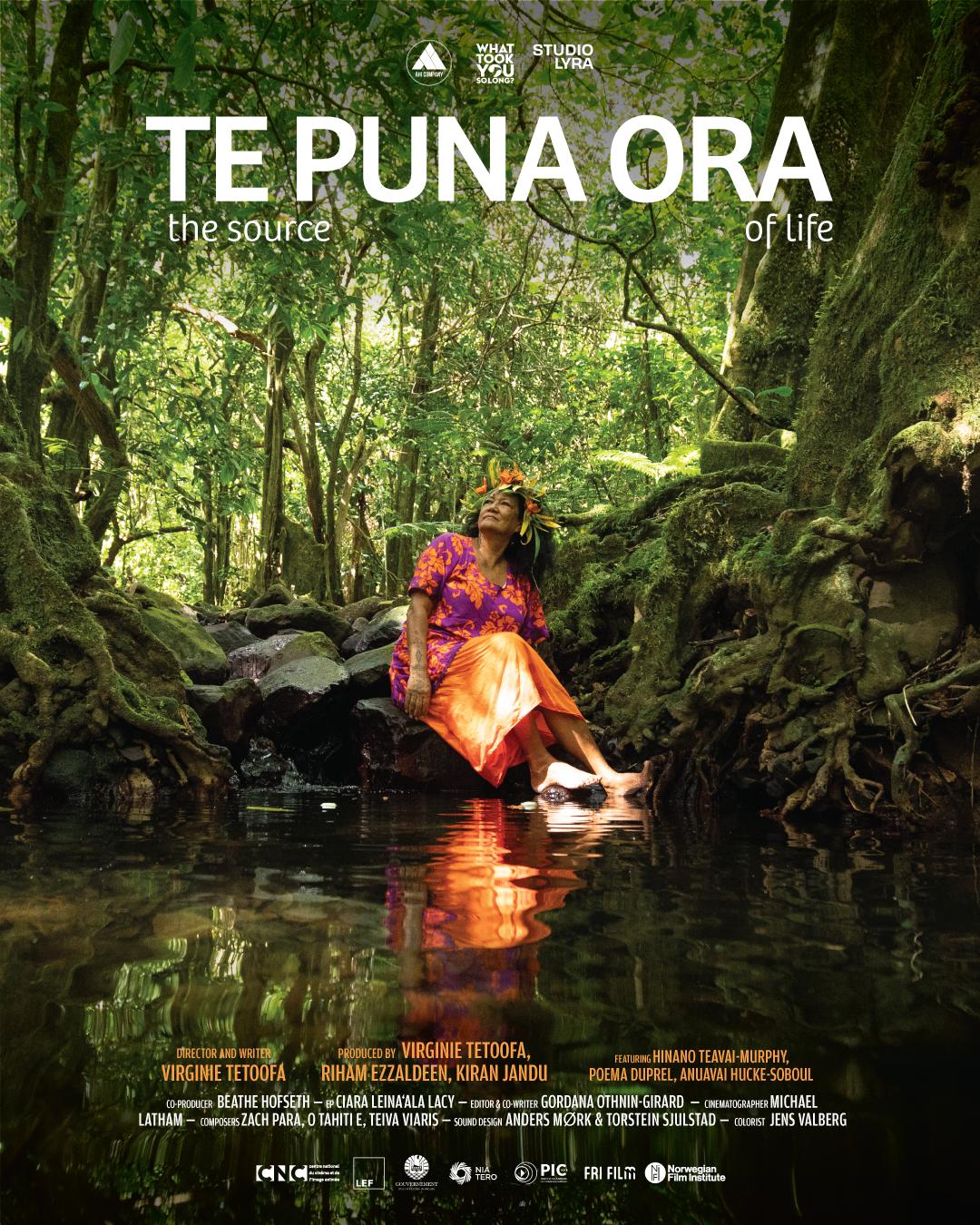 Likewise, the documentary “The Source of Life (Te Puna Oda)” at Native Tahitians dealing with the commodification of paradise. Yet unlike “Moloka’i Bound,” a fictional portrayal of struggle, “Te Puna Oda” is a more hopeful view of embracing culture and protecting an island homeland.
Three Tahitian women, Hinano Teavai-Murphy, Poema Duprel and Anuavai Hucke-Soboul, work to unite their community on Moorea Island against privatization. “The ocean is the most sacred temple for our people,” we are told. “It is the primary source of life since our ancestors time until today and this is what I am fighting for, our future generations.”
Directed by Virginie Tetoofa and scripted by Tetoofa with Gordana Othnin-Girard and Kiran Jandu, the documentary constantly reminds us of the lingering effects of colonization. The news is in French and they must speak in French. Yet the Tahitian language also survives in their private lives and within their community.
To give us greater understanding of the native culture, the documentary also dramatizes Maragai tribal world creation myth of Hina (Goenda Reea) and Ru (Marurai Robson).
More importantly, the film provides a depiction of real Tahitian women as something more than the exoticized models that men like artist Paul Gauguin presented. These women are not pliant and demure objects. They embrace their culture and use it to empower themselves in uniting their community and protecting their lands. While this might sound uncomfortably like a dynamic, but dry documentary, the cinematography under director of photography Michael Latham is poetic and that’s even with the mythical elements aside. Some of the images of the ocean are like a siren call to Moorea but unlike Gauguin’s paintings of a primitive paradise, these scenes are intimate revelations asking for respect.
While “Moloka’i Bound” is a slow-moving film about a population left out of paradise and marginalized by colonizing forces and a commodified culture, “Te Puna Ora” shows how embracing culture and raising concerns can prevail. Seeing these films in the same week provides a balance between mourning the loss of tradition and rising to a hopeful future through pride and cooperation.
“Te Puna Ora (The Source of Life)” premiered at the New Orleans Film Festival in October 2024. In English, French and Tahitian with English subtitles. The documentary was given a Special Jury Prize for Documentary Feature at the Los Angeles Asian Pacific Film Festival.
“Moloka’i Bound” had its world premiere at the Seattle International Film Festival in May 2024 where it was nominated in the New American Cinema Competition and Holden Mandrial-Santos received a Best Performance nomination. At the 2025 Los Angeles Asian Pacific Film Festival, it was given a Special Jury Prize for Narrative Feature. You can check out future screenings at the film’s official website: MolokaiBound.com. In English and Hawaiian, with English subtitles.
 Age of the Geek