Much has changed since the 1990s and Andrew Ahn’s “The Wedding Banquet” reflects that as well as his own heritage. Director Ang Lee’s “The Wedding Banquet” came out in 1993, premiering at the 43rd Berlin International Film Festival where it won a Golden Bear. The film also received Oscar and Golden Globe nominations. Now, 32 years later, with same-sex marriage legal in the US and Taiwan (2019) but not in South Korea or Japan, Los Angeles-born Ahn’s remake takes on love and marriage amongst East Asian Americans.
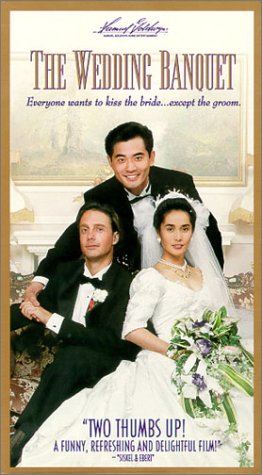 The Wedding Banquet (1993)
In the original film (which Taiwan-born Lee wrote with Taiwanese screenwriter and actor Neil Peng and Michigan-born James Schamus), a bisexual Taiwanese man, Gao Wai-Tung (Winston Chao), is living in Manhattan with his gay Jewish partner Simon (Mitchell Lichtenstein). Because his parents are in Taiwan, it’s easy to conceal his gay lifestyle but his parents are eager to see him married since he’s out of school and in his late twenties. Encouraged by Simon, Wai-Tung agrees to marry a poor young woman, Wei-Wei (May Chin), from mainland China so she can get a green card.
Unfortunately, when news of the impending wedding reaches Wai-Tung’s parents (Lung Sihung as Mr. Gao and Hua Ah-leh as Mrs. Gao), they decide to come and throw a lavish wedding banquet. Wei-Wei being both mainland Chinese and poor is a disappointment to the parents, but in the end (spoiler alert), she gets pregnant by Wai-Tung and although Simon is angry, Simon, Wai-Tung and Wei-Wei become a family and Wai-Tung’s parents get the grandchild they wanted. That’s a happy ending of sorts.
The Wedding Banquet (2025)
 Andrew Ahn’s remake takes place in contemporary times where same-sex marriage is legal, but not everyone is interested in taking the plunge into the marital pool. Los Angeles-born Ahn, the son of Korean immigrants, changes the cross cultural center of the film. While Ang Lee’s version was about a Taiwanese-Jewish gay couple in Manhattan who could not get married, the couple who are closeted to parental figures are a South Korean man, Min (Han Gi-chan), and American-born Chinese Chris (Bowen Yang). They live in the converted garage that belongs to Native American Lee (Lily Gladstone). Lee is happily unmarried, but in a committed relationship with Angela (Kelly Marie Tran). Angela and Chris know each other from college and even had an experimental drunken one-nighter. That hasn’t kept them from being friend.

With his college studies over, textile artist Min is being called home by his grandmother, Ja-Young (Oscar-winning Korean actress Young Yuh-jung). He proposes to Chris, but Chris has problems with commitment and adulthood. He’s put a pause on his own graduate studies and prefers to give birding tours.
When Lee and Angela’s second IVF attempt fails, Min proposes a green card city hall wedding in exchange for funding a third IVF attempt. When Min tells his grandmother via an internet face-to-face chat, he’s getting married, she insists on flying to Seattle and staging a traditional Korean wedding banquet.

What I love about the film is its mix of East Asian traditions, family at different levels of acceptance–including annoyingly supportive such as Angela’s activist and much lauded mother May (portrayed by Joan Chen), and the transformation of our society where there’s the possibility of a legal union. The ensemble is exceptional and their relationships well-nuanced. Yang’s Chris is a man nervous about reaching adulthood as signified by completing his academics or entering into a marriage with Han’s adorably sincere Min. Gladstone’s Lee is the most sure of her desires while Tran’s Angela has mother issues and hasn’t quite come to terms with becoming a mother. There is a predictability and some places could be tightened up. Some technical problems also mar this film such as shaky came where it makes no real sense.
To put things in perspective, it’s worth noting how things have changed in parts of Asia and the US. The US Supreme Court (Obergefell v. Hodges) pulled that same-sex marriage should be legal nationwide. Several states, including California (2008), had already legalized same-sex marriage. Massachusetts was the first state to do so in 2003.

Taiwan legalized same-sex marriage on 24 May 2019. South Korea does not recognize same-sex marriage, but the South Korean Supreme Court has ruled that same-sex couples can receive spousal benefits. In mainland China, same-sex marriage is not legally recognized. Homosexuality was decriminalized in 1997 and a few years later, in 2001, homosexuality was removed from the list of mental disorders. Limited legal rights for same-sex couples are available in Hong Kong, and some same-sex couples enter int legal guardianship agreements in order to have limited legal rights and benefits. Japan is the only G7 country (Canada, France, Germany, Italy, Japan, the United Kingdom, and the United States) not to legally recognize same-sex marriage but in March of this year the Japanese high court ruled that Japan’s refusal to legally recognize same-sex marriage is unconstitutional.
This version of “The Wedding Banquet” comes at a time when US general community acceptance of same-sex marriage is under threat so the remake is a timely reminder of where we’ve come and hopefully will allow some continued normalization of LGBTQ+ lives and loves. “The Wedding Banquet” premiered at the Sundance Film Festival in January of this year where it won the Sundance Institute/Amazon Studios Producers Award. The film will be released on 18 April 2025 in the US.
 Age of the Geek