
There’s a minimalist beauty to this Donmar Warehouse’s production of “Macbeth.” Starring David Tennant (“Doctor Who”) and Cush Jumbo (“The Good Wife”), the tickets for this West End (London) were doubtlessly much coveted. For those of us who couldn’t make the leap across the pond or otherwise missed out on tickets, this film is the next best thing.
Director Max Webster has cut the play down to just under two hours (1 hour and 54 minutes) while adding a few modern amusing interludes. The overall effect of the costume design and color scheme of black, grey and white and the bare sets is one of restraint and leanness, but the focus then becomes the lighting, quick transitions and the language. Under Webster’s direction, the rectangular stage suddenly becomes a banquet table and the audience then the background players in this drama. Exits and entrances involved walking amongst or near the audience and that reportedly, led to a delay in one December performance when “a disruptive audience member” was prevented from immediately returning to his seat.
The film of 2013 Kenneth Branagh production had beautiful imagery, taking advantage of the intimate confines of a deconsecrated Manchester church and history built into the very walls. As directed by Rob Ashford and Branagh, that version of the Scottish play, even on film for us overseas audience members, seemed warmed by the heat of the actors fighting against the cold of the stone walls. The gorgeous lighting emphasized the textures and the forbidding darkness. Modern audiences are too used to being bathed in light, but that wasn’t so in Macbeth’s time.
- Kenneth Branagh’s National Theatre Live ‘Macbeth’ (2013)
- ‘Macbeth’: Fassbender and Cotillard (2015)
- The Beauty and the Bias of Joel Coen’s ‘Macbeth’ (2021)
“Macbeth” has also been made into movies such as the 2015 (113-minute) film that used England and Scotland for location and starred German-Irish actor Michael Fassbender and French actress Marion Cotillard as the scheming couple.
In 2021, Denzel Washington and Frances McDormand were the Macbeths in a stylized black-and-white film: “The Tragedy of Macbeth.” Shot entirely on sound stages and directed and scripted by Joel Coen, in a rare solo effort, the film featured Kathryn Hunter as the Witches and an Old Man. Mary Zophres’ costume design added textured surfaces and the suggestion of ancient times of kings, castles and chaos.
Yet this Tennant-Jumbo led production is filled with bright lights (lighting designer Bruno Poet) and modern soundscapes. With svelte kilts and not a colorful tartan in sight (even though fans of Tennant know he can not only bring color, but sparkle and glitzy black tie to the tartan), the production makes us focus on the sounds. This is the first time I’ve heard the Scottish play with a Scottish accent. The Bathgate, Scotland-born Tennant unleashes the melody of Scotland upon the bard’s words. The effect is electrifying.
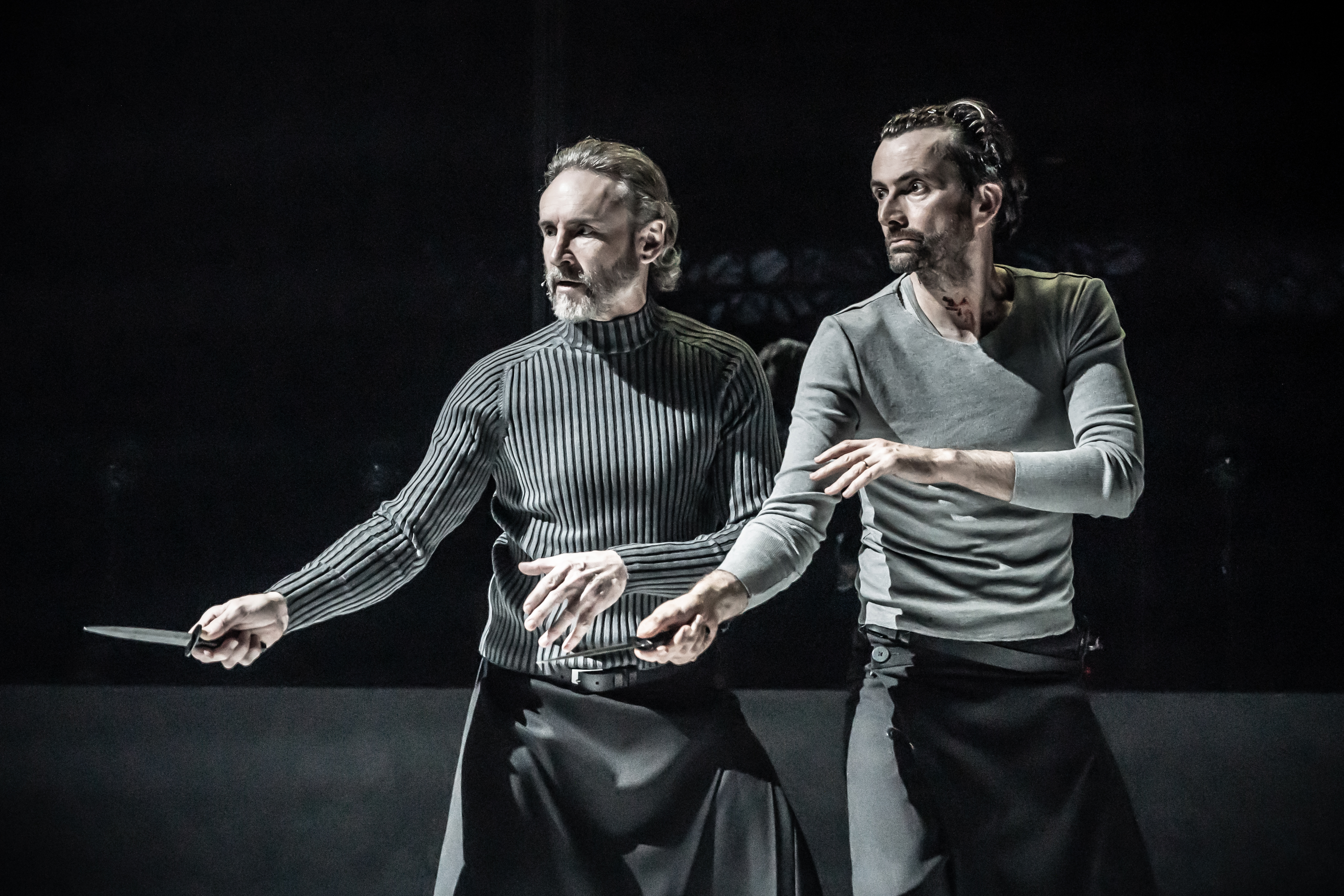
Macbeth begins as a faithful general, a thane (lord) serving King Duncan (Benny Young). Having defeated allied forces of Norway and Ireland in league with the traitorous Thane of Cawdor, generals Banquo (Cal MacAninch) and Macbeth meet witches who make predictions. Macbeth will be the Thane of Cawdor and soon king. Banquo will never be a king, but his descendants will include kings. Soon after the witches vanish, Macbeth learns he has become Thane of Cawdor.
King Duncan has a son, Malcolm (Los Watt), who has been named heir to his throne. Duncan unwisely decides to spend the night at Macbeth’s castle and, off-stage, Macbeth and Lady Macbeth murder the king, frame Duncan’s servants and then Macbeth murders them. Duncan’s two sons, Malcolm and Donalbain (James O’Sullivan) suspect treachery and flee, making them the prime suspects. Macduff (Noof Ousellam), having come to visit Duncan, begins to suspect treachery.
As Duncan’s next of kin, Macbeth assumes the throne, but Banquo is suspicious of Macbeth. And having killed twice already, Macbeth hires assassins to kill Banquo and his son Fleance (Raffi Phillips). Fleance escapes.
While that failure angers Macbeth, he can’t escape guilt. At a banquet for his lords, Macbeth sees Banquo’s ghost. Lady Macbeth, who doesn’t see the ghost, lies in an attempt to cover up his strange behavior. Soon enough, we will see that Lady Macbeth is haunted by guilt as her dreams are all nightmares.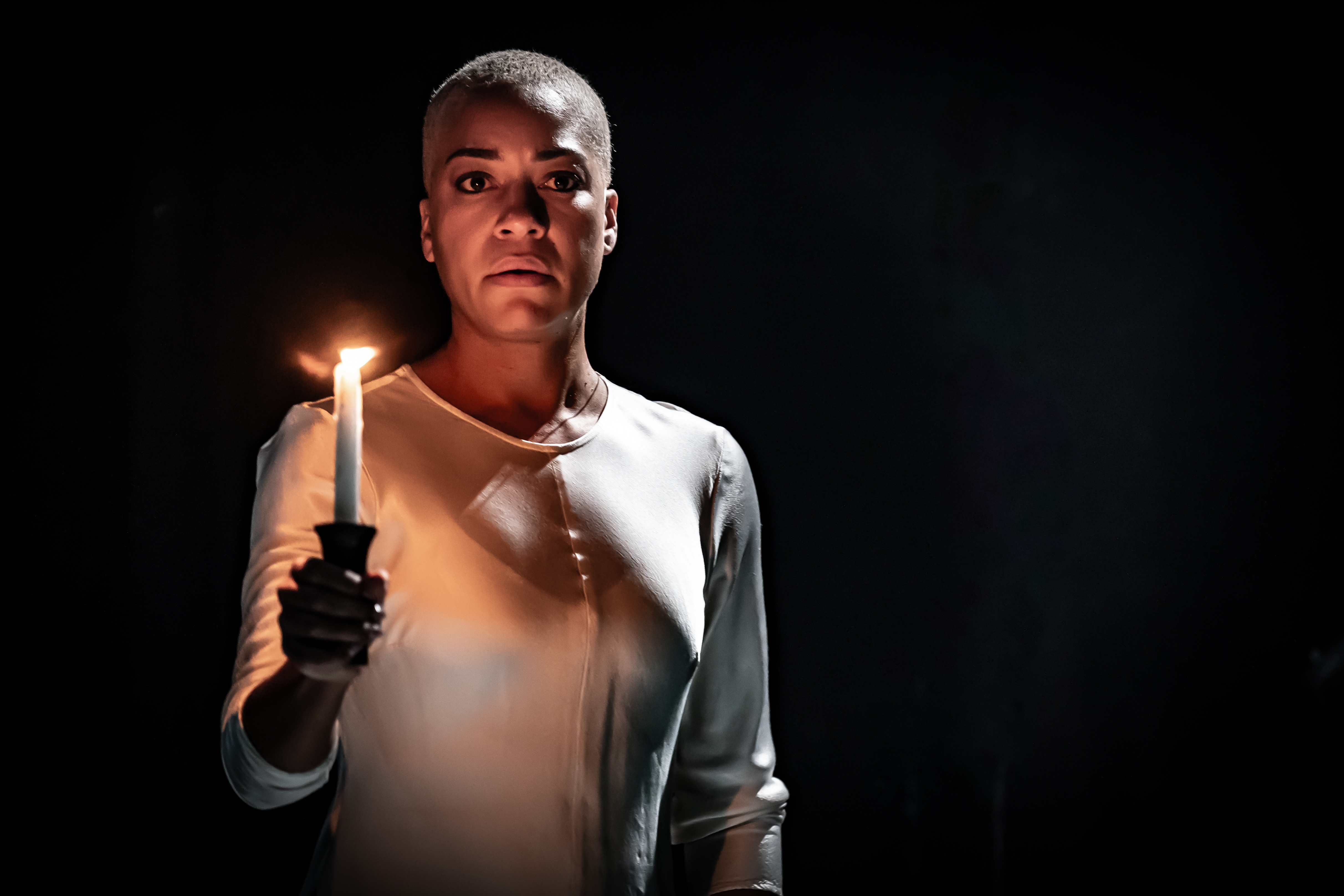
Macduff, who absented himself from the banquet, has gone to England to ally himself with Malcolm and help raise an army against Macbeth.
With the camera’s lens we are definitely at times in spitting distance from the actors. We feel the intensity of these machinations and in Macbeth’s final moments, the desperation and delusion explode. According to Playbill, the productions uses “binaural technology to create a 3D sound world, which the audience experiences through headphones, placing them inside the head of the central couple.” Director Webster worked with sound designer Gareth Fry and some of what we hear attempts to replicate this for the movie audience.
The aural experience is also enhanced by the live music from a Scottish folk band that features Gaelic singer Kathleen MacInnes. Composer and musical director Alasdair Macrae leads and conducts. There’s even a dance celebratory scene that Webster uses for contrast to the traitorous plans being made.
Tennant’s Macbeth is a man seduced by words that eventually delude him into believing himself invincible. He’s a man of wiry power and a bristling bravado. As his wife, Jumbo brings a more solid force of a woman uncertain of her position for she has brought no heir or spare to strengthen her status or assure her future. Clad in white, she isn’t the moral compass but the harbinger of death.
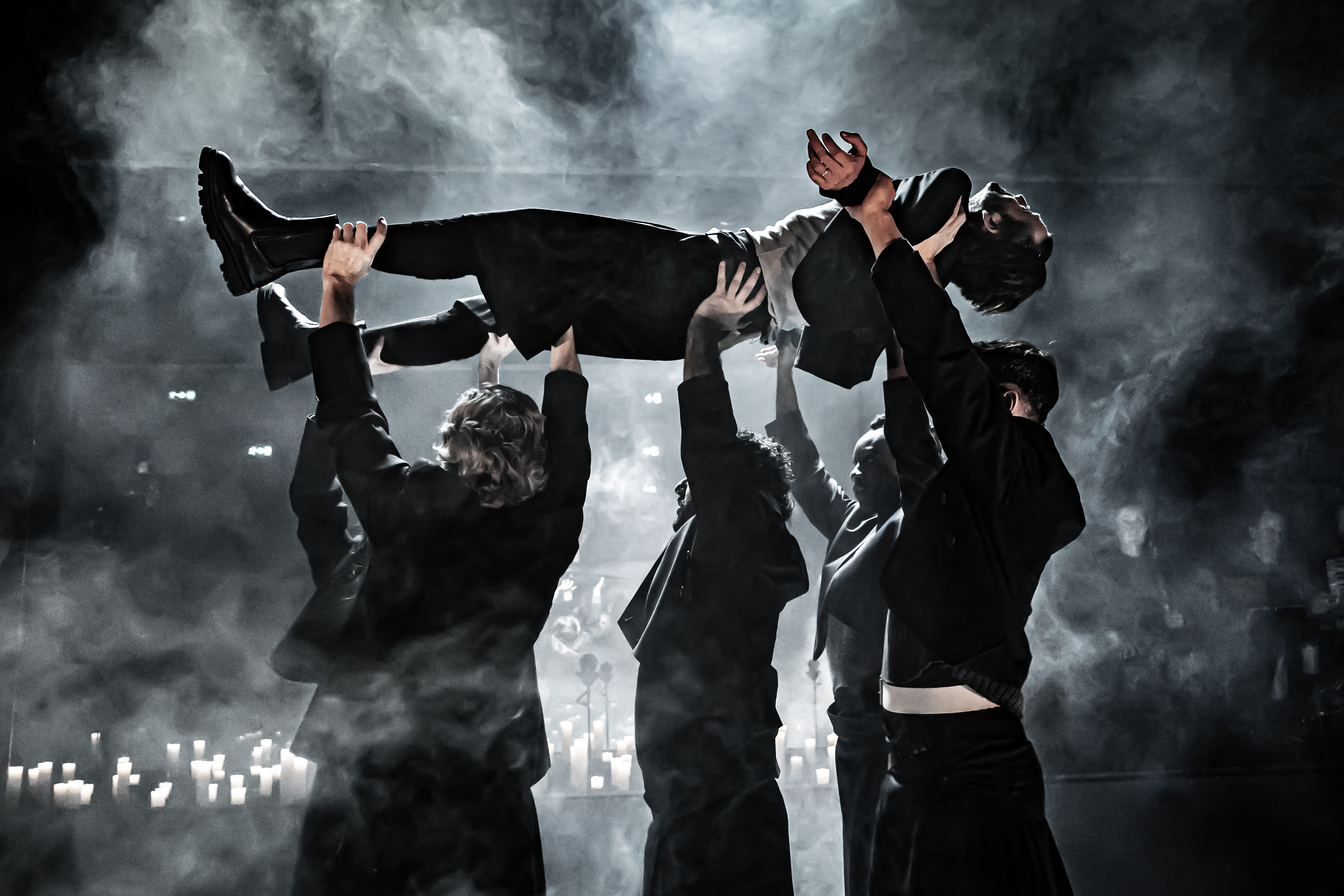 Many of the ensemble play more than one role (e.g. O’Sullivan is Donalbain, a soldier and one of the murdering assassins and a musician). Some of this switching emphasizes the grey morality of the play and the brutality of the times.
This isn’t Tennant’s first tangle with Shakespeare. He also played Hamlet in a Royal Shakespeare Company production that was also set to film in 2009. That was well received, yet in this version of ‘Macbeth,” Webster draws upon Tennant’s Scottish heritage and we have the melody of Scotland in both music and the utterances.
“Macbeth” will have a limited engagement at select movie theaters beginning 5 February 2025. For tickets and more information, visit MacbethDonmarCinema.com.
 Age of the Geek