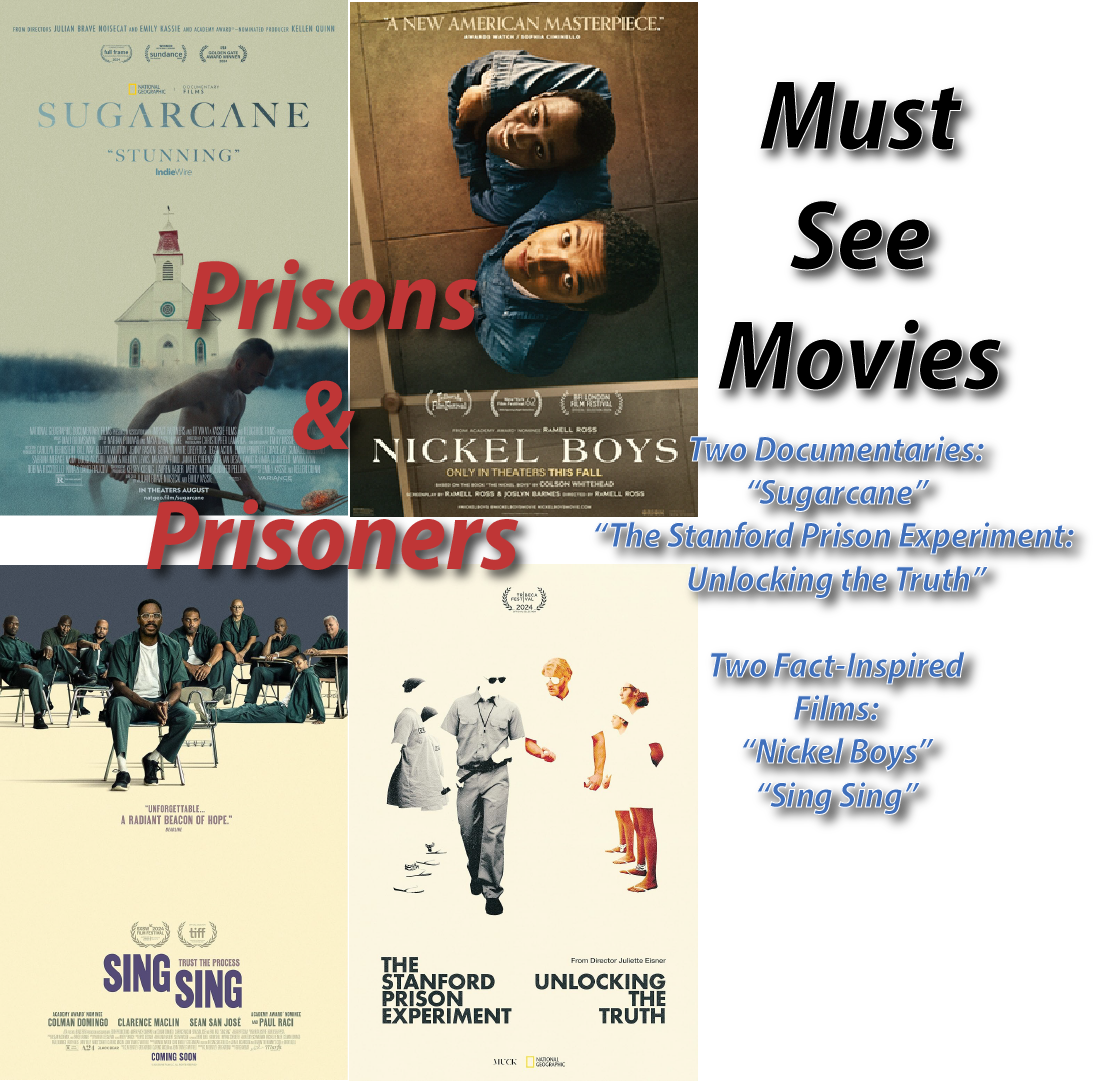
 What we think we know about prisons and prisoners, barring actual experiences, may be limited by our exposure to mass media. Recently, a 2024 documentary limited series indicated that the media and a media-savvy researcher misled the public perception of human behavior. One documentary, “Sugarcane,” and two fictional feature films, “Nickel Boys” and “Sing Sing,” take on the prison systems of the past and present. All are worth seeing and not just because of the subject matter.
Sugarcane and Residential Schools for Native Americans
“Sugarcane” is about the Canadian Indian residential school system, a network of boarding schools for Indigenous peoples that was funded by Canada’s Department of Indian Affairs, but administered by a variety of Christian churches.
The documentary film Sugarcane is about the residential school St. Joseph’s Mission which was near the Sugarcane Reservation of Williams Lake in British Columbia. In 2021, unmarked graves were discovered at the St. Joseph Catholic Church school. Chief Willie Sellars pushes for an investigation and there are survivors including Williams Lake chief Rick Gilbert who was part of a delegation to Vatican City.
The filmmakers Julian Brave NoiseCat and Emily Kassie have a personal connection to this tragedy. Co-director’s NoiseCat’s father, Ed, was abandoned there as a baby. Not all babies born their survived. NoiseCat was born in Minnesota, but raised in Oakland California. Kassie won a World Press Photo award in 2016 for her work on the DuPont’s chemical spill in West Virginia.
“Sugarcane” had its world premiere at the Sundance Film Festival where it won a Grand Jury award for directing. The film was given a limited release in the US and Canada on 9 August 2024 which expanded on 16 August 2024.
In Canada, schools operated in every province and territory except New Brunswick and Prince Edward Island. The last one closed in 1997. According to the Canadian Encyclopedia, the term residential schools, usually refers to schools established after 1880.
Residential schools were created by Christian churches and the Canadian government as an attempt to both educate and convert Indigenous youth and to assimilate them into Canadian society. However, the schools disrupted lives and communities, causing long-term problems among Indigenous peoples. The last residential school closed in 1996. (Grollier Hall, which closed in 1997, was not a state-run residential school in that year.) Since then, former students have demanded recognition and restitution, resulting in the Indian Residential Schools Settlement Agreement in 2007 and a formal public apology by Prime Minister Stephen Harper in 2008. In total, an estimated 150,000 First Nation, Inuit, and Métis children attended residential schools.
A similar system was in place in the US, including California. The ACLU website for Northern California includes it under “The Hidden History of Slavery in California.”
- Indian Boarding Schools (ACLUNC)
- Examining the Painful Legacy of Native American Boarding Schools in the US (3 August 2021, KQED)
- US Indian Boarding School History (Boarding School Healing)
- California Bears the Painful Scars of Native American Boarding Schools (23 November 2021 KCALNews)
According to the KQED article:
Three large Native American boarding schools operated in California: the Fort Bidwell Indian School, the St. Boniface Indian Industrial School in Banning, and the Sherman Institute in Riverside, founded as the Perris Indian School in Perris. A cemetery at the Sherman school contains the graves of students who died there and were not returned to their families, often due to lack of funds, according to the UUWS-CC.
In the US, the federal government still runs residential schools. According to the KCALNews 2021 article:
Today, only four federally run Native American boarding schools remain in the U.S. One is Sherman High School in Riverside. However, it has undergone a radical transformation.
Nickel Boys and the Dozier School for Boys
Colson Whitehead’s 2020 Pulitzer Prize-winning novel “Nickel Boys” was called “a spare and devastating exploration of abuse at a reform school in the Jim Crow-era Florida.” For this vivid adaptation, director RaMell Ross co-wrote the screenplay with Joslyn Barnes (“The Black Power Mixtape 1967-1975,” 2011), and both the novel and the film are inspired by the Dozier School for Boys.
The Arthur G. Dozier School for Boys operated in Marianna, Florida from 1 January 1900 to 30 June 2011. At one time, it was the largest reform school in the US. At the time of its closing, it was part of the Florida Department of Juvenile Justice. In 2012, a forensic anthropology survey began under the leadership of Erin Kimmerle of the University of South Florida. In 2016, Kimmerle gave a final report.
- Florida’s Dozier School for Boys: A True Horror Story (15 October 2012)
- Jan. 1, 1900: Notorious Dozier School for Boys Opens
- Florida’s Industrial Reform School System: Arthur G. Dozier School for Boys 1900 – Present (University of South Florida)
- Florida to Pay Millions to Victims of Abuses at Notorious Reform School (21 June 2024)
In the film, “Nickel Boys,” two different boys find their way into the Nickel Academy, a reform school. The film begins with Elwood Curtis (Ethan Herisse) who is being raised by his grandmother (Aunjanue Ellis-Taylor) in Tallahassee. Elwood shows interest in the Civil Rights Movement against Jim Crow laws, but in 1962, his grandmother worries that joining the movement would endanger Elwood’s life.
Although the US Supreme Court had decided that school segregation was unconstitutional (Brown v. Board of Education of Topeka, 1954), school desegregation wasn’t instantaneous.
While Rosa Parks refused to give up her seat to a White passenger in December (1 December 1955) in Alabama, in May of the next year (26 May 1956), two female students from Florida Agricultural and Mechanical University sat down in the “whites only” section of a city bus in Tallahassee. In 1960, students from Florida A&M University and others held a sit-in at Woolworth lunch counter in Tallahassee. In 1964, White and Black protesters waded into the pool at Monson Motor Lodge (18 June 1964). By 2 July 1964, then-President Lyndon B. Johnson signed the Civil Rights Act.
Elwood shows academic promise and one of his teachers gets him into a tuition-free program at a historical Black college.
On his way to the program, Elwood accepts a ride from a slick looking Black man, but the car is stolen. When the police stop them, Elwood is convicted as the man’s accomplice. As an underage criminal, he is sent to Nickel Academy. As with Dozier, Nickel Academy is segregated: The White students and the Black students have different accommodations and classes. As you might have guessed, the White students have better dorms, better food and better treatment. The school makes money hiring out their charges, particularly the Black students.
Although Elwood holds out hope because his grandmother has hired a lawyer, he makes friends with Turner (Brandon Wilson). Turner’s family seems to have forgotten about him and he’s cynical about his future, even after he ages out of the academy at 18.
Flashing forward, we meet an adult Elwood (now Daveed Diggs) who lives in New York City and owns his own business. News reaches him that unmarked graves have been discovered at the academy and evidence indicates the majority of the dead were Black. The adult Elwood is deeply disturbed.
If you’ve read the book, you’ll know how this ends. Even if you do, Ross and Barnes’ screenplay is sensitive and only suggests the abuse and deaths. As director Ross and cinematographer Jomo Fray (“All Dirt Roads Taste of Salt”) use camera angles to give us a more personal point of view. It’s both disorienting and touching. In the end, you have to mourn for all the bright minds and eager hearts lost to this horrific system.
“Nickel Boys” made its world premiere at the Telluride Film Festival 30 August 2024. It received a limited theatrical release by Amazon MGM Studios on 13 December 2024. The film has received nominations for the Golden Globes and the Critics’ Choice Awards.
Sing Sing
While the residential schools for Native Americans and the Dozier School are things of the past, prisons are not. A lot has changed since the 1960s and Greg Kwedar’s drama “Sing Sing” is about a real-life program in the infamous maximum security prison known as Sing Sing.
The Sing Sing Correctional Facility for men is operated by the New York State Department of Corrections and based in the village of Ossining. The name “Sing Sing” comes from the name of the Native American tribe, Sintsink, from whom the land was purchased in 1685 and was the original name of the village. Sing Sing, which is about 30 miles north of Midtown Manhattan, was first opened in 1826. In 1970, it was renamed Ossining Correctional Facility, but in 1985, it reverted to its old name. In 1996, Katherine Vockis founded the Rehabilitation Through Arts Program According to its official website, RTA currently operates in 10 maximum and medium security men’s and women’s New York State correctional facilities and…one in California.
The film follows the fictional John “Divine G” Whitfield (Colman Domingo) who discouraged that he’s in Sing Sing for a crime he didn’t commit finds himself encouraged by involvement in the RTA program. Guided by the theater director Brent Buell (Paul Raci), he discovers he has talent both as a playwright and performer. Preparing for a new production Divine G recruits the antisocial Divine Eye (Clarence “Divine Eye” Maclin) but once Divine G joins the group, he brings a dynamic which challenges Divine G. Divine G’s world crumbles into further chaos when an inmate with whom he was friends dies. Both of these “Divines” will help each other on their journey toward hope and the film shows us a way that prisons can help troubled men.
Kwedar and Clint Bentley based their screenplay on John H. Richardson’s “The Sing Sing Follies” and Brent Buell‘s “Break-in’ the Mummy’s Code.” Kwedar directs some of the former inmates and the film closes with footage from the RTA program featuring these actors performing in past productions at the facility.
After seeing “Sugarcane” and “Nickel Boys,” I felt a sense of despair. Does this senseless cruelty continue? If you take the original lessons from the Stanford Prison Experiment, you might feel this kind of inhumanity is unavoidable, inevitable. Yet having seen the new documentary on that experiment, I feel there’s an increased need for films like “Sing Sing,” ones that leave us with hope for imprisoned people finding solutions to make better lives when they get out.
“Sing Sing” premiered at the Toronto International Film Festival in 2023. It was released in the US on 12 July 2024. The film has won several festival awards and five CCA awards. Domingo is nominated for a Golden Globe.
 Age of the Geek