
I viewed Russian director Viktor Kossakovsky’s documentary “Architecton” along with the reunion film of Tom Hanks and Robin Wright, “Here” on the same day during AFI Fest 2024. Both are contemplations about place, human habitats and the hubris of living. Both are worth seeing although neither will leave one happy.
Architechton ⭐️⭐️⭐️
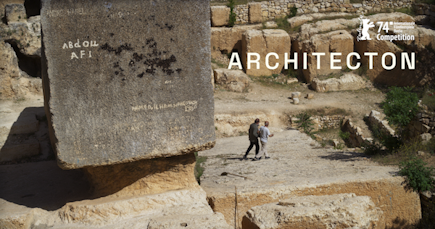 “There is something new within the sun today, or rather ancient,” the opening text, a quote from Italian poet Giovanni Pascoli, tells us. We will see both the new–ruins in Turkey following a 7,8 earthquake in 2023, and the old–ruins of a temple in Lebanon. What seems a small patch of grass, perhaps a lawn, turns out to be a small piece of beauty amid destruction. Once our view pulls out and we see that on either side are apartment buildings that are part deconstructed. Whole sides of the walls are down. From the things left behind, a TV or a sewing machine, it’s obvious that the former residents evacuated in great haste. What will become of these boxes of concrete? How will the rubble to returned to the earth?
Juxtaposition to these modern ruins are the large stones of a temple. We can marvel at how in ancient times the Temple of Jupiter constructed about 60 AD in Baalbek, Lebanon was made, something that is still unresolved by archeologists. Yet stones are different from concrete, metal and glass. They are natural elements.
In addition, Italian architect Michele De Lucchi is making a simpler monument, using natural elements. Will that survive past his lifetime? It’s hard to tell. Pascoli (1855-1912) was a classical scholar whose father was assassinated when he was 12, who was imprisoned after a protest and never married. The quote is from his poem, “The Kite” (L’aquilone). I found two translations of the poem.
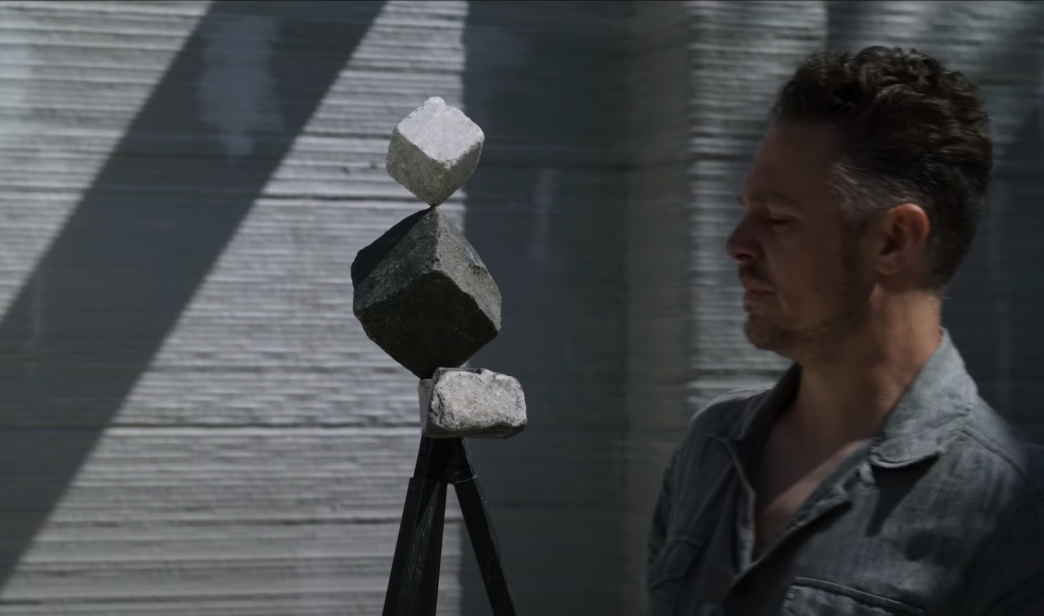 At times, there are a few rock balancing moments which always seem both magical meditative and suspenseful. This seems to play into the question of how as humans constructing a civilization do we find a balance with nature?
While concrete has been an important development for civilization as we know it, Kossakovsky’s documentary asks us to consider whether is really is a good solution to the problem of building. We think of the rise of civilization, but we must also consider the decline and fall. What happens then to the detritus of our lives. I can’t imagine them becoming as picturesque as the stone arches we’re shown.
Here ⭐️⭐️⭐️⭐️
In the US, we don’t often think of the past lives around us, particularly in newer houses. Yet the Robert Zemeckis film asks us to consider the events that occurred on a single spot of land that was destined to become a large living room with a view of a house where a famous founding father once resided. The film is a reunion of sorts, bringing Tom Hanks back together with Robin Wright and the director of the 1994 “Forrest Gump.”
Yet this is not a sequel to that film. How could it be? In the film, Wright’s Jenny Curren died before the end of the film, from some unknown disease, likely HIV/AIDS or Hepatitis C. “Forrest Gump” ended with Forrest, a widower, watching his son go to his first day of school.
Hanks and Zemeckis also collaborated on the musical fantasy film that tried to take Walt Disney’s 1940 animated feature film “Pinocchio” into live action. The Zemeckis-Chris Weitz scripting was painfully soulless, despite the Hanks’ aw-shucks warmth.
In “Here,” Zemeckis’ writing partner is Eric Roth, who wrote “Forrest Gump,” winning an Oscar for Best Adapted Screenplay. The film also won Best Picture, Best Director, Best Actor, Best Film Editing and Best Visual Effects. Roth also wrote last year’s “Killers of the Flower Moon.”
In order to gives us a feeling of the past and present existing as if at the same time, he uses several picture-in-picture frames so you watch scenes happening at the same time as if there was a screen of picture frame hung on the screen. If you like to concentrate on one images with an occasional intrusion of a split screen or half screen scene, this effect might bother you. I found it engrossing, but I also like watching two things at once and have worked with more than one computer screen at a time.
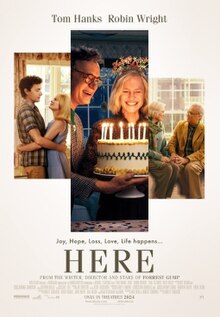 The main story is about Hanks’ character Richard Young and his family. His father Al Young (Paul Bettany) buys the house after returning from the war. His wife, Rose (Kelly Reilly), is expecting. Her first son is the troublemaker (Young Richard is played by Ellis Grunsell, Teddy Russell, Finn Guegan and Callum Macreadie at different stages.). As a young man, he gets into more trouble–his girlfriend Margaret is pregnant and they must marry. His and her future plans have to be delayed and are soon pushed aside by more pressing concerns. Richard will not study art; Margaret will not study law.
That space that is the living room was where an Indigenous man (Joel Oulette) courted, lived and parted with his wife (Dannie McCallum). Much later, a woman, Mrs. Harter (Michelle Dockery) worries about her husband John’s (Gwilym Lee) obsession with flying airplanes. An inventor (David Fynn) makes his big discovery tested in that very living room wit his gal (Ophelia Lovibond).
At times I questioned the gender-related sensibilities: Would a woman really dress and do those things before a large open window that faces the street? Even though I could feel the huge oppression that Wright’s Margaret feels, constantly being in close quarters with her in-laws despite how roomy that house is by Los Angeles standards. While we see Richard’s family grow old, less attention is paid to the African American family (Nicholas Pinnock as the father, Nikki Amuka-Bird as the mother and Cache Vanderpuye as their son).
The de-aging process used on both Hanks and Wright didn’t bother me, but I’ve sat through kabuki and odd small equity-waiver plays where men played women, sometimes quite effectively. I’ve also spent decades cringing while watching White people play non-White people.
I haven’t read the 2014 graphic novel by Richard McGuire that this is based on. Although the house that becomes the home for two generations of the Young family isn’t a concrete monstrosity, watching these two films together, made me think of every space where I lived and the possibilities of what came before and what will be left when I am gone. I wondered if all the worries of a lifetime are for naught or if they serve a good purpose and what joys we have and if, in the end, what we lost shall ever be found. I enjoyed the usage of frame-within-frame, which in someways reminds me of how plays can have two realities going on at once (e.g. the 1993 Tom Stoppard stage play, “Arcadia,” Scene 7).
There’s moments of joy and moments of regret built both films and as we each move forward in time, it’s worth thinking about our place, our here and what will be left behind. Some people may feel that time and place are linear, but others may feel the impact of history. These films are for the latter and I hope more people will consider incorporating picture-in-picture frames going forward.
“Here” premiered at AFI FEST on 25 October 2024. TriStars through Sony Pictures released the film into US theaters on 1 November 2024.
 Age of the Geek