From the beginning of the Japanese animated feature film, “The Colors Within,” we’re entering a strange world and that’s not because the dialogue is in Japanese, but because it starts with a child praying to God. A young girl prays that she will learn to accept the things she cannot change.
 “The Colors Within” about the formation of a band seen through the eyes of Totsuko Higurashi (Sayu Suzukawa), a third-year high school student who has a special power: She sees people in different colors. “There are colors I feel more than see.” When she sees a popular student Kimi Sakunaga (Akari Takaishi), she perceives as a “pretty color” (きれいな色). In the film, the color is depicted as a light blue. When Kimi drops out of school, Totsuko hears that she is working at a bookstore and searches until she finds her. By chance, a young boy their age called Rui (Taisei Kido) also chances by and asks the two girls if they are members of a band. On Totsuko’s impulsive initiative, the three form a band. With the help of a young sister (Rui Aragaki), Totsuko and Kimi align their actions and their music with their faith.
Christianity in Japan
In the US, the thought of a young girl living away from home in a dormitory at a Christian school might not be so unusual. However, this animated feature is set in Japan.
Statista notes that in 2021, 48.6% of the Japanese population was Shinto, 46.4% were Buddhist, but only 1.1% were Christian. Compare that to the US “self-described religious identification of the adult population” in the US in 2023. While the largest group were unaffiliated (27.5%), 13.4% were White evangelical Protestant, 13.3% were White mainline Protestant and 12.2% were White Catholic. Hispanic Catholic were 8.2%, Black Protestant were 7.7% and Hispanic Protestant were 4%. Then the Jehovah’s Witness were 1.2% and Mormon 1.5%. In the US, to be Christian is to be part of such a large group that it is further divided and differentiated.
In the US, Jewish were 2%. Buddhist, however, were only 0.7% (as were Muslim).
Buddhism has different sects and there were historic conflicts between Shinto and Buddhism and within Buddhism. The Christianity in Japan has a shorter history that is still centuries long and filled with sacrifice and tragedy and shows how some people had enough faith to survive for centuries in secretive worship.
Part of this is portrayed in the adaptation of Shūsaku Endō’s 1966 novel, “Silence.” That was a joint film, made by the US, Taiwan, Mexico and the UK. The screenplay was written by Jay Cocks and Martin Scorsese. Scorsese directed while Andrew Garfield and Adam Driver starred. The Japanese case included Tadanobu Asian.
Christianity, in this case, Catholicism, came to Japan through Spanish missionaries such as Jesuit priest Francis Xavier (1506-1552). Hideyoshi Toyotomi (1537-1598) banned Christianity in 1587. Of course, it wasn’t just the missionaries. His successor, Ieyasu Tokugawa at first allowed Christianity, but in 1612, banned it. But he also instituted an isolationist foreign policy that closed off Japan from 1603 to European countries except for the Dutch. The policy, sakoku (鎖国), was lifted in 1868 and ban on Christianity was lifted in 1873.
- The Japanese Christians Forced to Trample on Christ (23 November 2019)
- Driven Underground Years Ago, Japan’s ‘Hidden Christians’ Maintain Faith (11 October 2015)
Yet for context, one must remember that the judicial institution known as the Spanish Inquisition “lasted between 1478 and 1834.” The Inquisition led to the exile of the Spanish Jews and the suppression of Muslims by religious figures such as Francisco Cardinal Jiménez de Cisneros according to Britannica. The Spanish Inquisition was introduced to the Netherlands, Belgium and Luxembourg in 1522 by the Holy Roman Emperor Charles V. In the so-called Low Countries, the goal was to “wipe out Protestantism,” yet that was unsuccessful. John III of Portugal also introduced a similar tribunal to harass the Portuguese Jews in 1536, with the blessing of Pope Paul III.
For the contemporary setting of the film, “The Colors Within,” being Christian is to be an outsider.
Colors in Japan
While in Japan and the US different languages give colors different names, we perceive colors the same–apples are red and leaves are green and fish can be blue. Yet in the US, there’s a strong association of pink with women and girls and blue with boys and men. That hasn’t always been true and it is not universally true.
Students of Japanese will confront the blue-green problem. In Japan, the green light is “ao” which is usually used for “blue” as in a blue sky or aozora (青空)while “midori” is usually “green.”
In the US as in Europe, red has associations with the devil and anger. Satan has been portrayed as a red horned satyr and the 2015 Disney animated feature depicts anger as red (and masculine). Yet the pope’s robes are red. King Charles III is depicted in red in his first official portrait since the coronation.
- Symbolic Colors in Japan: The Meaning Behind Different Colors (5 January 2020)
- Colors of Japan: Literature Comes to the Table
According to an article on the AsianStudies.org website, “a variety of symbol systems makes appearances in food design for special occasions” such as the New Year celebration that that includes “an auspicious pairing is red and white (also seen in contests, where red is typically associated with the female and white with the male).” Yet for the Boys’ Festival which is not the national holiday “Children’s Day,” the colors are red, black and purple while the Girls’ Festival is associated with pink, yellow and green.
Red is also a color of celebration in Japan and other parts of East Asia.
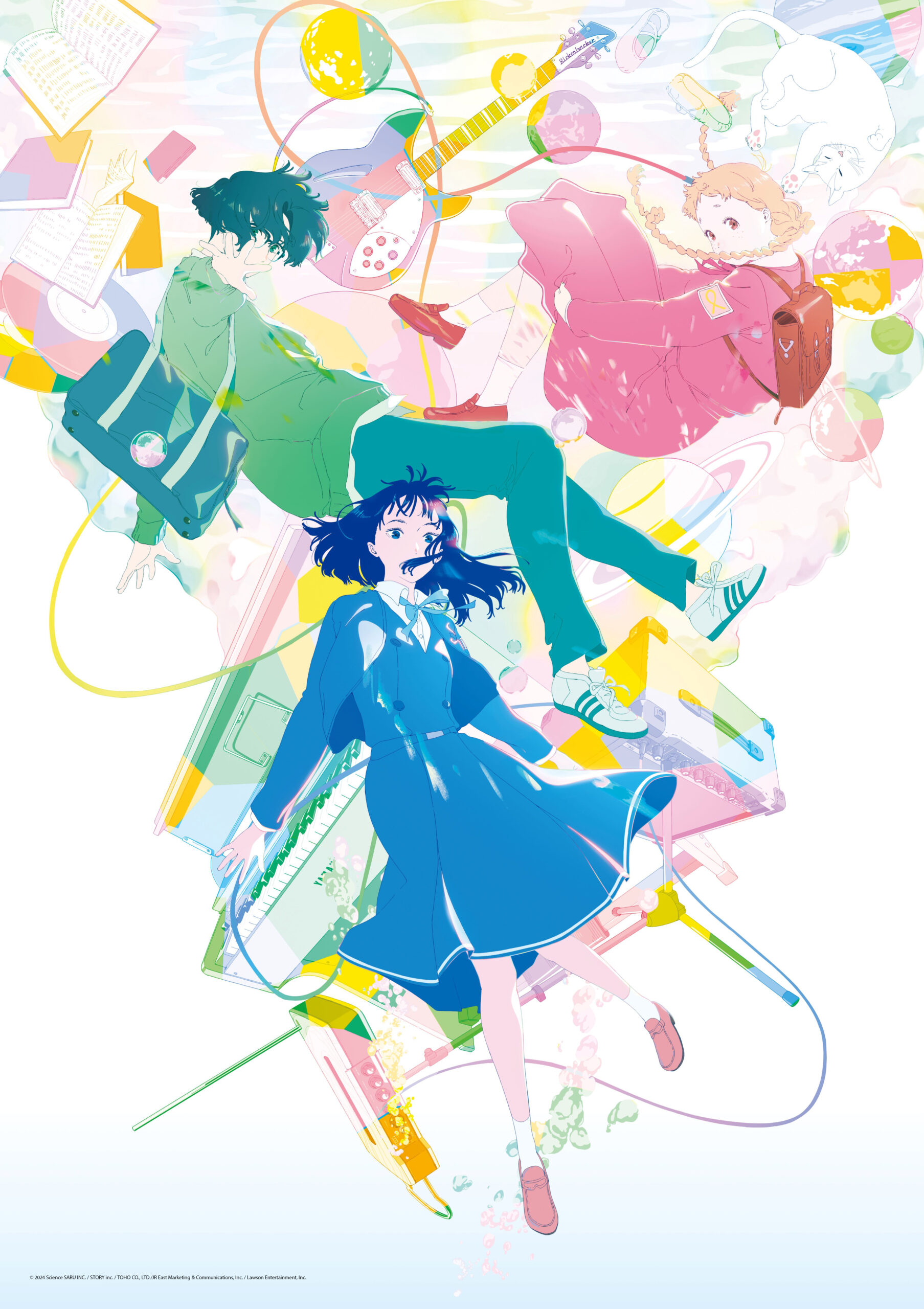 When Totsuko sees Kimi, she sees her color waves as blue. From the poster illustration, we see that Totsuko is red and Rui is green.
The actual title of the film in Japanese, is “Kimi no Iro” (きみの色). Kimi is the name of one of the characters. While Kimi is the name of one character, it also means “she” and can mean “she” in a more intimate sense such as a girlfriend or wife.
- 日暮トツ子(ひぐらし トツこ)
- 作永きみ(さくなが きみ)
- 影平ルイ(かげひら ルイ)
Looking that the names of the other characters, what is notable is that the first names Totsuko and Rui are spelt out in katakana, a syllabary usually used for foreign and onomatopoeic words. Kimi is written using the hiragana syllabary.
The last name “Higurashi” means sunset. The last name “Sakunaga” means “make eternal.” The surname “Kagehira” means “shadow” and “flat” or “peaceful.”
- The names of the nuns are interesting. The characters used for Sister Hiyoko mean “day,” “good luck” and “child.” The “ko” is often used at the end of girls/women’s names. However, there is a Japanese word, “hinoko,” using the hiragana syllabary which means “chick” like “a young bird.” The other nun, Sister Juri, has characters which mean “tree” and “village” but the homophone “juri” (受理) can mean acceptance.
- シスター日吉子(シスターひよこ)
- シスター樹里(シスターじゅり)
The Colors Within
What I like about this film is the beautifully detailed three main characters and that the two principal female characters, Totsuko and Kimi, are not trying to define themselves through romantic loves (although the character 色 can imply love or sensual pleasures), but are wrestling with ideas of self-worth and ethical actions, particularly how it relates to their love of music. My husband was surprised that rock music could be linked with the Christian faith, but there is a genre called Christian rock and even a 24-hour Christian Rock internet radio station, but that’s here in the US. This is essentially about a minority by faith trying to define themselves through their faith with music.
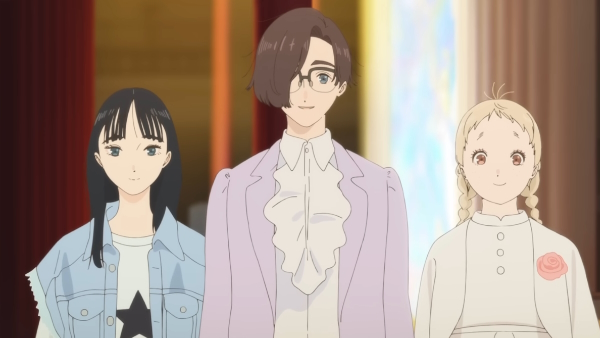
Director Naoko Yamada mentioned why it was important for Rui to have glasses, her reasoning was that he was studious. Her character designer objected because eyeglasses are hard to draw. She also noted how the character designer made their silhouettes distinctive.
 One thing I noticed is that Kimi’s eyebrows where thick, something both unusual and not considered classically beautiful although her mouth is small (something that China and Japan typically saw as attractive).
I myself am not Christian, so there may be deeper meaning in the Bible references.
“The Colors Within” had its world premiere at the Annecy International Animated Film Festival on 10 June 2024. It was released in Japan on 30 August 2024. The film will be released on 13 December 2024 in Los Angeles for awards eligibility and then again on 24 January 2025. In Japanese with English subtitles.
 Age of the Geek