National Geographic’s ‘Erased: WWII Heroes of Colour’ Is Informative But Dull
Narrated by executive producer Idris Elba, whose grandfather fought in World War II, National Geographic’s “Erased: WWII Heroes of Colour” consists of four episodes (“Dunkirk,” “Pearl Harbor,” “D-Day” and “Battle of the Bulge”) that attempt reveal the history of non-white soldiers. While the opening promises to cover Black, Indian and Asian soldiers, Asians are not present at all (outside of Asian Indians). Overall, the series, which uses archival footage and dramatizations, is repetitive, slow and clunky. Much better is the documentary “The Real Red Tails” which gives an intimate history of the Tuskegee Airmen while looking into the causes of one of the casualties during a training exercise.
Dunkirk:
World War II began at different times for different countries and the Battle of Dunkirk or, in French, Bataille de Dunkerque, was both the defense and evacuation of British and Allied forces to the UK from 26 May to 4 June 1940. The US would not officially enter the war until December 1941.
Dunkirk is located in Northern France about six miles from the Belgian border. It this the third largest French harbor.
Amidst the chaos of Dunkirk and the advancing German army, one little-known Indian regiment fights for victory and independence.
This episode reveals the gripping story of Force K6, a little-known Indian regiment of mule handlers in WW2, with one unit destined to be pivotal in evacuating Allied forces at Dunkirk. Other units who were stranded or captured in Nazi-occupied France had to find ways to escape to safety. Later, their wartime experiences fed the fight to end nearly 200 years of colonial rule in India.
Captain Anis Ahmad Khan served courageously in Dunkirk and spent nearly four years as a prisoner of war – the longest of any Indian officer in WW2. (Family of Anis Ahmad Khan/Zeenut Ziad)
The re-enactments tells the story of these men through their own words along with interviews of the descendants. This is the general format for all four episodes, some including archival recordings of the soldiers. The episode features descendants of Maj. Akbar Khan (his great-grandson Syed Hashmi of Massachusetts and his grandson Shahid Khan of Pakistan), Maj. Gen. Anis Ahmad Khan (youngest child Zeenut Ziad of Pakistan), and Naik Chaudry Wali Mohammad (son Mohammed Zubair of the UK).
The Indian soldiers belonged to the 25th Animal Transport Company, who had travelled 7,000 miles (11,265 km) with their mules to help the British army. All but four of them were Muslim.
This, of course, is interesting to me because involves not vehicles, but beasts of burden (mules), but we’re more interested in the men and not the animals. This is not the only place the Indian Army fought during World War II.
A composite image shows Major Akbar Khan next to actor Jack Gill portraying him in a WW2 historic reenactment scene for “Erased: WW2’s Heroes of Color.” Major Akbar Khan was the most senior Indian in the British Army during WW2 and a member of Force K6, a little known Indian regiment of mule handlers. Amidst the chaos of Dunkirk and the advancing German Army, the Indian regiment fought for victory and independence. (National Geographic)
The Indian Army also fought in Ethiopia and other parts of Africa as wells in what was then called Burma against the Japanese forces.
The episode looks at the 300 men who were mule handlers, but not the 40 Gurkhas (Nepali and Indian Gorkha) battalions that fought in the desert, Italy, Greece, Malaysia, Singapore and Burma. According to the National Army Museum, most of the Gurkhas were Hindu or Buddhist. The Gurkhas were involved in the Battle of Monte Cassino which is mentioned below.
It’s worth bringing up the Gurkhas and other Asian Indian troops because the episodes about African Americans could have focused on the Red Ball Express truck drivers and cargo loaders.
While the “Pearl Harbor” episode focuses on Navy service workers, this is for the specific battle and sudden heroics.
Yet the breadth by which the Indian troops were involved and why the fighting was in Africa show just why this was a World War and how things got messy in North Africa and West Asia.
Director Daniel Dewsbury won the 2020 BAFTA Breakthrough Brit Award and has been nominated for eight BAFTAs, most recently for the biographical feature documentary, “Hatton.”
“Dunkirk” premieres June 10 at 9/8c on Nat Geo, and streams June 4 on Disney+ and Hulu.
Pearl Harbor
Idris Elba reveals how three Black sailors defied the odds and miraculously survived the attack on Pearl Harbor and an oppressive, segregated Navy.
This episode tells the story of three Black sailors who not only miraculously survived the attack on Pearl Harbor but also saved countless lives. Working as messmen below deck on segregated ships, hundreds of Black sailors fought for their lives as Japanese bombs hit, with some performing incredible acts of heroism. It took years before many of these men were properly honored after their return.
Mess attendant Doris Miller (played by Abdul Sulaiman) is pictured in a WW2 historic reenactment scene for “Erased: WW2’s Heroes of Color. The series tells the stories of three Black heroes who miraculously survived the attack on Pearl Harbor. One of these men, mess attendant Doris Miller, defied racial stereotypes when he shot down enemy planes during the attack. (National Geographic/Seye Isikalu)
As you can imagine, one of those three is Doris “Dorie” Miller.
Besides Miller, mess attendant Clark Simmons and Frank Bland are mentioned and their descendants include Simmon’s eldest grandchild Erika Bethea, son and daughter-in-law of Bland Frank and Irene Bland and Miller’s great-grandnieces Desiree and Salena Miller.
Director George Amponsah is a BAFTA-nominated filmmaker whose recent works included the BBC 90-minute film “Black Power,” and the six-part trans-Atlantic slave trade documentary “Enslaved.”
George Bland is seen in close-up portrait. “Erased: WW2’s Heroes of Color” tells the stories of three Black heroes who miraculously survived the attack on Pearl Harbor. One of these men is George Bland, who served as mess attendant on the USS West Virginia. (The Family of George Bland/Frank Bland)Clark Simmons is seen in close-up portrait. “Erased: WW2’s Heroes of Color” tells the stories of three Black heroes who miraculously survived the attack on Pearl Harbor. One of these men was Clark Simmons, who served in the US Navy as mess attendant on the USS Utah. (Family of Clark Simmons/Claudette Simmons)
Miller, of course, hasn’t exactly been forgotten. Schools have been named after him. Ships have been named for him such as the (USS Miller (FF-1091) and the USS Doris Miller (CVN-81). He was portrayed by Elven Havard in the 1970 film “Tora! Tora! Tora!” and by Cuba Gooding Jr. in the 2001 “Pearl Harbor.”
Yet if you’re in the Pacific, you probably want to look at Asian and Pacific Islanders. There were plenty of heroes such as the first US-born World War II flying ace (Chinese American Arthur T. Chin of the Chinese Air Force in 1937) or the Hawaiian-Japanese hapa National Guard who captured the first POW of World War II (David Mekaele Akui). Akui would go on to be a member of Merrill’s Marauders, but would not be portrayed at all in the 1962 film, “Merrill’s Marauders.” Neither would the fourteen Japanese American Military Intelligence Service translators assigned to the unit (including Military Intelligence Hall of Fame inductee Roy Matsumoto of Laguna, California).
When I asked my husband who was born and raised in Hawaii, he was familiar with Doris Miller’s story, but not with Akui or the Merrill’s Marauders. The Hawaii National Guard did have people of Japanese descent and they were “segregated” after the bombing of Pearl Harbor.
This was the case for Mitsuo “Ted” Hamasu. Hamasu was stationed in Hilo when Pearl Harbor was attacked. These former National Guard members would form the 110th Infantry Battalion which would become part of the 442nd. These are stories that are probably less well-known that that of Doris Miller.
There is a Pacific-Asian connection to mess men because Filipinos, who have a long history in the US Navy and a shifting national identity (Spanish to US national to Philippine National), were often assigned to work as stewards. According to one source, Filipinos were also recruited as “mess boys” since 1898. So this episode left me wondering about how the US Navy’s segregation actually worked and if there were any Filipinos on board the ships that sank during the attack on Pearl Harbor.
With Filipino World War II veterans still fighting for recognition of their history, service and for benefits, the Filipino veterans would seem worth focusing on, particularly with the connection to Pearl Harbor and the demographics of Hawaii then and now.
When we remember Pearl Harbor, we should also remember the bombing of the Philippines on what was 8 December in Manila, but still 7 December in Hawaii.
“Pearl Harbor” premieres June 3 at 9/8c on Nat Geo, Streams June 4 on Disney+ and Hulu
D-Day
Private Henry Parham is seen in close-up portrait wearing his military uniform. Private Parham served with the 320th Barrage Balloon Battalion on D-Day. (Linda Hervieux)
Idris Elba unearths the stories of three men of the 320th Barrage Balloon Battalion, who landed in Normandy on D-Day and helped to liberate Europe.
In this episode, we unearth the hidden heroes of the 320th Barrage Balloon Battalion who helped liberate Europe. These American soldiers were the only all-Black combat unit to fight on the D-Day beaches. After valiantly serving their country, they returned home, hoping for the Civil Rights Movement to secure change, only to find a country where their heroics in France were quickly forgotten.
William Dabney (pictured here in an undated photo) served in the 320th Barrage Balloon Battalion on D-Day. (The Family of William Dabney/Vinnie Dabney)
The relatives of Corporal William Dabney (wife Beulah Dabney and their son Vinnie) and Waverly Woodson (wife Joann Woodson and their son Stephen) are interviewed. Shine Brown produced the BBC’s “Fight the Power” series.
This episode takes us back to Europe for the 6 June 1945 Normandy Invasion. While this series emphasizes that the US military troops were segregated, this was only partially true. The website WWIIMemorialFriends.org notes:
While portrayals of D-Day often depict an all-white male cast, the invasion force in fact included men and women from a diverse set of backgrounds, and each of their roles was no less essential. Some minority troops, including Chinese Americans and Hispanic Americans, served in military units alongside white service members, while African Americans served in segregated units. Women, meanwhile, served in the Army or Navy Nurse Corps or in the Women’s Army Corps, each of which had huge roles to play in the operation.
Medic Waverly Woodson Jr. and actor Ishmel Bridgeman appear in a composite portrait created for a WW2 historic reenactment production featured in “Erased: WW2’s Heroes of Color.” Waverly Woodson Jr. was a combat medic who served with the 320th Barrage Balloon Battalion on D-Day. (National Geographic)
Of the two segregated US troops–the all-black Anti-Aircraft Garage Balloon Battalion and the Comanche tribe Code Talkers, I think there is less known about the latter.
Moreover, since the episode on Pearl Harbor decided to focus on three African American soldiers, it would have seemed more balanced to take on another ethnic/minority group here.
For the fourth episode, we remains in Europe for the “Battle of the Bulge” and the original Black Panthers.
The original Black Panthers, an elite Black tank unit, push back Hitler’s final advance. Their war experiences later inspired civil rights movements.
This episode explores the untold story of the Black Panthers, an elite African American tank battalion. Unseen diaries and rare interviews chart the unit’s action through France, Belgium and Germany, including in the bloodiest American battle of WW2: the Battle of the Bulge. Their experiences inspired not just the fight for civil rights in the U.S. but also battles for freedom worldwide.
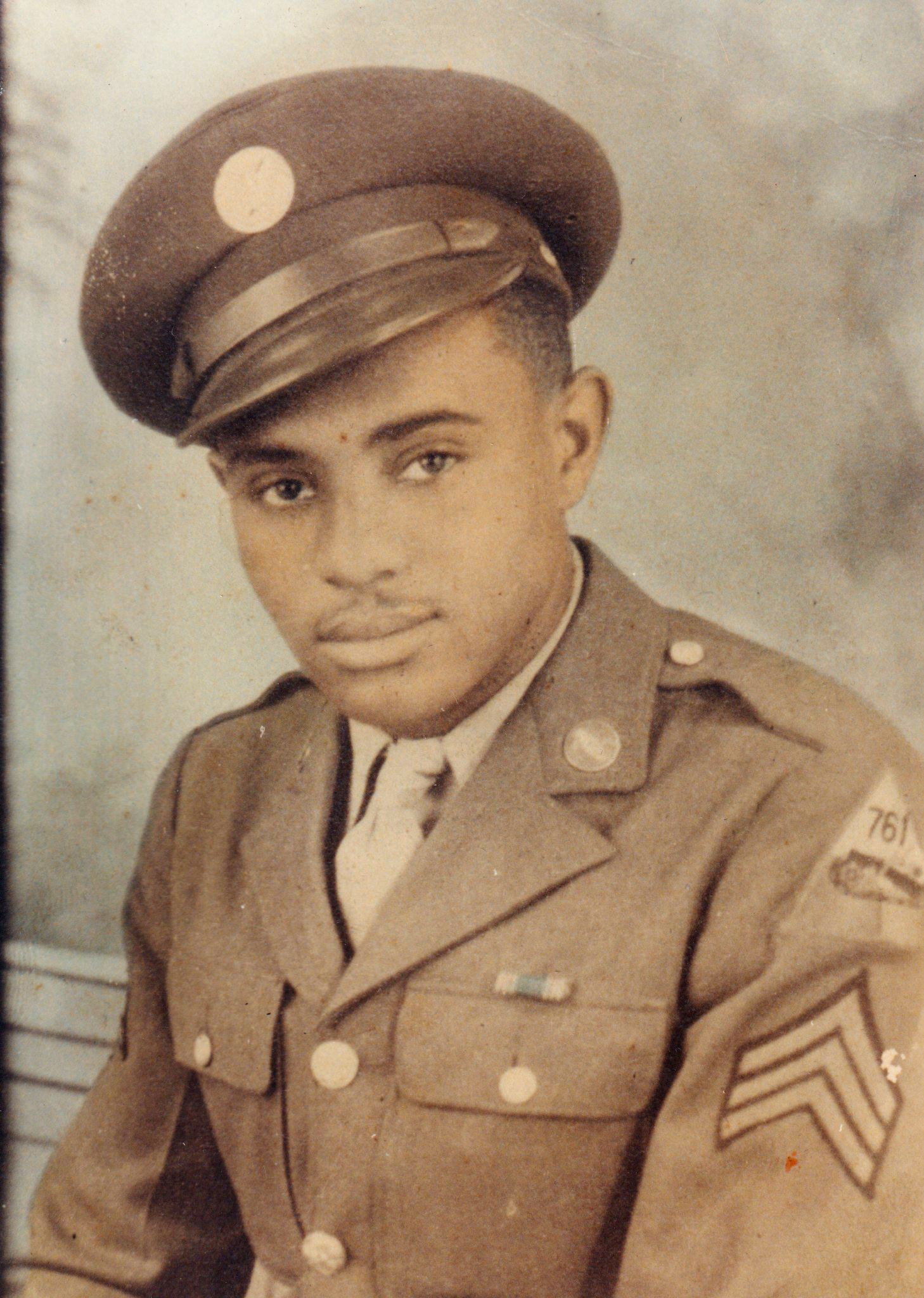
Staff Sergeant Johnnie Stevens was a tank commander who served with the 761st Black Panther Tank Battalion in WW2. (The Family of Johnnie Stevens/Doreen Stevens)
Of course, with both a Marvel character and a political group called Black Panther, this episode is great history, but not necessarily news.
This episodes includes interviews with the descendants of E.G. McConnell of the 761st Tank Battalion (daughter Carole Johnson) Cpl. Floyd Dade (daughter Shauna Siah) and Staff Sgt. Johnnie Stevens (daughter Doreen Stevens).
But that means the this first season is looking at African Americans in three out of the four episodes with only “Dunkirk” about Asian Indians, who were once also considered Black (as in “Little Black Sambo”). And with Elba as the executive producer and narrator, this is troubling. Moreover, there are all-Black female units serving, some of whom died were buried in France.
While I didn’t fact check all of the claims across these four episodes, I was struck by two statements in this one. “The Battle of the Bulge was the largest and deadliest battle that the United States fought during World War II,” Prof. Matthew Delmont, social historian, Dartmouth College, notes. But is that true?
According to FirstPost.Com, the top deadliest battles of World War II were, in this order:
The Battle of Stalingrad (Germany and Soviet Union)
The Battle of Moscow (Germany and Soviet Union)
The Siege of Leningrad (Germany and Soviet Union)
The Battle of Kursk (Germany and Soviet Union)
The Battle of Berlin (German and Allied Forces, primarily Soviet troops)
The Battle of Okinawa (US and Japan)
The Battle of Iwo Jima (US and Japan)
The Battle of Monte Cassino (Germany against the Allies, primarily UK, US, Polish and Canadian)
The Battle of Normandy (German and the Allies, primarily US, British and Canadian)
The Battle of the Bulge (German and Allies, primarily US).
The US Department of Defense in a 2004 article from the American Forces Press Service remembered the Battle of the Bulge as “one of the largest and bloodiest battles of World War II one that demonstrated the resolve of the U.S. Army despite being heavily outnumbered and faced with extraordinarily difficult circumstances.”
In a Forces.Net article, the Battle of Stalingrad is portrayed as a turning point of World War II. A PBS documentary calls the battle “Deadliest Battle.”
Johnnie Stevens’s daughter, Doreen Stevens, holds her father’s diary during an interview at her home in New Jersey. Staff Sergeant Johnnie Stevens was a tank commander with the 761st Black Panther Tank Battalion who served in WW2. (National Geographic/Fabian Mandujano)
The other statement that made me wonder was about the writing down of incidents. From the memoirs that came out of this particular war, I am somewhat doubtful that men were told not to write about it but the documentarians to not clarify if this directive was specifically for this tank division, or a general directive covering all branches and troops for security reasons.
“Battle of the Bulge” premieres June 10 at 10/9c on Nat Geo and streams June 4 on Disney+ and Hulu.
Despite having different directors for each episode, National Geographic’s “Erased: WWII Heroes of Colour” has an overall problem of being repetitive. Constantly reminding us that the re-enactment is of a particular historic person by placing the photographic image of the real person on the screen really takes one out of the moment.
The Real Red Tails
National Geographic also presents “The Real Red Tails” which is about a Tuskegee airman who died during a routine training mission.
“The Real Red Tails“ tells of the astonishing discovery of a P-39 airplane in Lake Huron, Michigan, reigniting a story lost to time and triggering one of the most important WW2 archeological missions in the Great Lakes. On the morning of April 11, 1944, Tuskegee pilot 22-year-old Second Lieutenant Frank Moody perished in what should have been a routine training mission when his plane malfunctioned and took a nosedive into the chilly waters. With unprecedented access, the one-hour special, narrated by Sheryl Lee Ralph (“Abbott Elementary”), will take viewers on a journey to uncover the 80-year-old mystery of how and why Moody’s plane ultimately went down. The special enlists teams of underwater archaeologists to recover parts of the downed plane for the first time and weaves in firsthand accounts from fellow airmen along with underwater footage from the wreck to give a final answer to the mystery.
That’s what the blurb says, but the episode starts with elderly men talking about how they had to practice to be perfect. We see a beautifully restored red tail airplane before we head into the waters of Lake Huron with the recovery team. This documentary is both a tribute and a mystery–as we learn abut the Tuskegee Airmen we also watch as investigators try to discern exactly what caused Moody’s plane to do down. I love a good mystery and this documentary is a pleasure to both watch and listen to.
The scripting of this documentary is much better: tighter and more engaging. However, bundled together with the “Erased: WWII Heroes of Color” episodes, there seems to be a focus on the Black male experience of World War II (if one considers Asian Indians Black) and with the exception of the “Dunkirk” episode, the US experience.
Yet for the US, World War II started in the Pacific, and the US also had troubling racial problems that went beyond the South. Federal legislation excluded first the Chinese and then the Japanese and other Asians. Naturalization was denied to many Asians, including Asian Indians (Thind v. US). There were lynchings in California of Chinese and Filipinos. Native Americans were enslaved, including in Los Angeles where there was a slave market (1850-1870).
What does the legal racism in the US say about race relations on an international level? After watching “Band of Brothers,” I did think there needed to be more inclusion and even the featured Tuskegee airmen in the companion series “Masters of the Air” wasn’t enough as far as African American are concerned. One of the missed opportunities of “Band of Brothers” was holding a mirror to the Jim Crow laws in the states where these men were trained (Georgia) and the concentration camp the soldiers come upon.
The introduction to each episode of “Erased: WWII Heroes of Color” clearly states both “Indians” and Asians” and yet we see no other Asian people besides Indians. This is particularly troubling coming after AAPI Heritage Month (May) and there is a whole war in Asia, west and east, to be explored.
“The Real Red Tails” premieres June 3 at 8/7c on Nat Geo, and streams June 4 on Disney+ and Hulu.





 Age of the Geek