
Wearing grey and black with a splash of red, I brought along a little green zipper-mouthed guy to see “Godzilla Minus One/Minus Color” on a sunny Saturday morning in the South Bay of Los Angeles.
 My husband and I have both owned black-and-white televisions during our younger days. I should add, that we aren’t that old. In both of our lifetimes, there was never a time when Godzilla didn’t exist. My family had owned a black-and-white television because color was too expensive. For years, I watched TV programs and commercials that were meant to be in color, but I only saw in black-and-white.
As a grad student at UCLA, I was so broke that I had a small black-and-white TV/radio clock that was given to me by a friend when he moved back to Asia. The screen was so small and the picture so grainy that watching tennis made little sense.
Yet as a child growing up in the San Diego area, there were lazy Saturday and Sunday afternoons spent sitting on lying on the floor watching films that originally were shot in black-and-white, usually horror or science fiction. Godzilla was one of those creature features along with the likes of the 1954 “Creature from the Black Lagoon.” The original “Godzilla” film came out that very same year, 1954, but didn’t screen in the US until two years later as the 1956 “Godzilla, King of the Monsters!” That included the addition of Raymond Burr as the narrator.
The first Godzilla film that was in color was “King Kong vs. Godzilla” (キングコング対ゴジラ) in 1963. That would be the third Godzilla film and before the introduction of Mothra (“Mothra vs. Godzilla” モスラ対ゴジラ, 1964) and Ghidorah (“Ghidorah, the Three-Headed Monster” 三大怪獣 地球最大の決戦, San Daikaijū Chikyū Saidai no Kessen, 1964) but after the 1955 “Godzilla Raids Again” (ゴジラの逆襲).
Godzilla Minus One Minus Color
I’ve already reviewed “Godzilla Minus One” and you can read my full review here.
There are some problems with going to black-and-white. The lighting doesn’t always compensate for the loss of color yet you can always define the black hair of the actors from the background. Sometimes the light which washes to the brightest white value in the background distracts the audience’s eyes from the action in the foreground. You become more aware of the lighting on the actor’s faces and wonder if the lack of bright eye highlights were intentional enough to having meaning that you might extract from films (e.g. the 1941 “Citizen Kane”). I’m guessing that likely there is none, but still I’d question whether subliminally you wouldn’t intuit some difference whether intentional or not.
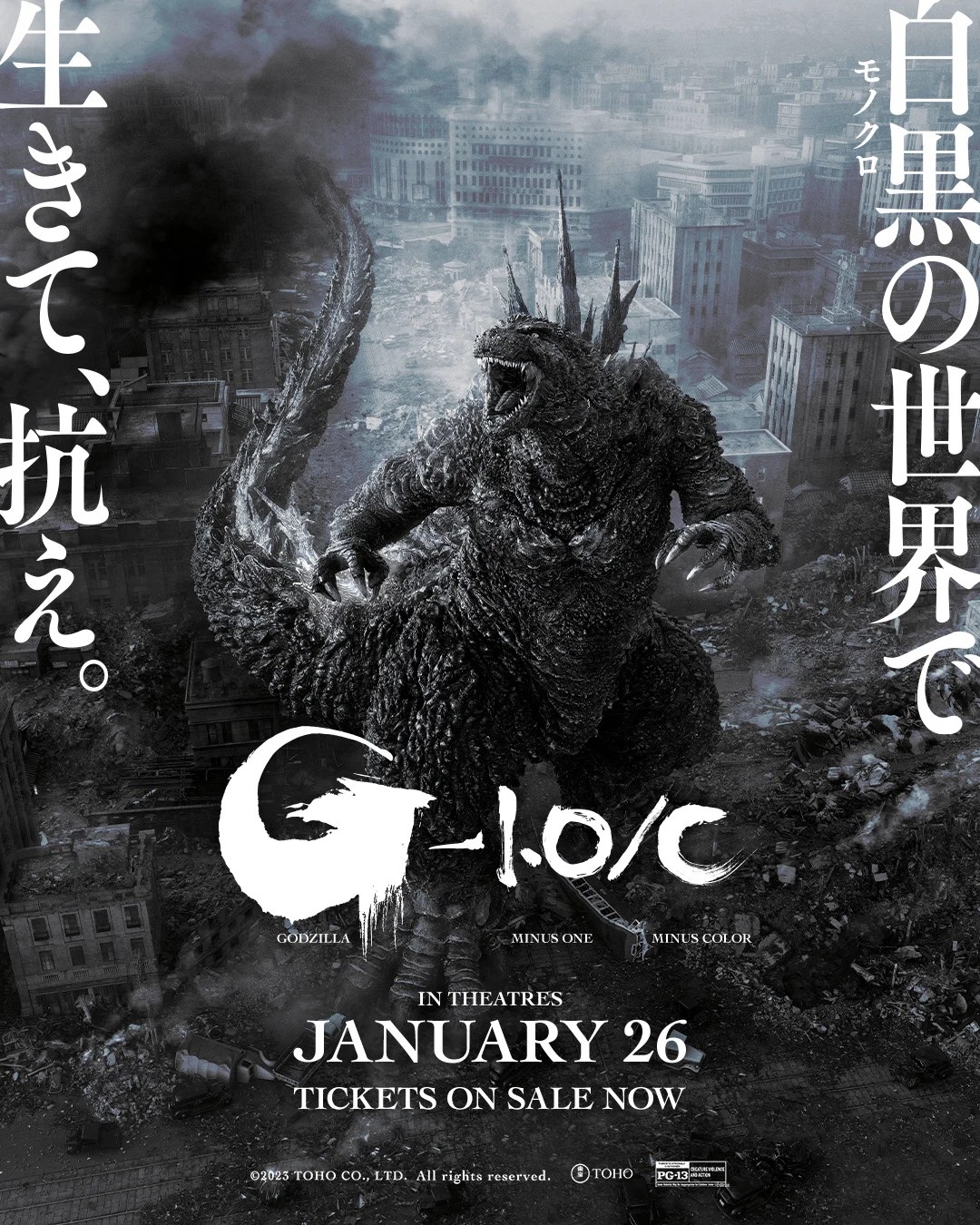 Still there are scenes that are just as powerful in black-and-white as in color. This is mainly because Godzilla himself isn’t a showy color or colors as say some of the other kaiju, most notably in the Godzilla galaxy would be Mothra. The change to black-and-white makes some of the shots of Godzilla almost elegant.
For this screening, I focused on the lighting and the soundtrack, but because of a childhood and even young adult life spent watching black-and-white, there was a comfy nostalgic wave that washed over me as a laughed and cried and wished there was some incredible augmented reality game where I could be Godzilla crushing and stomping on some realistic city or cities after a day in LA traffic.
This was my third theatrical screening of “Godzilla Minus One.” The first was a private press screening where I had front row seats on a comfy couch. The second was at a 4DX show (LA Live Regal).
The 4XD is really the way to go with any Godzilla film because once you feel the theater shake when Godzilla walks on the streets of Tokyo, anything else feels less real.
“Godzilla Minus One/Minus Color” is in theaters for one week only, starting on 26 January 2024. In Japanese with English subtitles.
 Age of the Geek