
It’s been decades since I’ve read Roald Dahl’s 1964 children’s adventure novel “Charlie and the Chocolate Factory.” After seeing Timothée Chalamet in “Wonka,” I immediately went back to the 1971 “Willy Wonka & the Chocolate Factory” and then followed that with the 2005 “Charlie and the Chocolate Factory.” Each movie employs music and has its own strengths.
Willy Wonka & the Chocolate Factory ⭐️⭐️⭐️⭐️
The title says it all. This is a story about Willy Wonka as seen through the eyes of Charlie. Rewatching this film in 2023, I was hit by a wave of sticky sweetness. I remembered my younger days when walking home meant passing first Farrell’s Ice Cream Parlour which had an old-fashioned style candy store and then half-way home, the mall that had Sears, which also a candy counter where candy could be measured out by the ounce.
At the time of this film, there were about 120 Farrell’s nationwide. The original location closed in 2006 in Eugene, Oregon and the very last location to close was in Brea (8 June 2019).
Like the Farrell’s Ice Cream Parlours, this “Willy Wonka & the Chocolate Factory” feels dated because of the clothing, technology and the film used. So this film might be best for younger children who won’t be critical of these aspects or adults who want to wallow in the nostalgia.
Charlie Bucket (Peter Ostrum) is from a poor family who cannot afford the luxury of stepping into a candy store on his way home and buying sweets. The owner, Bill (Aubrey Woods), is a kindly man and he’s the one who sings “The Candy Man.” The small town is dominated by the Willy Wonka chocolate factory, but no one works there. A tinker (Peter Carell) explains to Charlie one evening that no one enters and no one leaves the factory. Charlie’s grandparents share a single bed and it’s his Grandpa Joe (Jack Albertson) who explains that Wonka was forced to close down his factory because some of his employees aided his competitors by stealing Wonka’s recipes. After laying off his entire workforce, and closing the gates of his factory, Wonka kept the gates closed, even three years later when the production mysteriously resumed.
There’s considerable excitement generated worldwide when Wonka announces that he has hidden five Golden Tickets in chocolate Wonka Bars. The finders of the tickets will get a factory tour and a lifetime supply of chocolate. Almost immediately a sinister figure, Mr. Slugworth (Günter Meisner), is seen slithering around in the background. Although the film shows places like Japan taking part of the buying pandemonium, the winners are a gluttonous German boy, Augustus Gloop (Michael Böllner); a spoiled daughter of a wealthy English father, Veruca Salta (John Dawn Cole) and two Americans–a gum-chewing champion, Violet Beauregarde (Denise Nickerson) and a television-obsessed boy, Mike Teevee (Paris Themmen) . Mr. Slugworth is seen whispering into the ears of each of the lucky ticket holders.
Charlie only gets a chocolate bar on his birthday but is disappointed to find it doesn’t have the Golden Ticket. Grandpa Joe later takes him aside and gives him his tobacco money to use for another Wonka Bar, but the ticket isn’t in that bar either. Charlie gives up hope when news reports the fifth ticket was found in Paraguay. That fifth ticket in Paraguay turns out to be a forgery. Walking home, Charlie finds money in the future and buys a Wonka Bar and discovers the last ticket. Bill tells him to run home, before anyone can take it from him.
At home, Charlie’s good luck inspires Grandpa Joe to jump out of bed for the first time in two decades. Charlie chooses hime to be his chaperone for the tour. Before the tour, Slugworth asks Charlie to get a sample of Wonka’s Everlasting Gobstopper, a candy for poor people that changes color and flavors, but never gets smaller or disappears.
From the beginning, it is clear that Willy Wonka is a man of many surprises and not above some trickery. He is also a business man and requires that people on the tour sign a contract. The tour of the chocolate factory is filled with traps and mishaps and each of the children succumb to temptation, including Charlie and his grandfather. Yet unlike the others, Charlie and Grandpa are able to complete the tour. Wonka reminds them that they didn’t follow the guidelines and lost their opportunity at a lifetime of chocolate. Although angry and disappointed, Charlie resists the temptation to give Slugworth the Gobstopper, proving himself worthy of inheriting the chocolate factory.
Director Mel Stuart takes us on a wondrous journey, one that starts as relatable to kids growing up in a Farrell’s Ice Cream Parlour era and from there takes flight into a fantasy better than but not far removed from “Walt Disney’s Wonderful World of Color” (1961-1969) or “Disney’s Wonderful World (1979-1981). Wilder’s Willy Wonka is that favorite eccentric uncle who has some poignant story that he will not burden you with. He will pretend to be the responsible adult while watching other bratty kids make mistakes that will lead to hard life lessons. If you’re a good kid, he’ll lead you on grand adventures that you’ll relive as an adult, even if seeing through your adult eyes, he has grown more weary and less magical.
Viewing this in 2023, the film seems a bit dated, so it is best for younger children or adults who want to wallow in whimsical nostalgia. Gene Wilder makes the mold for Wonka that is more approachable than Johnny Depp’s and allows for the possibility of Timothée Chalamet’s. “Willy Wonka & the Chocolate Factory” made its world premier 28 June 1971 in Chicago. The film is currently streaming on HBO Max.
Charlie and the Chocolate Factory ⭐️⭐️⭐️
Although the Charlie has been put back in the title, this film really does hinge on Johnny Depp’s portrayal of the candy maker as well as the sensibilities of auteur filmmaker Tim Burton (working off of John August’s screenplay). This remains a musical fantasy, but none of the songs became major hits.
The film begins with chocolate being poured into molds and wrapped with a few having the Golden Ticket inserted.
In this film, Charlie Bucket (Freddie Highmore) has an intact family. His father (Noah Taylor) had, until recently, worked at a toothpaste factory, but was replaced by a machine. His mother (Helena Bonham Carter) does the best she can. Grandpa Joe once worked at the Wonka factory, but it was closed due to industrial espionage.
When the contest is announced, we meet the gluttonous Augustus Gloop, the spoiled Veruca Salt (Julie Winter), the competitive Violet Beauregarde (AnnaSophia Robb), the obnoxious Mike Tease (Jordan Fry) as well as their parents. This version stays closer to the children’s book, with Charlie and his grandfather finishing the tour without disobeying the rules. However, Wonka is given a lesson to learn when Charlie declines the opportunity to be Wonka’s heir since he’d have to give up his family. Wonka then loses creative focuses until, through Charlie, he is encouraged to visit his dentist father. They reconcile and Wonka learns that his father was secretly proud of him and had been following his career, clipping out articles. The entire Bucket family is then invited to live on the grounds of the factory.
While the star of the 1971 film, Peter Ostrum, decided to leave acting (and take up veterinary science), this Charlie Bucket (Freddie Highmore) is currently the lead of “The Good Doctor.” Fans of Burton won’t be disappointed. His people are always outsiders and a bit off the wall.
If Gene Wilder’s Wonka was the eccentric uncle you who entertained and enchanted children, Johnny Depp’s Wonka was that weird uncle who was harmless, but slightly off in a way that made conversation or ordinary situations often awkward. Instead of a perfume of pensiveness like bittersweet chocolate that Wilder’s Wonka had, Depp’s Wonka was that weirdly white chocolate, creamy and almost chocolate, but not really what you have in mind when you want to eat chocolate and unpredictable in its actual sweetness.
Wonka ⭐️⭐️⭐️⭐️
“Wonka” reminds us immediately of the Golden Ticket in the opening sequence, giving credit to the original author, before taking us through a pink haze to a small ship where up on the mast, our Willy Wonka (Timothée Chalamet ) sings, “It is time to bid the seven seas farewell. And the city I’ve pinned seven years of hopes on lies just over the horizon.”
When we meet him, he’s wearing white-striped beige pants and a white long-sleeved shirt under a brown vest. The purple overcoat and top hat come soon enough, but they are tattered and his boots, he tells us, are leaky. He has spent all his money on his obsession with chocolate. The crew he leaved behind like him well enough, wishing him good luck and the color of his vest seems to have changed. He has only 12 silver sovereigns in his pocket. He’ll soon lose them all as he pursues his “hatful of dreams.” Yet that hat is magical as Mary Poppins carpetbag. You never know what he’ll be pulling out of it.
His destination has a famous restaurant on every corner and a Galeries Gourmet. But he needs a place to stay and a suspicious person Bleacher (Tom Davis) who takes him to the boarding house of Mrs. Scrubitt (Olivia Colman). Despite being warned by an orphan girl named Noodle (Calah Lane) to read the small print, Wonka signs the ridiculously lengthy contract.
The next day, Willy sells the Hoverchoc, floating chocolates that cause a person to levitate. He soon meets the leading chocolatiers: Arthur Slugworth (Paterson Joseph), Felix Fickelgruber (Mathew Baynton) and Gerald Prodnose (Matt Lucas)–all members of the Chocolate Cartel. The police are called and all of his earnings confiscated for “disrupting the trade of other businesses.” With only a sovereign left, he believes he can cover his room, but the small print charges him for everything, including uses the steps and the soap. He owes ten thousand sovereigns which with hard labor in the basement laundry will come to 27 years and 16 days. It’s not that he didn’t read the small print, Noodle quickly deduces, Wonka can’t read.
Sent down the dirty laundry chute, Willy meets with the other unfortunates which include accountant Abacus Crunch (Jim Carter), plumber Piper Benz (Natasha Rothwell), a quiet woman named Lottie Bell (Rhakee Thakar) and comedian Larry Chucklesworth (Rich Fulcher). We soon learn that the police are under the control of the cartel because the chief of police (Keegan-Michael Key) is addicted to chocolate and bribed with pricy bon tons.
We do meet an orange man with green hair, an Oompa Loompa named Lofty (because for his kind, he’s rather tall). Wonka stole cacao that Lofty (Hugh Grant) had been watching and now, by Lofty’s calculations, Wonka owes a chocolate debt that must be paid.
First recruiting Noodle and then the rest of the laundry workers, Wonka begins selling his chocolate on the streets, trying to earn enough money to free them all. But the Chocolate Cartel has both the police chief and the head priest Father Julius (Rowan Atkinson) under the thrall of their chocolates and the cartel isn’t above murder.
This is a children’s film so there will be no murders, even by chocolate. The film has a steampunk sensibility and while Chalet isn’t a dancer, the dancing numbers are still lovely enough. The costumes (by Lindy Hemming) are confectionary perfection. Chung-hoon Chung (“The Handmaiden,” 2016; “Oldboy,” 2003; and “Last Night in Soho,” 2021) casts an enchantment. The screenplay by Paul King and Simon Farnaby is filled with whimsy and witty word turns. Wonka ask, “How to you like it? Dark, white nutty? Absolutely insane?” He gets arrested by “defying the laws of gravity” as well as “disrupting the trade of other businesses.” As director, King brings the right light touch and respects both the dancing, choreography and the dream.
Timothy Chalamet’s vocals are pleasant enough. If Chalamet’s Wonka was an uncle, he’d be the obsessive dreamer. Perhaps he wouldn’t be the uncle you’d ask to take your children to a dental appointment and you might not expect him to make the birthday party, but he’d bring a moment of magic into a child’s life.
On the diversity score, Chalamet is part Jewish. Lane, Keegan-Michael Key, Paterson Joseph and Natasha Rothwell are African American. British actress Rakhee Thakrar is of Asian Indian descent. If this fictional city was in Europe then one would perhaps expect more North Africans.
As for Jason Acuña’s criticism of Grant’s casting, Oompa-Loompa’s were originally depicted as Black African pygmies. The pygmy people are ethnic groups who are of unusually short stature, but they are not people who have the medical condition of dwarfism, including proportionate dwarf.
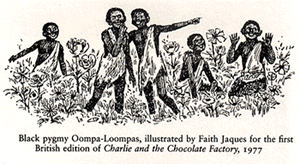
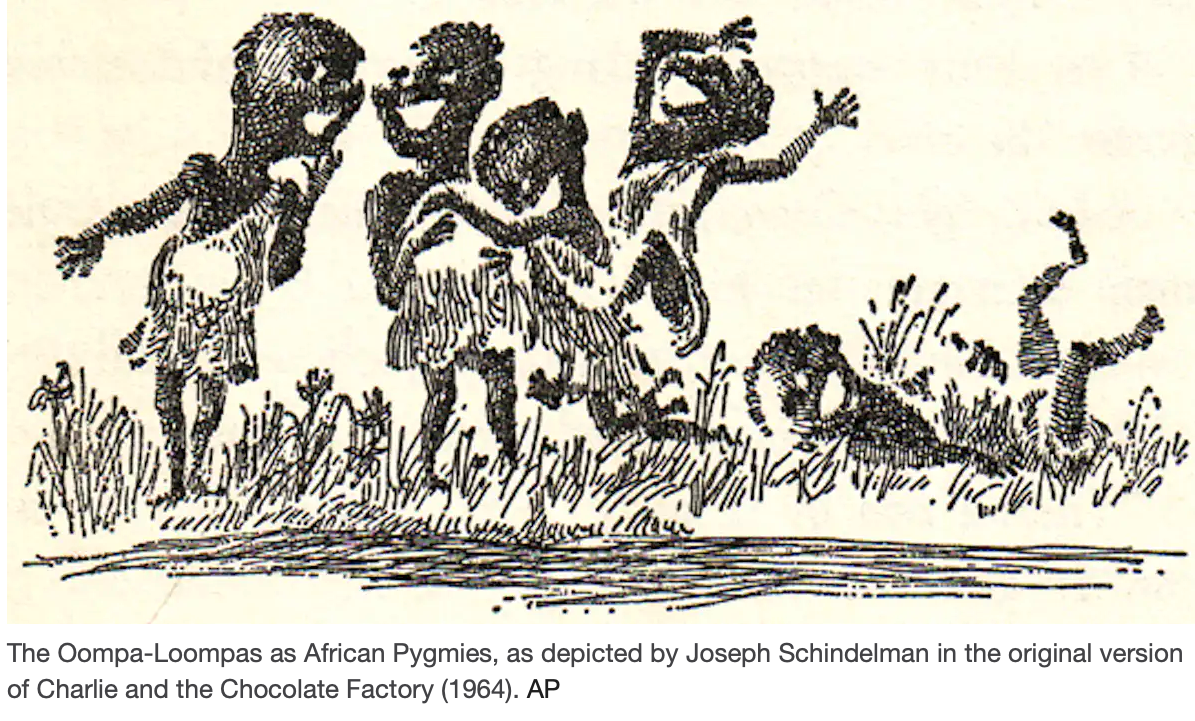 In the 1973 revised edition of “Charlie and the Chocolate Factory,” the Oompa-Loompa’s were “long-haired, rosy-cheeked, and white, hailing from the island of Loompaland.” In the 1971 film, they became people with orange skin and green hair.
- How Wonka Handles the Controversial History of Roald Dahl’s Oompa-Loompas
- From pygmies to puppets: what to do with Roald Dahl’s enslaved Oompa-Loompas in modern adaptations? (15 September 2021)
-
Charlie and the Chocolate Factory hero ‘was originally black’ (13 September 2017)
Although Dahl was British, the original publication was the US edition in 1964 (illustrated by Joseph Schindelman). The first UK edition was in 1967 (illustrated by Faith Jaques).
In the 1971 film, the Oompa-Loompa’s were played by Rudy Borgstaller, George Claydon, Malcolm Dixon, Rusty Goffe, Ismed Hassan, Norman McGlen, Angelo Muscat, Pepe Poupee, Marcus Powell, and Albert Wilkinson, all actors with dwarfism. According to Goffe:
At that time, there weren’t many British actors who were short (I am 4ft 2in), so six of the actors were British and they used one Maltese actor, another from Turkey, one from Germany, and one woman. There were 10 of us in all. The director Mel Stuart sometimes got very frustrated telling us what to do in English and then trying to explain to the Maltese, German and Turkish actors what he wanted as well.
In the 2005 film, one person, Deep Roy, a Kenyan-British actor with dwarfism who was of Asian Indian descent played all of the Oompa-Loompas.
Remember though, chocolate was originally found in the Americas and was only introduced to Europe in the 16th Century. Currently though the Ivory Coast leads in world production (38 percent) followed by Ghana and Indonesia (14 percent each). There are plenty of islands in Indonesia, but none with people who have orange skin and green hair. Maybe it’s the yeti sweat.
This wonderfully whimsical film gives us a world of pure imagination where a man with a magical hat takes on a Chocolate cartel with new found friends. Take you kids or embrace your inner child and warm your cockles on this frothy fantasy.
“Wonka” had its world premiere in London on 28 November 2023. It was released in the US on 8 December and in the US on 15 December 2023.
 Age of the Geek