Recently, I was reading about the recent graduate who was tearful about her first 9-to-5 job and how she was recently laid off. That news was coupled with the family visiting from out-of-town who decided to investigate a freezer and found a body as I watched two versions the Andes flight disaster: “Society of the Snow” (La sociedad de la nieve, 2023) and “Alive” (1993). We live in weird times, but even if your father or grandfather didn’t trudge on foot through miles or snow to go to work, two men did on the brink of starvation in 1972 as their relatives and friends laid dead and frozen and the lucky few faced the possibility of a similar fate.
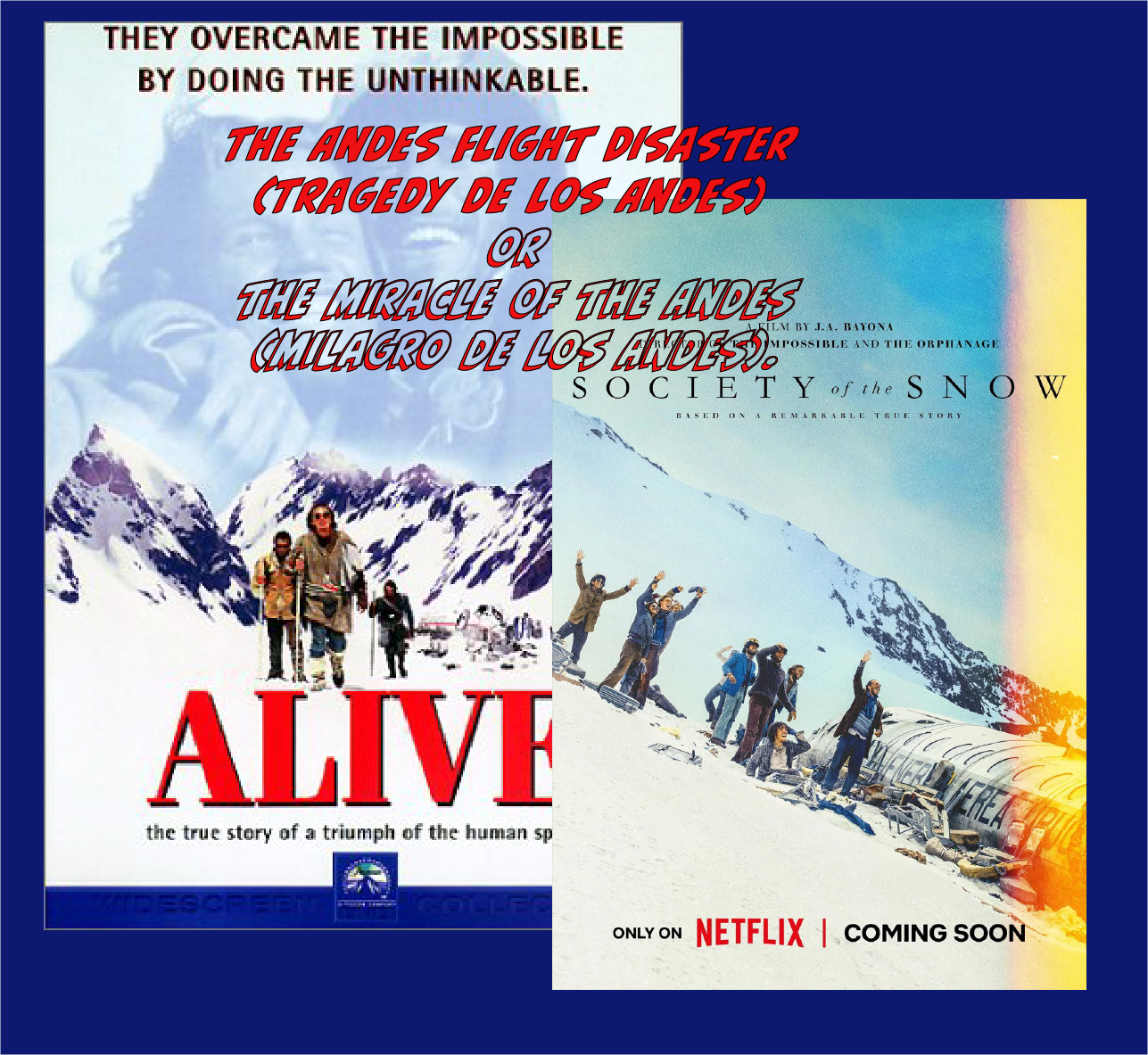 Uruguayan Air Force Flight 571
The incident is variously referred to as the Uruguayan Air Force Flight 571, the Andes flight disaster (Tragedy de los Andes) and the Miracle of the Andes (Milagro de los Andes). The chartered flight in a Fairchild FH-227D left Montevideo, Uruguay on its way to Santiago, Chile on 13 October 1972. The plane had 45 passengers and crew. Of that 19 were members of the Old Christians Club rugby union team. With them were their friends and family. This amateur team was scheduled to play against an English rugby team, the Old Boys Club.
The plane was considered underpowered and the survivors remember experiencing turbulence before the crash. Three passengers, the navigator and the flight attendant died first when the tail section clipped the ridge and broke free from the body of the plane. Two more passengers fell out of the now open rear of the fuselage. Another four passengers died after the fuselage hit the snow bank (including the team doctor, Francisco Nicola). The pilot died instantly and the co-pilot died the next day. That left 33 passengers alive. During the first night, besides the co-pilot, four passengers died.
Although 11 aircraft from Argentina, Chile and Uruguay searched for the flight on the second day and a few aircraft did fly over the crash site, none of the rescue teams spotted the white fuselage nor the cross the survivors fashioned out of luggage in the snow. On three occasions the survivor saw aircraft fly over the crash site. The search and rescue operations were cancelled after eight days and on 21 October, the rescue mission concluded that no one could have survived and then planned to have a recovery mission in December when the snow melted (because of the reverse seasons in the Southern Hemisphere).
As they waited to be rescued, 17 days after the crash, an avalanche covers the fuselage, smothering eight more people.
On 12 December 1972, Nando Parrado, medical student Roberto Canessa and Antonio “Tintin” Vizintin began climbing the glacier. Vizintin returns to camp a few days out so that Canessa and Parrado can have more food to fuel them on. On 20 December, Parrado and Canessa see Sergio Cataléan and on 21 December they are rescued. A day later, six people are rescued and the rest (eight) are rescued on 23 December 1972.
In the end, 29 people died and 16 survived.
Alive
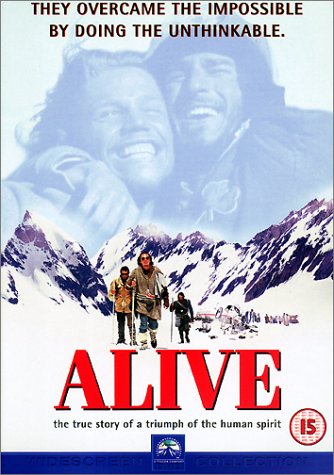 “Alive” begins with a survivor, Carlitos Páez (played by John Malcovich as the elder, but by Bruce Ramsay as the younger) narrating a slideshow of photographs taken before the crash. While people tell him they would not have survived, he notes one never knows what one is capable of until confronted in reality. “To be affronted by solitude without decadence or a single material thing to prostitute it elevates you to a spiritual plane where I felt the presence of God,” he says.
From there, the movie flashes back to the past with a small airplane flying above snow laden mountains and the subtitle tells us that “a South American rugby team, together with some friends and relatives crosses the Andes to play a game in neighboring Chile.” That seems weird because the team is already identify from the photos as Old Christians Rugby Team. Did the writer John Patrick Shanley who based his screenplay on the Piers Paul Read book, “Alive: The Story of the Andes Survivors,” believe a US audience wouldn’t know where Uruguay was although he expected them to know where Chile was located?
Ethan Hawke and Josh Hamilton play the two men who made the trek out to find help, Nando Parrado and Roberto Canessa, respectively.
In “Alive,” with the exception of three people, the names of those who died where changed for the film. “Alive” can be streamed with purchase on Amazon Prime Video.
Society of the Snow
To the sound of flowing water, the camera follows a small stream cutting through the snow-laden mountain sides. The Spanish language narration tells us what happened and the English subtitles translate as follows:
On October 13, 1972, a Uruguayan plane crashed into the Andes Mountains. There were 40 of us passengers and five crew members on board. Some call it a tragedy. Others, a miracle. What really happened? What happens when the world deserts you? When you have no clothes and you’re freezing? When you have no food and you’re dying? The answer is in the mountains. We have to return to the past, knowing that the past is what changes the most.
The camera has shown us just how difficult it was to see the plane wreck from the air before we flash back in time.
The action then goes to a rugby field with the sound of cheers and running and the impact of bodies as teammates shout to each other. In the locker room, the players are paying for their portion of the flight. Elsewhere, a church is filled with people, including members of the flight. Outside on the streets there are protests and in a small eatery, men are convincing others to join because the flight is a real deal. When else will they have a chance to visit Santiago, Chile for such a price? These are men of different vocations, but mostly young men at the beginning of their lives.
As they are at the airport, a popular song of the time period plays: “Break it All” by the Uruguayan rock band, Los Shakers who modeled themselves after The Beatles after seeing the 1964 “A Hard Day’s Night.” “Rompan Todo” (“Break It All”) is the name of a 2020 Netflix documentary about the history of rock in Latin America.
I mention the music because in the film “Alive,” the radio plays Dionne Warwick singing part of the 1969 hit, “Do You Know the Way to San Jose.” While it was likely meant to denote a musical era, that took me out of the film “Alive,” but in “Society of the Snow,” at about the same time in the chronology of the survivors time on the mountains, you’ll hear a tango. Both Uruguay and Argentina are credited with tango as an Intangible Cultural Heritage of Humanity by UNESCO (United Nations Educational, Scientific and Cultural Organization). Thus in the “Society of the Snow,” the youth culture (The Shakers) and the traditional culture (tango) are invoked in the soundtrack. But that may be because I grew up and currently live in California and I know where San Jose is (in comparison to Hollywood).
We see the men leaving their loved ones behind at the airport and are reminded by the narrator that many are leaving home for the first time. The men and women are dressed more casually in this film than in “Alive.” Whereas many of the passengers in “Alive” were seen on board the plane in suits (and one woman has a pearl necklace), in “Society of the Snow,” the men are seen in long-sleeve button-down shirts, and only some have ties. A few have their shirt sleeves rolled up. Some are wearing sweaters over their shirts. Then they hit turbulence. While this version is less pretty and perfect, I feel it better captures the both the confusion and chaos of the crash as well as the culture that the group comes from and how that guides them through their survival.
Written (with Brent Viliplana, Jaime Marques and Nicolás Casriego) and directed by Spaniard J.A. Bayona (“A Monster Calls,” 2016 and “Jurassic World: Fallen Kingdom,” 2018), “The Society of Snow” takes viewers inside a Spanish-speaking culture and has an intimacy that “Alive” does not. Bayona had previously directed another true disaster survival film, the English-language film “The Impossible” (Lo imposible, 2012) that was about Spanish doctor Maria Bélon and her family’s experiences surviving the 2004 Indian Ocean tsunami during a Christmas holiday in Thailand.
Here “Society of the Snow” is based on Uruguayan journalist Pablo Vierci’s 2009 book of the same name (La sociedad de la nieve). The cast are from Uruguay and Argentina, many of whom are newcomers, including Matías Recalt as Roberto Canessa, Augustin Pardella as Nando Parrado and an actual rugby player, Agustín Della Corte as Antonio “Tintin” Vizintin. Filming took place in Spain, Uruguay, Argentina and Chile, including the actual crash site. “Alive” was filmed in British Columbia (directed by Frank Marshall, who has previously directed the 1990 “Arachnophobia”). “Alive” cinematographer Peter James gives us startling white snow and blue skies, but cinematographer Pedro Luque helps us feel the Mod era in Uruguay with the saturated bright colors before we come under the oppression of the cold blues of the Andes. Still both cinematographers capture the stark beauty of the mountains.
“Society of the Snow” is the better film in its portrayal of love, loss and survival in the Andes. It is less concerned with action and heroics than “Alive” and there’s more certainty about religious faith (because after all, it is in the name of the rugby club). Neither indulges in lurid sensationalism when it comes to the cannibalism, thankfully.
You never want to encounter frozen bodies, particularly of your relatives and you never want to find your relative has a frozen body in the refrigerator. Watching both these films reminds one that our complaints are relatively minor and working together, we can achieve great things, including saving ourselves. “Society of the Snow” reminds us also of the value of listening and embracing the culture from which the story springs.
“Society of Snow” closed the 80th Venice International Film Festival (Out of Competition slot) and ws released theatrically in Uruguay on 13 December 2023 and in Spain on 15 December 2023. It will stream on Netflix on 4 January 2024. It is Spain’s entry for the Best International Feature Film at the 96th Academy Awards.
 Age of the Geek