Recently, I was reminded of my DNA testing. Originally, I had MyHeritage and was curious at its original findings, so I decided to compare MyHeritage to 23andMe.
 MyHeritage is an online genealogy platform based in Asia–Or Yehuda, Israel. It also have offices in Tel Aviv, Israel, Lehi, Utah, Kyiv, Ukraine and Burbank, CA. As of 2023, the service supports 42 languages. Gilad Japhet, an Israeli genealogist, is an Israeli entrepreneur and genealogist. According to TheOrg.com, Japhet has a BS in computer science from Technion – Israel Institute of Technology. I don’t see that Japhet has any biological training.
The demographics of Lehi, Utah are 90.6 percent White (with 1.8% Asian and 0.5% Native Hawaiian or other Pacific Islander). Burbank, however, is 67% White and 23.8% Latino with 11.7 percent Asian. Keep in mind that the US Census Bureau continues to identify North Africans and West Asians as White.
23andMe Holding Co. is a publicly held personal genomics and biotechnology company which is based in South San Francisco, California. It was founded by biologist Linda Avey, Paul Cusenza and Anne Wojcicki. Avey had been a staff research associated at UC Irvine and moved on to other companies in the fields of biopharmaceutical and academic research. South San Francisco is 30% White, 29.8% Hispanic or Latino but more importantly, 43.4% Asian.
MyHeritage
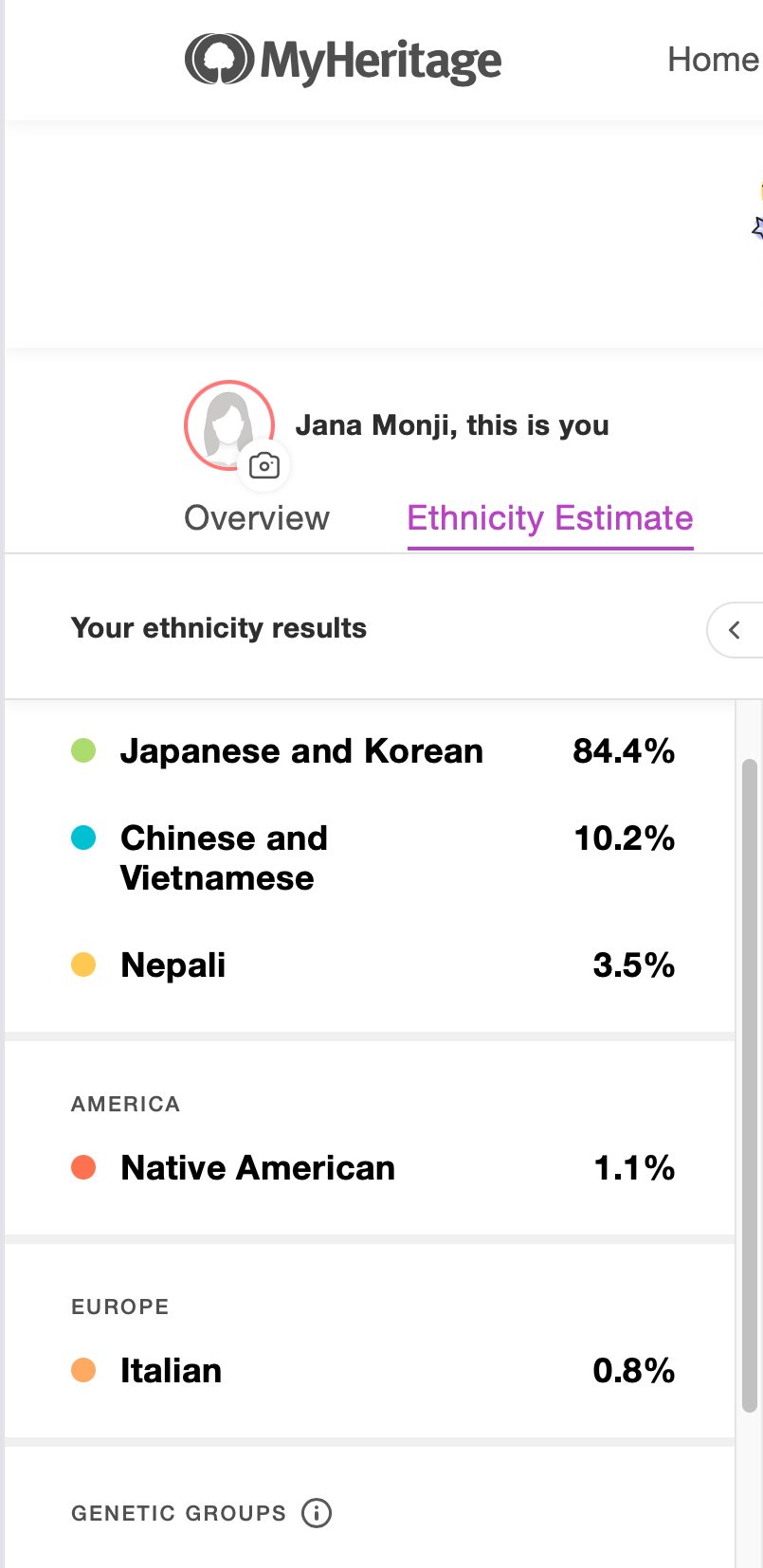
In August of 2017, the original results of my DNA test listed me as predominately Japanese and Korean, with a small percentage Chinese and Vietnamese and an even smaller percentage Nepali. Today, 9 September 2023, the results have mostly stayed the same except for some two small additional ethnicities.
My husband’s original results were Japanese and Korean and Chinese and Vietnamese with a small percentage of Native American.
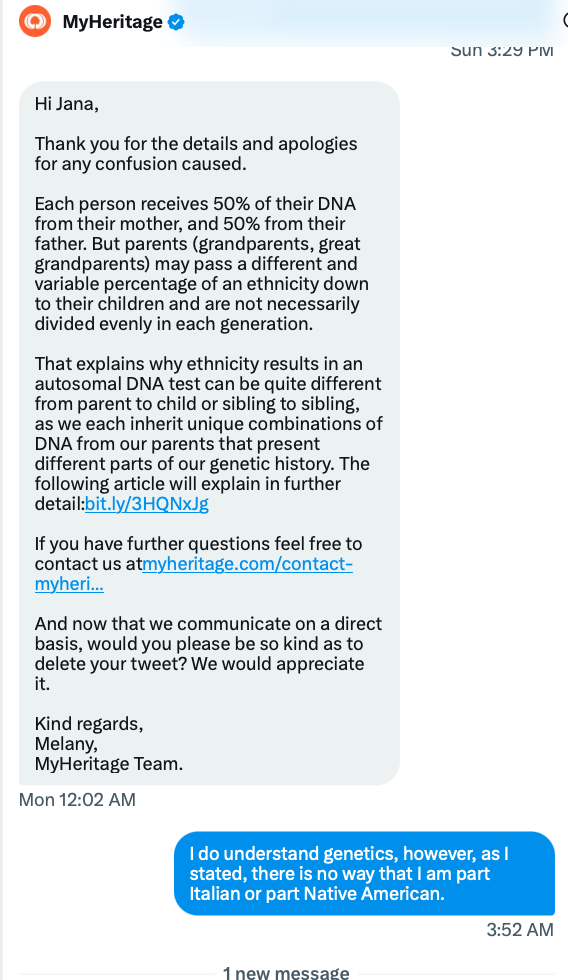
 So I tweeted that I had so many questions and I got this DM from MyHeritage. Bless them. This kind of messaging may work for some people.
 I haven’t received an email yet.
My husband’s results from MyHeritage are now more accurate (59.7% Chinese and Vietnamese plus 49.3% Japanese and Korean), but still broad. Is he Japanese or Korean?

23andMe
Because I was so amused at my husband’s original 2017 results from MyHeritage, I decided to try out 23andMe.
23andMe gave me these results:
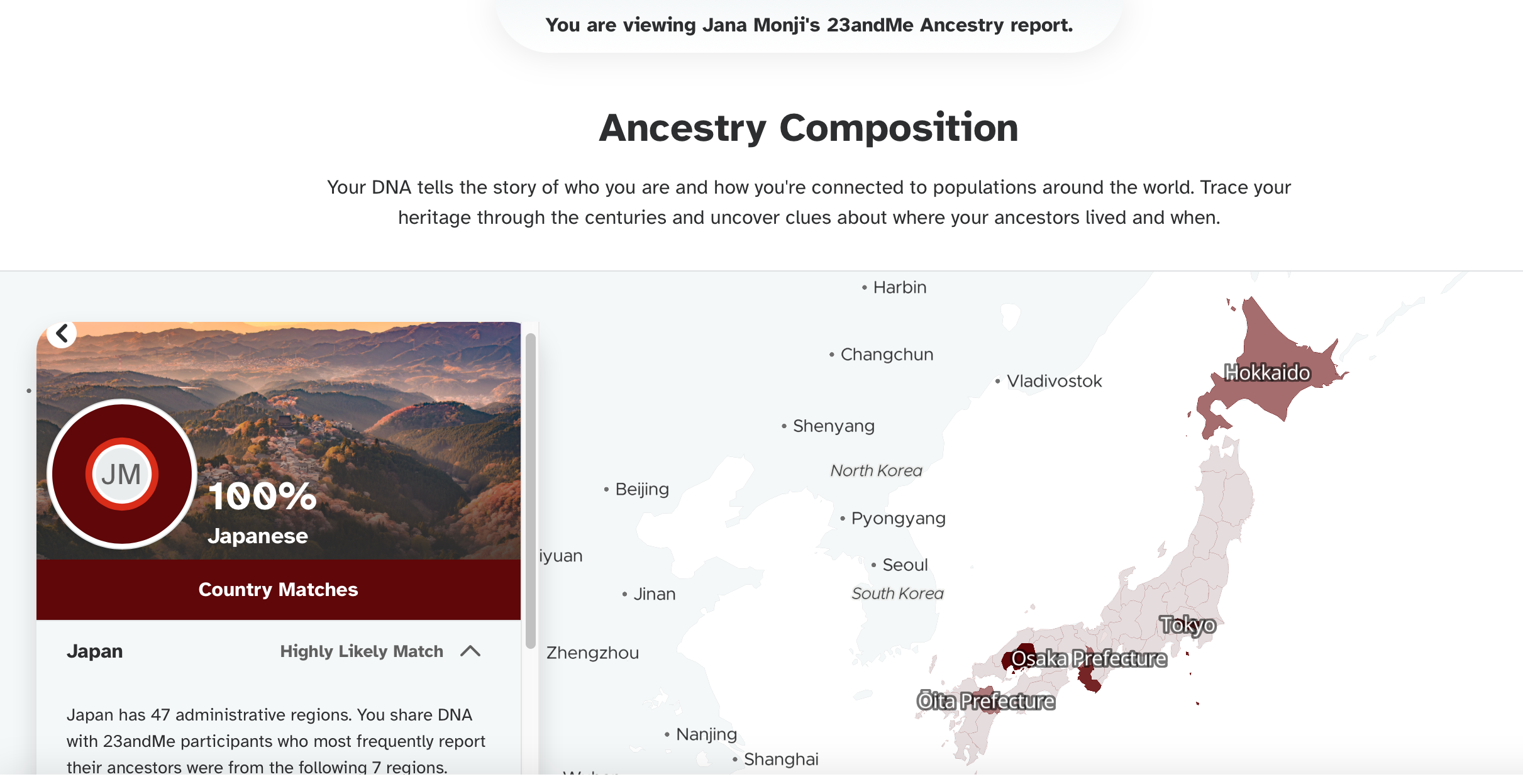 This is closer to what I know about my family history. My maternal side is from the Kansai area, predominately Osaka and Wakayama. I’ve heard that my grandfather, who I never knew, was from somewhere in Wakayama, near Hashigui-iwa [橋杭岩].
My father’s side of my family are from an area called Moji (門司). There is a Moji Ward in Kitakyushu, Kyushu Japan. That is close to Oita Prefecture. I’m not sure where my maternal grandmother was from. Both of my paternal grandparents died before my father graduated from high school.
My husband’s current results from 23andMe are as follows: 51.3% Chinese (Southern Chinese and Taiwanese at 29.5 percent and South Chinese at 21.8%) and 48.7 percent Okinawa prefecture. This makes sense and notice how the 23andMe divides East Asia.

Conclusion
I can’t speak for the accuracy of MyHeritage for people from either North Africa or the Sub-Saharan Africa, but I can say that the classifications for East Asia and Southeast Asia are too broad and even insensitive. There is prejudice in Japan against Koreans and in Korea against the Japanese. There is also prejudice in Vietnam among the Chinese Vietnamese against the Vietnamese, or at least, there used to be. The genetic information from MyHeritage wasn’t particularly helpful at all and consider that I am only the second generation out of Japan. Both sets of grandparents were born in Japan and Japan was not open to the West and the Americas until the 1860s. Perry came to Japan in 1953. We know the port of Nagasaki was open to the Dutch, but Japan did have trade with China and Korea. There were pirates based in Japan (13th to 16th centuries) but there is some debate of their true ethnicity (Japanese, Chinese, Korean, Mongolian), but it is unlikely any of them were Italian.
MyHeritage lists 42 languages it is available in: Afrikaans, Arabic, Armenian, Bulgarian, Catalan, Chinese-Mandarin, Chinese Traditional, Croatian, Czech, Danish, Dutch, English, Estonian, Farsi, Finnish, French, German, Greek, Hebrew, Hindi, Hungarian, Italian, Japanese, Korean, Latvian, Lithuanian, Macedonian, Malay, Norwegian, Polish, Portuguese, Portuguese – Brazil, Romanian, Russian, Serbian, Slovakian, Slovenian, Spanish, Swedish, Thai, Turkish, Ukrainian. If they provide a service in Chinese-Mandarin, Chinese Traditional (Taiwanese), Japanese and Korean, they are not servicing those customers well. I’d venture that they aren’t providing the Malay speakers with a good service either. I’d also give a question mark to the Italians.
Because MyHeritage originally listed my husband as a small percentage of Native American in 2017 and now lists me as part Native American in 2023, I would guess that MyHeritage would not be reliable information about Native American heritage or for Native American genealogy.
If you’re East Asian or Southeast Asian, skip MyHeritage. Try 23andMe.
 Age of the Geek