The Indiana Jones series makes archeology seem like a cool and often dangerous field of study but is ultimately about the superior White man fighting against and for more primitive peoples. The main opponent are the Nazis even in last film which is set post World War II. The premise of a White man, fighting other White men for the future of the world which is predominately non-White is problematic in 2023, but there was plenty of questionable aspects of the series from the beginning.
The Indiana Jones franchise began in 1981 with “Raiders of the Lost Ark,” but that film takes place in 1936. The second film, “Indiana Jones and the Temple of Doom,” which came out in 1984, takes place in 1935. Although the franchise begins with a hero filled and is filled with moments of humorous bravado, both of those films have cringe-worthy moments.
Indiana Jones and the Temple of Doom (1984)
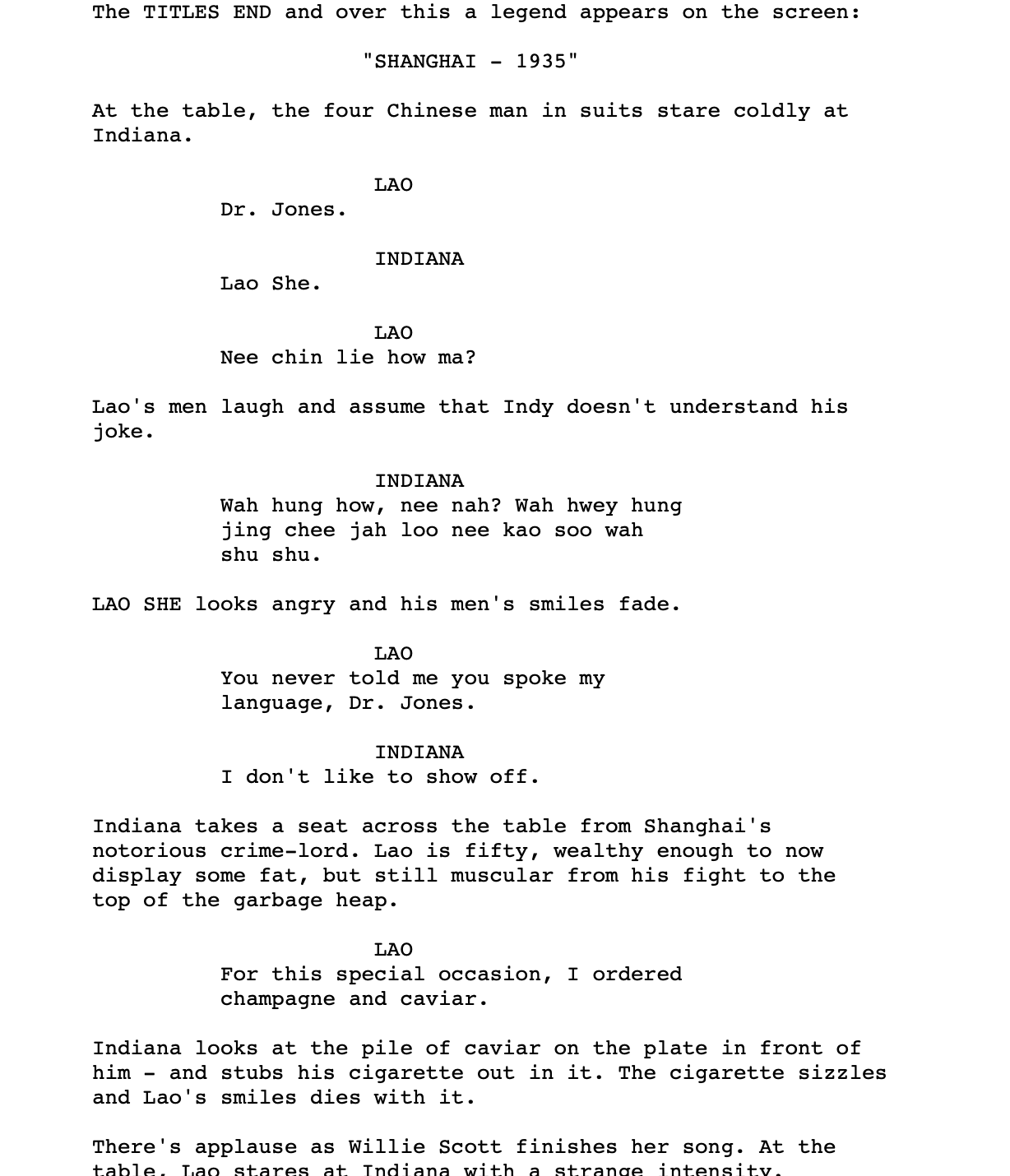
 Set in 1935 Shanghai, Indiana Jones is dressed up in a tux to deal with a Shanghai crime boss Lao Che at the nightclub Club Obi Wan. Lao Che hired him to retrieve the remains of Emperor Taizu of Ching, Nurhaci (1559-1626) because for some reason no Chinese person would do it. Jones, would could not speak German well if at all in the first film, has no problem with Chinese although the Chinese dialogue was subject to discussion. It didn’t sound like Mandarin to me, but I’ve only studied Mandarin for three years at college level. In Shanghai, I think it should be in the Shanghai dialect which I am unfamiliar with. There is a Reddit discussion which seems to conclude that this is just phonetically transcribed Chinese that probably makes no sense at all. More on that below.
In payment for the remains of Nurhaci, Lao Che (Roy Chi) is supposed to give Jones an overly large diamond. While Lao Che does give Jones the Peacock’s Eye diamond, Jones is double-crossed by Lao Che who slips him poison and will only give him the antidote in exchange for the diamond. Jones’ friend Wu Han (David Yip), takes a gangster’s bullet and dies. During the chaotic escape attempt, the nightclub singer and sometime mistress of Lao Che, Wilhelmina “Willie” Scott (Kate Capshaw) who sang “Anything Goes” in Mandarin, gets the vial of serum and puts down her bra.
Willie and Jones escape in the car driven by Short Round (Ke Huy Quan) with Jones drinking the serum after plunging his hand down Willie’s sequined gown. In their escape from Shanghai, they fly out in a plane owned by Lao Che. When the threesome are asleep, the pilots dump the fuel and take the only parachutes to escape into the snow-covered mountains. Short Round wakes Jones up and the threesome escape using an inflatable raft to surf down the slopes of the Himalayas into a river. Down the river they arrive in the Indian village of Mayapore.
In the village, Jones learns that a sacred stone has been stolen and taken to the Pankot Palace along with the villages children. Of course, the villagers are helpless to Jones has to retrieve their sacred stone and bring back the children. Jones believes the stone is one of the five Sankara stones given by the Hindu gods to help humans fight evil.
At the palace, Jones, Willie and Short Round become the guests of the young maharaja. But all is not as it seems. At night, Jones is attacked by an assassin. Killing the man, Jones discovers that underneath the palace are tunnels where Thuggee cult members conduct human sacrifices. The cult posses three of the give Sankara stones. The children from Mayapore are enslaved to help find the remaining stones. The three are captured. Jones is forced by the high priest Mola Ram (Amrish Puri) to drink a potion that places him under the control of Mola Ram. Jones is about to sacrifice Willie when Short Round, who has escaped, helps Jones break out of his trance.
The three are able to collect the three Sankara stones, free the children and as they are escaping Mola Ram, they cross a rope bridge. Jones cuts the bridge down, sending many of the Thugs down into crocodile-infested waters, including Mola Ram. The British Indian Army soldiers of the 11th Poona Rifles (led by Captain Philip Blumburtt who is played by Philip Stone) arrive and help defeat the Thuggees.
The helpless villages of Mayapore are reunited with their kids and Jones gives them the remaining stone. That might pass as a happy ending and another White Saviour film.
Diversity
If Indiana Jones does indeed know 27 languages, Chinese is not really one of them. German may or may not be one of the languages he knows. But there are other problems in Shanghai. The dancing girls at the nightclubs, including the ones in a stereotypical China doll haircut are all White or White passing. You might not notice this at first and the IMDb doesn’t list any East Asian sounding names under the dancers.
Short Round is a boy who Jones caught trying to pickpocket from him. We’re told that his parents died during a bombing. The Imperial Japanese Navy Air Service bombed Shanghai (28 January 1932), supposedly to quell protests against the Japanese occupation of Manchuria. Chinese control over Shanghai fell to the Japanese in 1937 (Battle of Shanghai/Battle of Song). The foreign concessions were left intact and would, during World War II, become a haven to Jewish refugees. As the war continued, the extraterritoriality of the foreign concessions slowly eroded. Shanghai remained under the Japanese until the end of World War II.
The Indians aren’t portrayed well and neither are their religions. It might be different if your average American was well-informed about Hinduism, Kali or Shiva, but they are not. The film’s depiction of Indian cuisine isn’t much better and seems to have been more inspired by the need to provide an interesting segment as a background of exposition. Couple that with the yellow face from the first film, the unflattering portrayal of the Chinese in the first segment (who were, like the British, US allies during World War I and World War II) and you have what seems to be a film that pays tribute to the Orientalism of films and pulp fiction from the 1930s and 1940s and a cinematic addition to negative East and South Asian stereotypes.
There’s also that voodoo doll segment. Has that ever been part of Asian Indian culture? Merriam-Webster associates voodoo with African ancestor worship in Haiti.
The Thuggee archers, like the Star Wars stormtroopers, are horrible shots. And why, in 1935, are they using bows and arrows and not firearms like the Poona Rifles. And the Poona Rifles are lead by a White British man.
Both actors British Indian Roshan Seth (born during the British Raj to a Hindu father and a Muslim mother) and Indian actor Amrish Puri (1932-2005) defended the banquet scene, but I would question whether they completely understood the repercussion this had on the American Asian Indian community. This would be particularly true for Puri who predominately worked in Hindi-language films. Both men were in Richard Attenborough’s 1982 “Gandhi.”
In addition, there’s the problem of Willie as a screaming, opportunistic woman, who despite being able to scratch her way to the top of Shanghai underground society as the mistress of a loathsome Shanghai crime lord, has very little grit. She’s the butt of many of the visual jokes, such as the mounting the elephant the wrong way, perfuming the elephant and then mistaking a snake for an elephant trunk. They don’t feel the same. Then there’s how Jones decides to use his bullwhip to overcome Willie’s verbal “no.” She wants to head back to Missouri instead of continue to have anything to do with him but he uses his bullwhip to stop her from leaving him and bring her back to him. Of course, we know that was a short-lived romance.
So despite the cute kid Short Round, I found this film was something like nouveau Hollywood Orientalism with a dose of misogyny. Too bad the kids couldn’t have rebelled or the villagers, instead of the British army, couldn’t have come to Jones’ aid at the end.
Indiana Jones: Raiders of the Lost Ark (1981)
 George Lucas and Philip Kaufman provide the story while screenwriter Lawrence Kasdan worked out the details. Steven Spielberg directed. The beginning sequence gives us the memorable giant rolling ball sequence and sets up the rivalry between Indiana Jones and René Belloq (Paul Freeman). The hat, the bullwhip and the fear of snakes are already in place before we see Jones as a professor at the fictional Marshall College. Jones works to find and preserve treasures under International Treaty for the Protection of Antiquities. He is well-known as “the obtainer of rare antiquities.”
Instead of bringing in a team of archaeologists to study the temple in Peru, Jones goes into an ancient temple with his less-than-trustworthy companion Satipo (Al Molina) with Satipo’s partner, Barranca (British Palestine-born Armenian-British actor Vic Tablian). Jones finds a golden idol, but Belloq, with the help of the indigenous Hovitos tribe, takes away the idol and Jones runs for his life.
Back at Marshall College, Jones is established as a heartthrob, with one coed blinking to reveal the words “Love you” on her eyelids. After his class, two Army Intelligence agents ask Jones to help them: The Nazis are excavating a site in Canis, Egypt. One of the intercepted telegrams mentions Jones’ mentor, Abner Ravenwood. Jones realizes the Nazis are searching for the Ark of the Covenant. Adolf Hitler believes possession of this artifact will make his army invincible. Ravenwood had a medallion which was the key to the Ark’s location.
Ravenwood and his daughter, Marion were in Nepal, running a bar, but now Ravenwood is dead. Jones arrives just before the Gestapo.
Here’s where we learn that Jones is pretty creepy. Indiana Jones entered into a relationship with the 15-year-old daughter of his mentor, Dr. Abner Ravenwood, when he was 27.
Marion says, “I was a child! I was in love! It was wrong and you knew it!”
Jones replies, “You knew what you were doing.”
Did Lucas and Spielberg really think it was okay to teach a generation, or now, generations of girls and boys that having an affair with a minor was okay and somehow part of being a superior White man? What we now know is that Lucas suggested that Marion be eleven:
I was thinking that this old guy could have been his mentor. He could have known this little girl when she was just a kid. Had an affair with her when she was eleven.
It was Spielberg who objected, saying, “She had better be older than twenty-two.”
Lucas, however, said, “Fifteen is right on the edge. I know it’s an outrageous idea, but it is interesting. Once she’s sixteen or seventeen it’s not interesting anymore.”
That’s pretty perverted thinking, but it somewhat explains why the primary female roles continued to be problematic.
I’m okay with Barranca as a Peruvian guide of questionable repute being played by Tablian, because if the Spanish and the Portuguese who settle in South America were obviously Europeans. Armenia has, at times, bordered the Mediterranean Sea and there was the Armenian Bay (now the Gulf of Alexandretta) and Spain and Portugal certainly did have commerce and sea trade in the Mediterranean. However, Tablian also plays a Sherpa in Nepal. While Armenians can be considered West Asians, they certainly are not South Asians. There’s also that bit of yellow face with White stuntman Malcolm Weaver portraying a Nepalese aiding our main bad guy, Nazi Gestapo agent Major Arnold Toht (Ronald Lacey).
“Raiders of the Lost Ark” came out the same year (1981) that Peter Ustinov played Charlie Chan (“Charlie Chan and the Curse of the Dragon Queen”) and a year before Linda Hunt would play an Asian man in “The Year of Living Dangerously.”

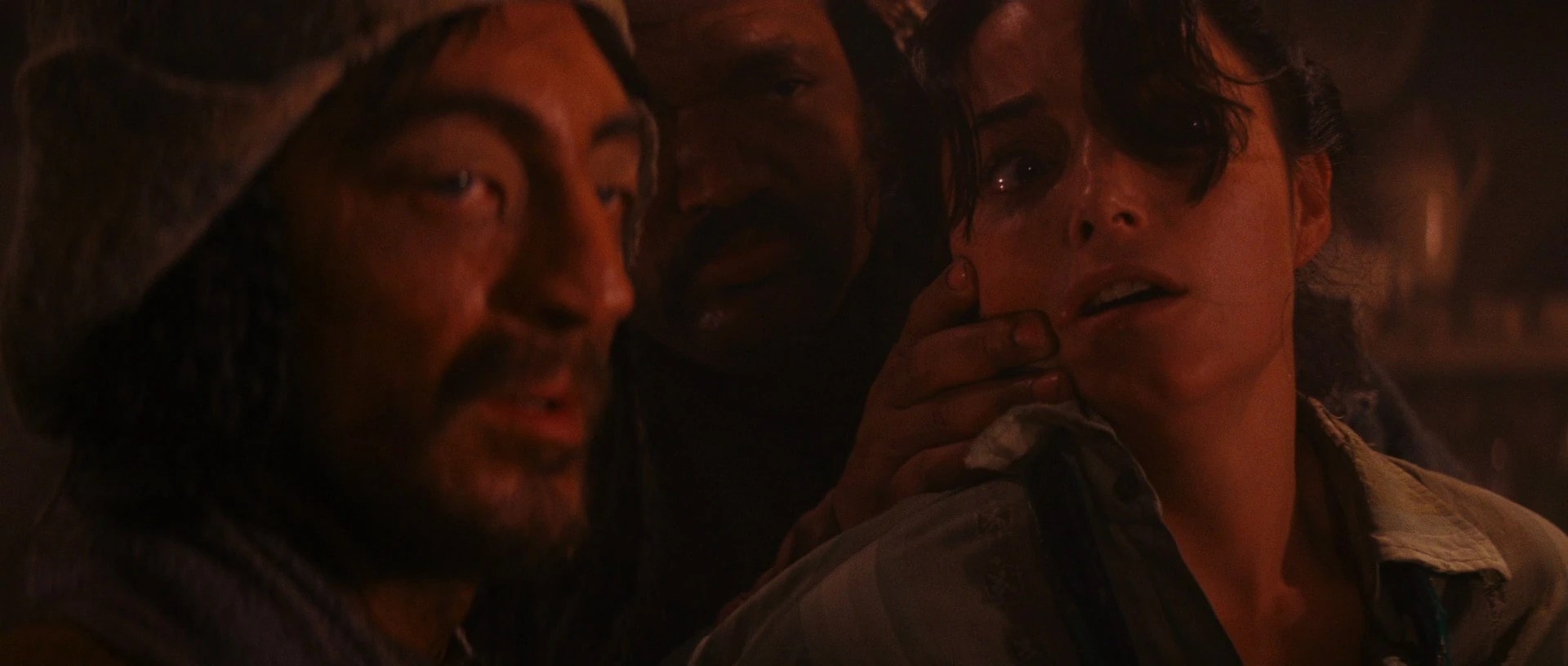 As Jones fights the Sherpas, the place burns down. Toht attempts to get the medallion, only to burn its image in his hand, but Jones and Marion escape with the medallion.
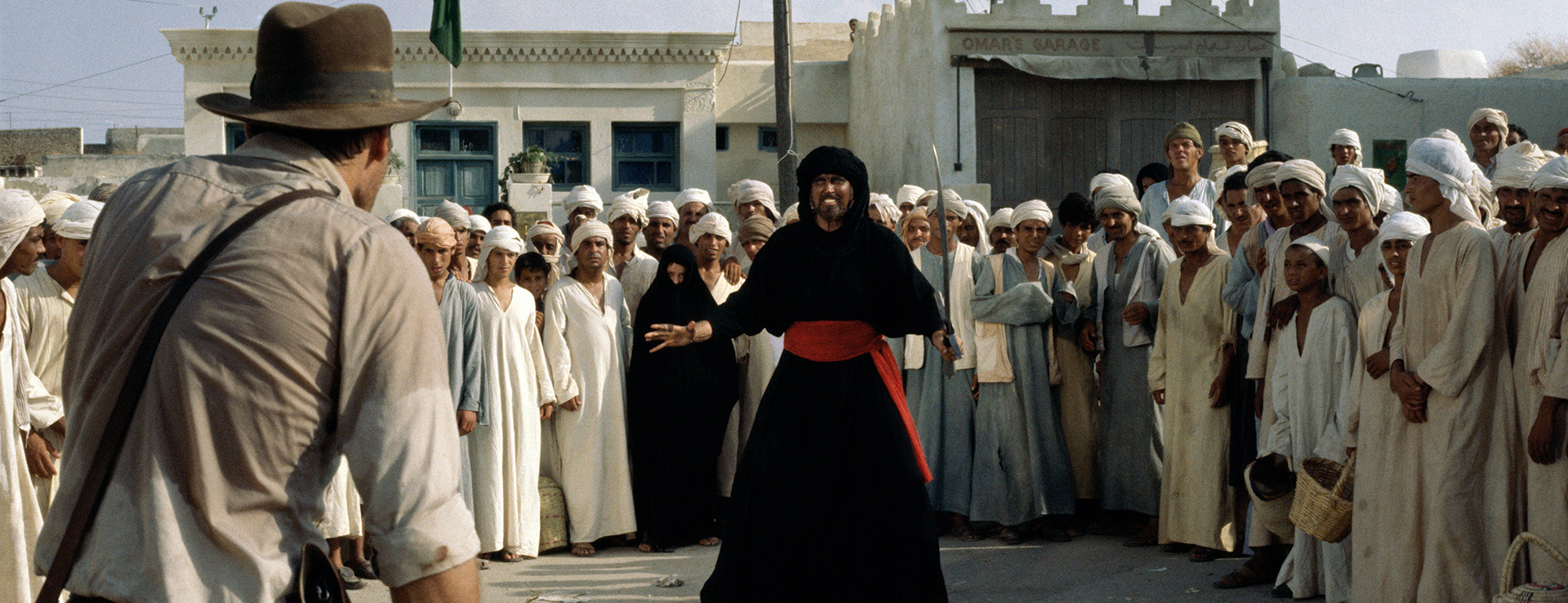
Jones and Marion end up in Egypt where Jones is aided by his old friend Sallah (John Rhys-Davies), an expert excavator. There’s the famous scene where Jones is challenged by the black-robed Arab with a sword and pulls a gun. Sallah is supposedly Egyptian from the name, however, Rhys-Davies is Welsh.
If you’ve followed the series, you know that Jones and Marion survive and so does Sallah.
The casting of White actors when surely one could have found South Asians (or East Asians who could pass as South Asians) or Arabs in locations like France, Tunisia or Hawaii is a diversity problem. The Hovitas are in service of the White man Belloq. The Sherpas are in the service of the White Nazis led by Toht. The Arabs are in the service of Jones or Belloq and Toht. Where are the expert Egyptian Egyptologists? Where were the Native American leaders? Where were the members of the Peruvian government? Jones seems to be stealing from Peru for the US.
 In the 1930s, the Kingdom of Egypt was still under the British military occupation, but that is still different from the French (Belloq) and the American (Jones) as well as the German. You’d think the British would have noticed an excavation by Nazis led by the Gestapo agent of questionable interrogation methods. But what do I know?
Indiana Jones and the Last Crusade (1989)
 Set in both 1912 (for the prologue) and 1938 (main action), this film attempts to recapture the lighter tone of “Raiders of the Lost Ark,” and brings back bad guys that everyone can hate: the Nazis. Spielberg directed with a story by George Lucas and Dutch-born Menno Meyjes (“The Color Purple”) and a screenplay by Jeffry Broam (“Lethal Weapon 2”).
While on a cave exploration trip with his Boy Scout troop, a young Indiana Jones discovers a band who have discovered the oversized golden crucifix (bigger than anything I’ve seen an obscenely wealthy rapper wear) once owned by Francisco Vázquez de Coronado (1510-1554). Coronado did cross what is now the southern part of Utah in 1540. The journey establishes how Jones got his hat, bullwhip and fear of snakes. Although Jones successfully takes the crucifix because “it belongs in a museum” and takes it home, his father is too busy to listen to Jones’ story. When the town sheriff arrives, the crucifix ends up in the hands of the bad guys who have paid off the sheriff. Eventually, in 1938, Jones is able to acquire the crucifix off of the coast of Portuguese and survives although the ship, named Coronado, sinks.
Jones returns to the college, turns over the crucifix to Marcus Brody (Denholm Elliott), but it seems he hasn’t graded his students’ work. They are waiting outside his office which is more of a storage room for artifacts. Instead of handling the main function of a teaching professor, he escapes through a window, only to be met by Walter Donovan’s men. Donovan (Julian Glover) is his father Henry’s financial backer. Through Donovan, Jones learns that his father (Sean Connery) has disappeared while searching for the Holy Grail.
Jones has received Henry’s diary that details his research on the Grail. Jones and Marcus Brody travel to meet Henry’s associate, Elsa Schneider (Alison Doody), in Venice. Underneath an ancient library, they discover a catacomb which provides clues to where the grail is, but the Order of the Cruciform Sword attack them in an attempt to protect the Grail. From their leader, Kazim, Jones learns his father is behind held prisoner in an Austrian castle. Marcus is sent to Iskenderun to meet their old friend Sallah while Jones and Schneider go to Austria to battle with Nazis to free Henry.
Of course, the Grail isn’t in Austria. The father and son will travel to Hatay or what is now part of Turkey to find the Grail, but it won’t be the Fountain of Youth.
This is Jones learning to work with and come to terms with his relationship with a distant and distinctly self-involved father. Yet emotional development isn’t the forté of these films. Schneider reveals that this series is better at developing female villains and yet, I suppose the only way to truly make her interesting (without involving sex with a minor) was to have both father and son having separate sexual experiences with her. Indiana Jones seems a bit slutty; his father seems foolish. Are women only interesting when they have sex with the lead character?
Perhaps the worse part of this film is that despite the theme of father-son relationships, Short Round seems to have been forgotten. This is just three years after the events of “Temple of Doom” and five years after the “Temple of Doom.” It would have set up a nice parallel relationship between Indiana Jones and Short Round and Indiana Jones and his father to show if Jones was falling into the same pattern as his father or breaking the mold. That might have added depth.
Indiana Jones and the Kingdom of the Crystal Skull (2008)
 Set in 1957, the film with a story by George Lucas and Jeff Nathanson (“Rush Hour 2” and “Catch Me If You Can”) and screenplay by David Kopek (“Jurassic Park,” 1993; “The Lost World: Jurassic Park,” 1997), embraces the Cold War. The enemies are the Soviets. We’ve skipped over the US involvement in World War II where the Soviets (and the Chinese) were US allies.
The film begins with a car of young men and women driving recklessly through the desert. From there, we see them challenge the soldiers in an army convoy. That should trigger your suspicions. The convoy veers off of the main road and into a restricted area. The US army officials are really Russians in disguise and they gun down the US soldiers guarding the gate to the infamous Hangar 51. From the trunks, these Soviets soldiers pull out Indiana Jones and his companion, George “Mac” McHale. After being beaten by Colonel Antonin Dovchenko, he begins to cooperate.
The Soviets are under the command of Dr. Irina Spalko (Cate Blanchett). Jones uses gunpowder to help guid him to the location and then shotgun shells. They are looking for a crate that has a highly magnetic quality. Once the crate is found, and opened, a humanoid form is revealed. Jones escapes, but in doing so also discovers that Mac isn’t on his side. Mac and Spalko escape together, but Jones takes shelter in a small Doom Town destined to be destroyed by a nuclear bomb today. Jones closes himself in a lead-lined refrigerator and survives. But once he’s discovered, because of his association with Mac, he’s interrogated by the FBI.
Returning to Bedford, Connecticut, he finds his office has been ransacked. Worse, he is no longer the sexy young professor and he’s feeling his age as we quickly learn that both is father, Henry Jones Sr. and museum director Marcus Brody have died. Forced to take a sabbatical, he buys a train ticket to New York, but before boarding the train, he meets greaser Mutt Williams, who gives Jones a letter from his mother, Mary Williams. Unfortunately, the two are followed by two KGB agents but escape by starting a fight in the local eatery between the Greasers and the Marshall College lettermen.
From Mutt, Jones gets a series of clues left by Harold “Ox” Oxley who is a Brit who studied at the University of Chicago with Jones and was obsessed with the legendary crystal skulls. Oxley discovered that a crystal skull was found by the Spanish conquistador Francisco de Orellana (1511-1546). Orellana had the taken the skull, but disappeared.
In Nazca, Peru, Mutt and Jones visit the sanatorium where Oxley is being treated. They find he had drawn the location of Orellana’s final resting place. Orellana has disappeared while searching for the crystal skull. In the tomb, they kill two warriors who wear skulls as masks and are blowing poisonous darts. Discovering the mummified remains of Orellana, they also discover the crystal skull because of its magnetic effect. Emerging into the jungle with the crystal skull, they are confronted by the Soviets and taken prisoner.
At the Soviets camp, Spalko has brought the alien corpse from Hangar 51 (because what better place to examine it than in the middle of the jungle) and shows that the alien’s bones are made of crystal like the crystal skull. Spalko also has Mutt’s mother, who is revealed to be Marion Ravenwood, the widow of Colin Williams (and RAF pilot who married her when she was a single mother, but he was killed during World War II). Jones helps Spalko locate the general area of the temple of Akator, but also attempts to escape. During the escape, Marion and Jones are trapped, sinking in a dry sand pit. Thinking they will die, Marion reveals that Jones is Mutt’s real father. Mutt saves Marion and Jones, despite Jones’ fear of snakes, but they are caught by the Soviets.
Soon enough, Jones, Mutt, Oxley, Mac and Marion escape with a crazy car chase through the jungle which ends with them surviving the threat of giant army ants after stealing, losing and stealing back the crystal skull and sliding down the rapids and three water falls. The ants were afraid of the crystal skull and so are the natives the Jones party find in the temple entrance beneath the last waterfall. Yet the Jones party are being followed by the Soviets because Mac is dropping homing devices.
Inside, they find the collection of the inter dimensional beings and once the crystal skull is returned to its rightful place stuff happens and only Jones, Mutt, Marion and Oxley escape.
Let’s back up here and remember that the ants and the natives in Brazil are essentially the same. Twice the native population of South America get to be nameless, uncivilized perils for our intrepid adventurers. The fictional Ugha have nothing better to do with their lives than live in the walls. According to the Indiana Jones wiki:
The Ugha were an ancient tribe that lived in the western Amazon in the city of Avatar. Building a society six to eight thousand years ago, the Ugha received thirteen visitors from above, whom they worshipped as gods. These gods taught them irrigation, animal domestication and technology with which the Ugha, with the help of their dieties, established the city of Akator.
Akator is the Lost City of Gold in modern-day Brazil near its border with Peru. This depiction is problematic because it established that the indigenous people of Peru are incapable of formulating these skills of civilization without the help of a more advanced civilization. So without the White man, they required interdimensional beings. This is only slightly better than the Lost White Civilization trope.
While bringing back Marion was the right step, the trope of the unknown son is questionable, particularly when we know about another adoptive son who wasn’t brought back in the third film or this film and, we know now, the fifth and final film.
Mutt is essentially killed off, unseen, in “Indiana Jones and the Dial of Destiny“ (2023) (set in 1944 and 1969) with his death (Vietnam War) and the parental grief as the catalyst for the separation of Marion and Jones. Marion has filed for a divorce as Jones is being forced to retire. His students barely listen to him and he’s the old guy in the apartment building who objects to loud music. While the franchise did a good job with the villainous Spalko, it has trouble building up a sense of married life and even rebuilding the relationship between Marion and Jones although, if you haven’t seen the first film (“Raiders of the Lost Ark”), you won’t fully understand the tender moment shared between Marion and Jones in this one.
Overall, the series has not treated indigenous or non-White populations well. It could have given primary roles to a person within one of the chasing tribal groups. Instead, the series has added to the canon of Orientalism in film and modern depictions of yellow face while giving roles of people who would not be considered White in the US by anyone but the US Census Bureau (i.e. Middle Eastern North African) to White people (e.g. Sallah is played by a Welsh actor). When the film series could draw on historic adventurers who did have families (e.g. Robert Falcon Scott, 1868-1912; or George Mallory, 1886-1924). According to the Indiana Jones wiki, Jones was born 1 July 1899. Mallory was almost two decades older, but Edmund Hillary of New Zealand (1919-2008) was twenty years younger.
Indiana Jones didn’t have galaxies and duties as the captain of a federation starship to keep him busy and away from a home life like Captain James T. Kirk. Kirk’s son, David Marcus,* became a scientist like his mother (“Star Trek II: The Wrath of Khan”) but his death results in bitterness and emotional growth for Kirk that is part of the storyline. In Star Trek, the crew formed deep emotional bonds with the friendship between Mr. Spock and Kirk being central to the original series as well as commentary by Dr. McCoy.
Indiana Jones’ friends come and go. They often die without any fanfare or family to complicate matters or bring an emotional pulse to the storyline. Moreover, Jones’ widower father was able to have a home life with a wife and young son for a time, and in a traditional college setting through the 1950s, wives were an essential part of the college social scene.
This saga ends with a whimper instead of a bang and I don’t see that the newly introduced goddaughter will be much help in carrying the Indiana Jones torch forward. “Indiana Jones and the Dial of Destiny” premiered at the 76th Cannes Film Festival in May 2023 and was released in the US on 30 June 2023.
*There’s debate over whether Captain Kirk knew he had or son or not. See this discussion. In any case, the existence of a son was a surprise to Star Trek fans.
 Age of the Geek