
The racism within is powerfully portrayed in the Roundabout Theatre Company’s revival of the Pulitzer Prize-winning “A Soldier’s Play” is currently at the Ahmanson. “A Soldier’s Play” is one of those historical pieces where color-blind casting would be a self-defeating tragedy. The play is about being Black or African American in a segregated army during World War II in the South and how racism can be internalized.
Playwright Charles Fuller (1939-2022) won a Pulitzer Prize for Drama in 1982 and he wrote the script when the play was adapted into an Oscar-nominated 1984 film, “A Soldier’s Story,” starring Howard E. Rollins Jr, Adolph Caesar and Denzel Washington.
Billy Budd, Sailor (An Inside Narrative)
According to a 2020 article in Vulture, Fuller was inspired by his stint in the army and Melville’s “Billy Budd, Sailor (An Inside Narrative).” Fuller joined the US Army in 1959, serving Japan and South Korea–this was after the Korean War (1950-1953) but during the Vietnam War (1955-1975). He left the army in 1962. “Billy Budd” is a novel by Herman Melville (1819-1891) that was unfinished upon his death. The titular character is a handsome man with a fatal stutter who is still popular with his fellow sailors, but is targeted by an officer, Master-at-arms John Claggart. Claggart brings false charges of mutiny against Billy Budd and Billy Budd kills him. Budd is, due to martial law, sentenced to death.
Fuller has chosen to focus not on the Billy Budd of his play, but on the officer who sets the events into motion that will lead to his death.
A Soldier’s Play
The story takes place in fictional Fort Neal, Louisiana in 1944. You might want to know a bit about World War II history as it pertains to Black and African Americans. World War II was the last war when the troops were segregated.
-
African Americans Fought for Freedom at Home and Abroad during World War II
-
Black Americans Who Served in WWII Faced Segregation Abroad and at Home
- Honoring Black History World War II Service to the Nation
Louisiana
Alonso Álvarez de Piñeda (1494-1520) “discovered” the mouth of the Mississippi in 1519. Louisiana was originally a territory of France until Napoleon I sold the Louisiana territory to the United States in 1803, and from the beginning, it was a place where many people of different ethnicities met. Piñeda was born in Spain and as a cartographer he created a map of parts of the Gulf Coast, but he died in battle against the Native Americans in Mexico.
The first Asian American settlement was established as early as 1763 in the marshlands of what is now Saint Malo, Louisiana. The settlers were Filipino sailors and indentured servants who had escaped from the Spanish Galleons. The Spaniard enslaved natives from various parts of their territories, including the Philippines and even brought some to Spanish territories in the Americas. They might not be Chinese, but they were often classified as enclaves chinos or “Chinese” slaves.
The racial violence in New Orleans post Civil War (1861-1865) was not limited to Black or African Americans.
In New Orleans, a mob lynched 11 Italian Americans in 1891. In 1899, five Italians were lynched. They were the only Italians in the town of Tallulah, Louisiana, and all were from Cefalu, Sicily.
The Year 1944
Although Fuller bases his drama in a fictional army base, there were Louisiana army bases where African American soldiers trained. According to Densho, Camp Livingston and Camp Clairborne “attracted large numbers of African American soldiers” and “by early 1942, there were 17,000 African American servicemen based at the two camps.” In 1942, there were two incidents were African American soldiers were arrested. In 1944, a soldier named Edward Green was shot and killed by the White driver of the bus he was riding.
According to the US Army website, the 92nd Infantry division were the first African American soldiers sent into combat in 1944. A Japanese American division would make it into the European war before them.
Before the Japanese American soldiers would be in Louisiana, the federal government would bring in prisoners. Louisiana was also the place were Pacific Coast and Hawaiian Issei (first generation Japanese who could not legally become naturalized citizens) began arriving in May of 1942 to be interned in the custody of the Department of Justice. Ethnic Japanese men from Latin America would also be placed in Camp Livingston beginning in June 1942. Besides this civilians of Japanese ancestry, there were Japanese prisoners of war.
The 100th Infantry Battalion which was mainly Japanese Americans from Hawaii did visit Louisiana at Camp Clairborne (6 January 1943) to participate in training maneuvers before their deployment to North Africa in 1943. The 100th Infantry Battalion was there until June of 1943. Some of the 100th Infantry Battalion soldiers, “previously had visited fathers held in the internment at Camp Livingston” according to Densho, but by mid 1943, the Japanese aliens at Camp Livingston were transferred to other camps.
Yet both the play and the film operate as if there were no intrusions of Japanese and Japanese Americans in Louisiana or on the training camps.
Fuller’s play is not just about Black or African Americans in the army, but how the game of baseball elevated the soldiers in this particular troop. In the film, you won’t hear the word “Jap,” but in the play, you’ll hear it at least twice (The N-word is mentioned 22 times in the play).
But no matter what we think of the Sergeant’s death, we
will not allow this incident to make us forget our responsibility to this uniform.
We are soldiers, and our war is with the Nazis and Japs, not
the civilians in Tynin. Any enlisted man found with unauthorized
weapons will be immediately subject to summary court-martial.
Then again, in a letter:
Dear, Louis. You and the boys keep up
the good work. AH of us here at home are praying for you and inspired
in this great cause by you. We know that the Nazis and the Japs can’t
be stopped unless we all work together, so tell your buddies to press
forward and win this war. All our hopes for the future go with you,
Louis. Love Mattie.”
Yet there was a connection between both the Yankees (Babe Ruth) and the Negro Leagues and the Japanese American community on the Pacific Coast.
A Japanese American, Kenichi Zenimura (1900-1968), was instrumental in bringing not only Japanese American baseball teams but also teams from the Negro League. These weren’t West Coast based players; the all-black Philadelphia Royal Giants went to Japan for goodwill tours. There was a Negro League team, the Los Angeles White Sox, which had a Japanese second baseman. Managed by Lonnie Goodwin, the LA White Sox played against the Fresno Athletic Club Japanese American team and lost in 1925. Together Goodwin and Zenimura would begin the goodwill tours in 1927. However, by the late 1930s, as the US and Japan were on the path toward war, “baseball relations were cut off.” Yet Zenimura was still alive and by 1944 he would be in Gila River concentration camp where built a baseball field (Zenimura Field, 1943-1945) and organized a three-division, 32-team league.
While both the film and the current touring revival of Fuller’s work are worth watching, the play/script is a somewhat dated in its dialogue about race. There is obviously more than just issues of Black and White here. The people of Japanese descent had less legal rights in certain states than Black or African Americans and that was true in California. The Japanese, like the Chinese and the Filipinos had been the targets of racism that was part of federal and state legislation as evidenced by federal, state and local laws and, even, lynchings. Moreover, what we consider White now (e.g. Italian Americans), is not necessarily what was considered White in the 1940s.
The Japanese and Japanese Americans had a presence in Louisiana during the time period that the people in this play would have likely been exposed to them and their circumstances.
What’s unfortunate is when more recent productions such as the TV series, “A League of Their Own,” continue to forget that one of the larger race issues during World War II was that of Japanese Americans and because India and China were Allied nations, laws changed. Even in 1982, when Fuller won the Pulitzer Prize for Drama, Japanese and East Asian Americans were facing anti-Asian hate. During 1982, Vincent Chin (1955-1982) was killed in a mistaken racially motivated assault by two White men. Chin was Chinese American. The two men, Ronald Ebens and his stepson Michael Nitz, both who had been working in the auto industry in Detroit, believed that Chin was Japanese or Japanese American.
A Soldier’s Story: The Film
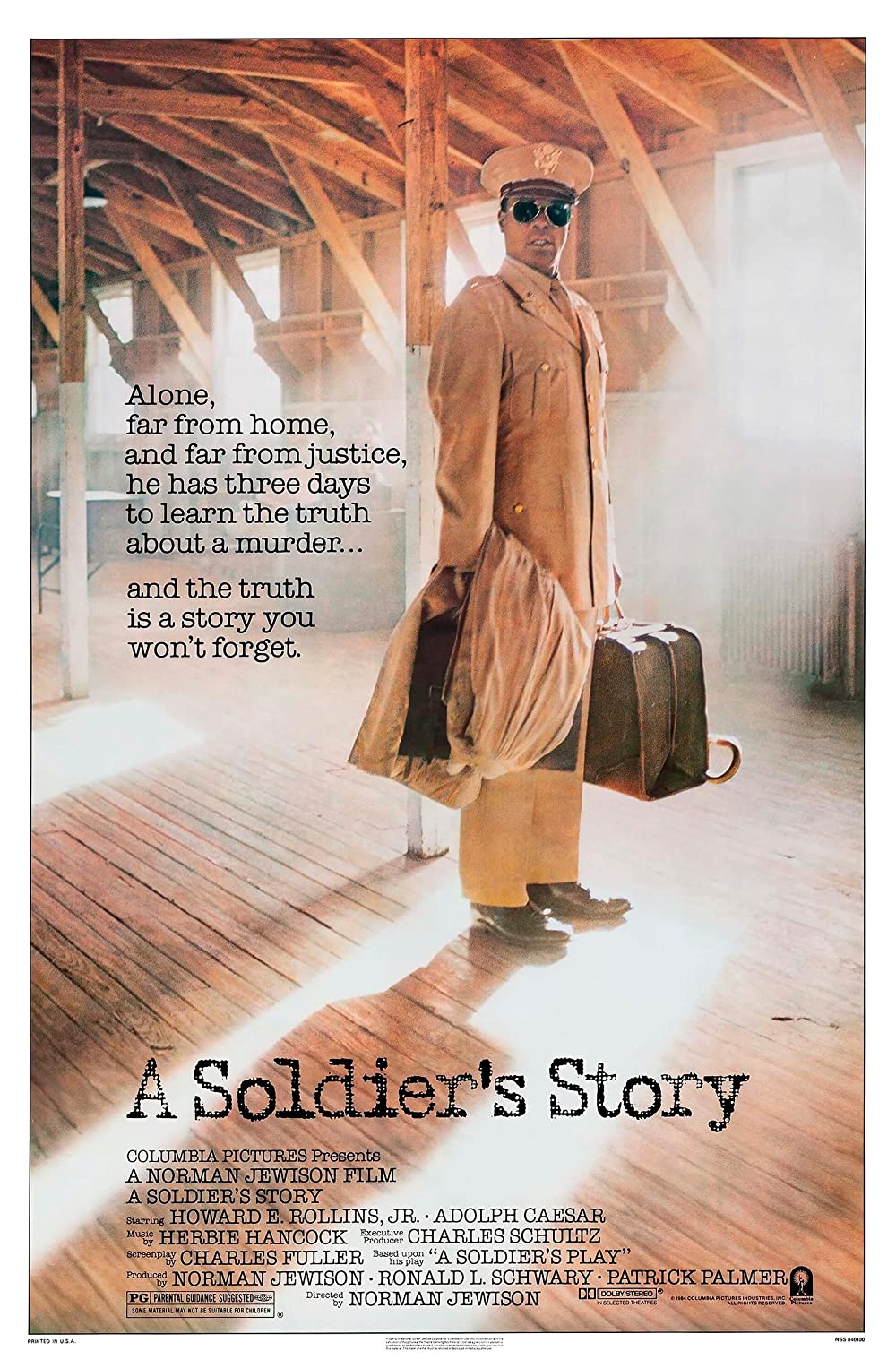 “A Soldier’s Story” opens up with the focus on a woman (Patty LaBelle as Big Mary). She’s not important to the story, but her voice and the lyrics she sings are. The film visually indicates how dangerous, how foolhardy it was in this Louisiana town to be both African American and drunk in public as we follow a drunk African American officer, Sergeant Vernon Waters (Adolph Caesar), staggering down the sidewalk. He pass a bench for White people and another for “colored.” The people we see have segregated themselves. Waters exclaims, “They still hate you!” before he’s shot in a dark wooded area by an unseen assailant. Unchanged: “A Soldier’s Story” opens up with the focus on a woman (Patty LaBelle as Big Mary). She’s not important to the story, but her voice and the lyrics she sings are. The film visually indicates how dangerous, how foolhardy it was in this Louisiana town to be both African American and drunk in public as we follow a drunk African American officer, Sergeant Vernon Waters (Adolph Caesar), staggering down the sidewalk. He pass a bench for White people and another for “colored.” The people we see have segregated themselves. Waters exclaims, “They still hate you!” before he’s shot in a dark wooded area by an unseen assailant.
The African American officer from the Judge Advocate General’s Corps, Captain Richard Davenport (Howard E. Rollins Jr.) arrives, but he isn’t welcomed by the commanding officer Colonel Nivens (Trey Wilson) nor the officer who has been pushing for an investigation, Captain Taylor (Dennis Lipscomb). Taylor is the only white officer in favor of a full investigation, but he fears that a Black officer, something most of the people–Black or White–at Fort Neal have never seen, will have little effect, especially if the perpetrators are White men with the Ku Klux Klan. Unchanged: The African American officer from the Judge Advocate General’s Corps, Captain Richard Davenport (Howard E. Rollins Jr.) arrives, but he isn’t welcomed by the commanding officer Colonel Nivens (Trey Wilson) nor the officer who has been pushing for an investigation, Captain Taylor (Dennis Lipscomb). Taylor is the only white officer in favor of a full investigation, but he fears that a Black officer, something most of the people–Black or White–at Fort Neal have never seen, will have little effect, especially if the perpetrators are White men with the Ku Klux Klan.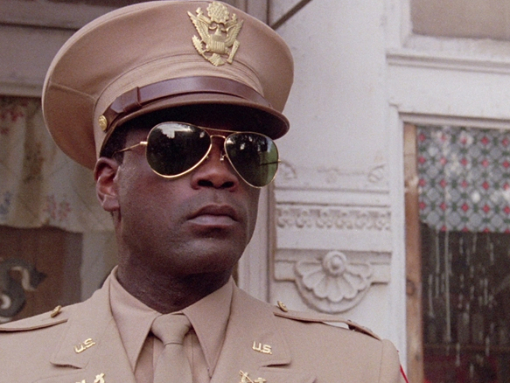
This particular company of soldiers are officially part of the 221st Chemical Smoke Generator Battalion and have been assigned menial jobs, yet because most of the soldiers are former players from the Negro Baseball Leagues, they have been used for entertainment. They play against other military teams and Waters had acted as their managers. Their success against White soldiers have made the company popular and there’s talk of a moral booster exhibition game against the New York Yankees.
Although nothing in the film or the play points this was a time when both Babe Ruth (1895-1948) and Lou Gehrig (1903-1941) were no longer part of the team, but the Yankee roster included Italian American Joe DiMaggio (His parents were considered enemy aliens and his father’s fishing boat was seized).
While Davenport is initially told by James Wilkie (Art Evans) that Waters got on well with the men, it becomes apparent that Waters’ had a pathological hate for Black soldiers from the rural South. Waters’ especially made a target of CJ Memphis (Larry Riley), a well-liked soldier who was not only a good baseball player and handsome, but also a good blues singer. Memphis is, by this time, dead from suicide and Davenport is able to figure out how the suicide and the murder are connected.
Davenport’s line, “Who gave you the right to judge? To decide who is fit to be a Negro and who is not?” is not in the play.
The film ends with Captain Taylor saying, “I guess I’ll have to get used to Negroes with bars on their shoulders, Davenport. You know, being in charge.” Unchanged: The film ends with Captain Taylor saying, “I guess I’ll have to get used to Negroes with bars on their shoulders, Davenport. You know, being in charge.”
Davenport replies, “You’ll get used to it, Captain. You can bet your ass on that. You’ll get used to it.”
Writing for Time magazine, Richard Corliss (4 February 2008) considered this film one of the top 25 films on race.
By “race,” Corliss just meant in terms of Black and White only.
A Soldier’s Play
 This is a striped back production. We never get a sense of the community outside of the military base. Waters (Eugene Lee) is murdered on a high platform at the back of the stage (set design by Derek McLaine), emphasizing his isolation from everyone–his men and his commanding officers. This is a play totally focused on men and the savagery of hate, but music and musical traditions of African Americans are present in the play.
Under the direction of Kenny Leon, the important of music within this troop is established, emphasizing how central the good-looking, musically talented CJ (Sheldon D. Brown) was to the moral of this particular troop.
The sergeant isn’t a big man. He’s small and a bit bent at the shoulders. In 1981, Lee originated the role of Cobb, a corporal who is CJ’s best friend. Now Lee playing the other side. Waters’ is a man driven by internalized racism. He has a particularly disgust for African American soldiers from the rural South who conform, or at least in his mind conform to White stereotypes of Black men. The death of CJ weighs heavily upon him and the topic of lynching becomes twisted into Fuller’s vision of Waters’ brand of toxic masculinity.

Photo by Joan Marcus
Compared to Rollins’ cinematic iteration of Davenport, Norm Lewis’ investigating African American officer seems more thoughtful. Rollins’ Davenport bristled with a sharp, cutting anger. Lewis’ Davenport reined his anger in to help energize and inspire his investigative impulses. William Connell’s Taylor is affable and well-meaning. Remember: He’s pushing for an inquiry where others would rather it die away.
There’s a sense if irony in the play because the truth is never really known. Davenport notes:
In northern New Jersey, through a military foul-up, Sergeant Waters’s family was
informed that he had been killed in action. The Sergeant was, therefore,
thought and unofficially rumored to have been the first colored casualty’
of the war from that county and under the circumstances was declared a
hero. Nothing could be done officially, but his picture was hung on a
Wall of Honor in the Dorie Miller VFW Post #978.
Taylor and Davenport do have the last exchange in the play. After Taylor asks Davenport, “Will you accept my saying, you did a splendid job?”
Davenport is at first sarcastic, but Taylor says:
The men— the regiment— we all ship out for Europe
tomorrow, and I was wrong, Davenport— about the bars— –
the uniform— about Negroes being in charge, I guess I’ll
have to get used to it.
Davenport replies:
Oh, you’ll get used to it— you can bet your ass on that. Captain — you will get used to it.
Yet whatever lessons were learned by the officers, were lost. The film has a more upbeat ending than the play which notes:
The entire outfit —officers and enlisted men— was wiped out in the Ruhr Valley during a German advance.
In the film, we as the audience can believe that perhaps men like the captain did learn and did do well by his men. In the play, all of what passed seems to have gone to waste with the wrong man honored.
As with the musical “South Pacific,” color-blind casting makes no sense with “A Soldier’s Story” or “A Soldier’s Play,” but even in the South, particularly in Louisiana, race matters wasn’t simply Black and White. There’s a sense of intra-racial prejudice that is a problem worth discussing in most ethnic groups in the US, and that’s not colorism, but rather the arbitrary lines and logic of being Black enough, Latino enough or Asian enough for some judgmental arbitrary group.
Coincidentally, this play was first produced when there was a high anti-Japanese sentiment (Japan-bashing) that resulted in the death of a Chinese American man. In Louisiana (1992), there was a Japanese boy was shot and killed for knocking at a door. Now, this national tour arrived in Los Angeles when anti-Chinese/anti-Asian sentiment is again at a high. While it is sometimes understandable that a playwright might want to simplify a situation to focus on something specific, it should also be acknowledged that the work diverges from reality. Racism in the US doesn’t existed on a binary of Black and White. Asian Americans, including Japanese Americans, were in Louisiana both as suspected enemies and as fellow military men.
The play was an Off-Broadway production by the Negro Ensemble Company, opening in 1981 with Adolph Caesar as Sergeant Waters, Denzel Washington as Private Peterson and Larry Riley as Private CJ Memphis. All three reprised their roles in the film. Samuel L. Jackson was Private Louis Henson in the original cast.
This is not the first time “A Soldier’s Play” has been performed at the Center Theatre Group. In 1982, the Mark Taper Forum had a production which starred Denzel Washington and Adolph Caesar.
This national tour of the play by the Roundabout Theater Company was the play’s Broadway debut, and opened in January 2020, but was closed after 55 performances due to COVID-19 pandemic safety measures. Instead of reopening on Broadway, the production began its national tour in 2022. Unchanged: This national tour of the play by the Roundabout Theater Company was the play’s Broadway debut, and opened in January 2020, but was closed after 55 performances due to COVID-19 pandemic safety measures. Instead of reopening on Broadway, the production began its national tour in 2022.
“A Soldier’s Play” continues at the Ahmanson until 25 June 2023. For tickets and more information, visit the Center Theatre Group website.
 Age of the Geek