
- Pennsylvania teens get probation after using AI to create fake nudes of classmates (26 March 2026)
- ‘Disturbing incident’: Police investigating after Lake Zurich High School students distribute AI-generated nude images of classmates (3 April 2026)
- Sam Altman: CEO of OpenAI
- Daniela Amodei: President and Co-Founder of Anthropic
- Emily M. Bender: Linguistics Professor at the University of Washington
- Yoshua Bengio: Turing Award Co-Winner
- Liv Boeree: Game Theory Expert
- Ajeya Cotra: AI Risk Advisor
- Peter Diamandis: Founder and Chair of XPRIZE and Singularity University
- Random Fernando: Co-Founder of the Center for Humane Technology
- Karen Hao: AI Reporter
- David Evan Harris: Chancellor’s Public Scholar at UC Berkeley
- Sanmi Koyejo: Assistant Professor of Computer Science at Stanford
- Peter Lee; President of Microsoft Research
- Deborah Raji: Researcher at UC Berkeley
- Ramesh Srinivasan: Professor of Information Studies at UCLA
- Rocky Yu: CEO of AGI House
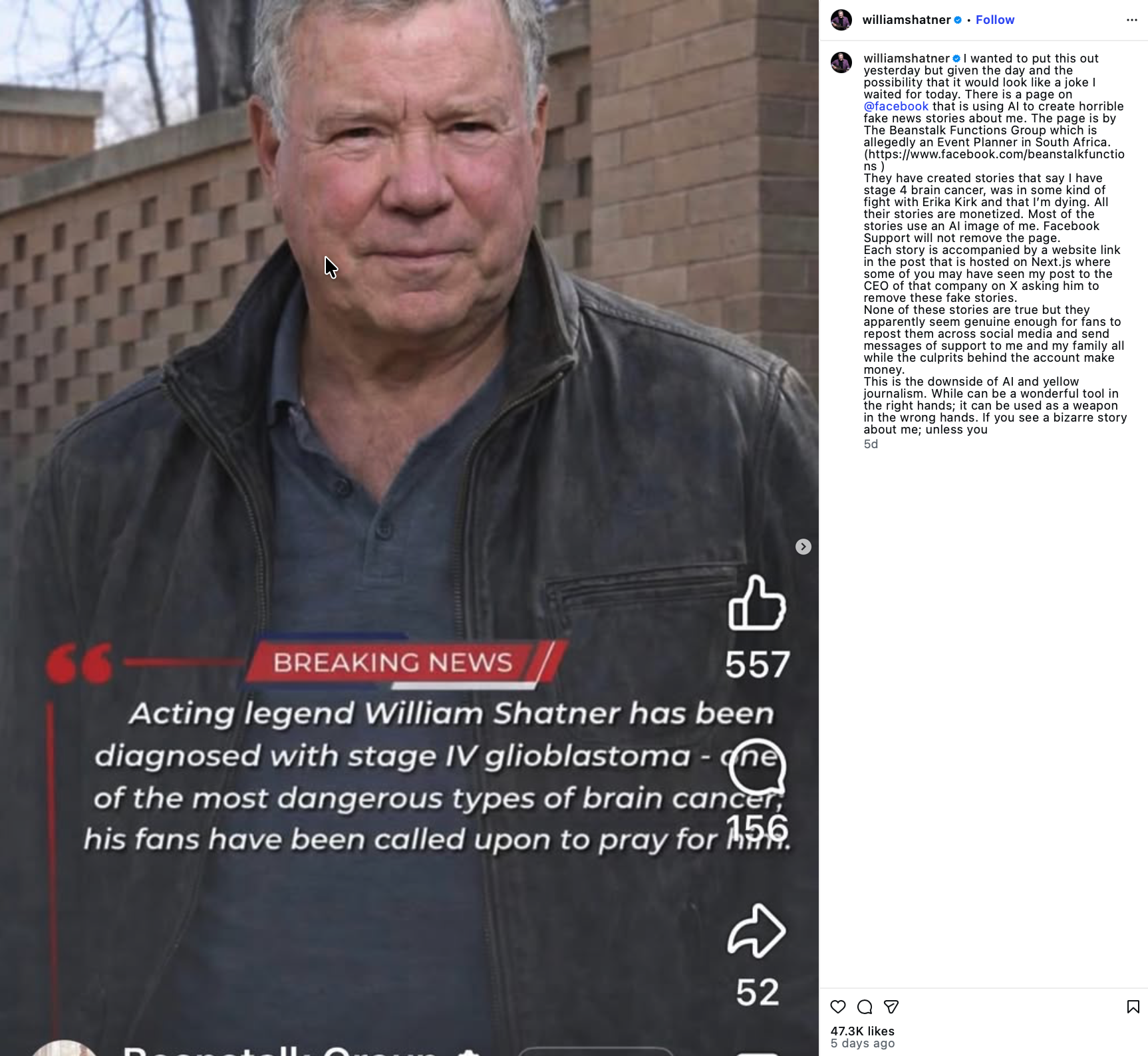
Overall, while this documentary is mildly entertaining, it is also self-indulgent and very self-aware. Don’t expect anything too controversial. We’ll hear both sides: the good and the bad. But there are things we don’t hear. We won’t hear from people who have suffered because of AI, including actors and artists. I know the problem with William Shatner is too recent to be included, however, the question of the movie extras or background actors being used and reused is an issue that could have been addressed.
- ‘Have We Done ourselves out of a Job?’: Concerns in Film and TV Industry Over on-set Body Scanning (17 October 2025)
- Movie Extras Worry They’ll Be Replaced by AI. Hollywood Is Already Doing Body Scans (2 August 2023)
There’s no one from Caltech or MIT. While mention is made of both China and Taiwan, we don’t hear experts from there either. Considering the acceptance of technology in Japan and South Korea, and the more collective approach in their societies, I wanted to hear experts from those areas as well.
One of the questions that has long been asked by science fiction writers but isn’t asked in this film is can computer programs teach ethical behavior? Can computers be programmed to have empathy and perceive the rewards of kindness and friendship. To a large extent Star Wars is the story of C3Po and the Droids are built and act in a manner that the audience should feel sympathy for them. They are lovable. In “Star Trek: The Next Generation” one major storyline is the dilemma of Data. Is he a sentient being and should he have the same individual rights as biological members of the Federation or is he merely property of the Starfleet. In Star Wars, some Droids definitely have both empathy and ethics. My husband pointed out, the question of programing in ethics was not addressed in this documentary.
2026 ‧ Documentary ‧ 1h 44m
 Age of the Geek