
Life as a foreigner–away from friends and family, can be lonely. Even if one isn’t a foreigner, life in a big city like Tokyo can be lonely. In Japan, there’s a pragmatic practice, renting a person to fulfill different roles and that includes the titular “Rental Family.”
I moved away from my hometown after I graduated, but I was only a two-hour drive away from home. I’d later move overseas for as long as a year to be an exchange student. Often I was connected to a university or study program. I’d find comfort in my religious community or classmates, but some people don’t have that.
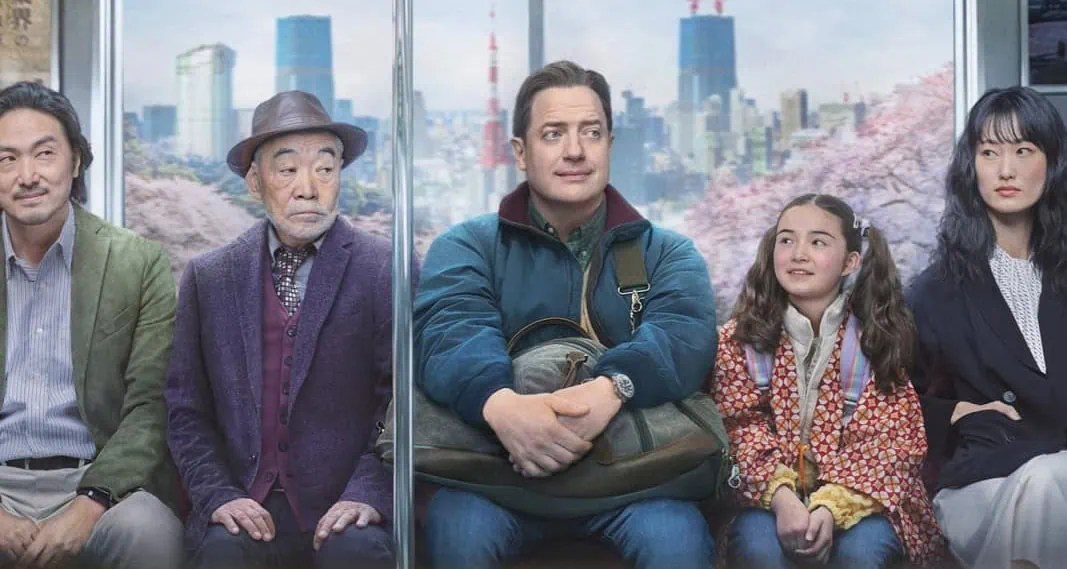 Such is the case with our protagonist, Philip Vandarploeug (Brendan Fraser). After initial success as the goofy mascot in a Japanese toothpaste commercial, he’s been desperately drifting from audition to audition, only being rewarded with minor roles for seven years. When we first see him, he’s rushing through Shibuya station on the way to another audition. Philip ends up going first to his favorite bar, noticeably discouraged. He returns to his Japanese-style apartment looking out of his balcony while drinking a beer, observing the lives of brighter, seemingly happier people in another apartment building.
One day his agent tells him to rush out to from Tokyo to Saitama (埼玉県) for a role as a “sad American” that pays well. No audition required. He arrives a little late, but sits in on a funeral. Afterward he is thanked by the organizer, Shinji Tada (Takehiro Hira). Shinji is the owner of the titular company, Rental Family. Shinji explains that Philip could be the agency’s “token White guy,” adding, “What I’m offering here is a chance to play roles with real meaning. ”
At first, Philip isn’t totally convinced despite some help from his coworkers Aiko Nakajima (Mari Yamamoto) and Kota (Kimura Bun). His first big role is as the fiancé of a much younger woman (Misato Morita) bound for a life in Canada after her pretend wedding in a luxury hotel. Philip gets stage fright because, “It’s a lie; I’m messing with people’s lives.”
Yet the woman seems happy and Philip becomes a regular cast member. He’s a friend to play video games or a cheerleader at a karaoke bar. His two longest running gigs are as a reporter interviewing a famous actor Kikuo Hasegawa (Akira Emoto) at the bequest of his daughter Masami (Sei Matobu) to help with her father’s dementia and as the father of a hapa girl Mia Kawasaki (Shannon Mahina Gorman) whose mother, Hitomi (Shino Shinozaki), wants a fake father figure to help bolster Mia’s application into an exclusive private school.
While Philip’s assignments tend to be easy and lucrative, Aiko’s specialty entails enduring angry wives and possible battery. She pretends to be the mistress of a husband brought to be confronted by the wife. For that, getting slapped is part of the job and luckily Japan has national health services.
Yet while Philip is giving meaning to lives, he’s also forming real feelings that are reciprocated. This is a real industry and if you’re wondering why the PG-13 rating and why I won’t call this family friendly, there are definite adult themes. Hikari and Stephen Blahut’s script is nonjudgmental as it takes us to a discretely shot (by Takurō Ishizaka) live sex show and shows us Philip’s relationships. It’s an interesting juxtaposition: A tentative faux father-daughter between Philip and Mia against Kikuo and Masami next to the sexual, voyeuristic side of men. So unless you want to explain the sex industry in Japan or in your community to your kids, you make this an adult only viewing.
As director Hikari has a sensitive and light hand and she uses all of Fraser’s affable golden retriever-ish charisma without losing the film’s relatable reality.
This whimsical and heartwarming comedy is a gentle look at the human condition of loneliness and a distinctly Japanese solution.
“Rental Family” had its world premiere at the Toronto International Film Festival on 6 September 2024. It was one of the special screenings at AFI FEST in October. The film is scheduled for release in the US by Searchlight Pictures on 21 November 2024.
 Age of the Geek