
The opening film for this year’s Animation Is Film festival in Hollywood at the TCL Chinese Theatre, “Scarlet” or “Hateshinaki Sukāretto” (果てしなきスカーレット) dealt with time, space and vengeance with a decidedly Shakespearean touch. Written and directed by Mamoru Hosoda, the first screening sold out and was followed by a brief talk by Hosoda.
A North American and European audience will likely immediately recognize the names of some characters: Claudius, Polonius, Laertes and Rosencrantz and Guildenstern. These names are from the Tragedy of Hamlet.You might not recognize some less prominent characters from Shakespeare’s Hamlet such as Cornelius and Voltemand. These were courtiers of Claudius’ court who were sent to Norway to implore that king to restrain his nephew, Fortinbras. Fortinbras is threatening Denmark.
Yet there is no young man at the center of Hosoda’s “Scarlet.” The protagonist, Scarlet (voiced by Mana Ashida), doesn’t have a brother. She is the much beloved daughter and only child of the king, Hamlet (Masachika Ichimura).
If you recall in Hamlet, Fortinbras will appear to claim Denmark. His father, also named Fortinbras, had been killed by Hamlet’s father, also Hamlet, in a duel. Fortinbras is convinced to attack Poland instead of marching into Denmark. Yet at the very end of Shakespeare’s tragedy, Laertes, Claudius, Gertrude and Hamlet are dead, and Fortinbras enters the court. Before he died in Horatio’s arms, Hamlet had named Fortinbras his successor. Fortinbras takes the crown and declares that Hamlet will have a military funeral.
In “Scarlet,” writer/director Hosoda begins the film toward the end, with a woman dressed in a white gown looks toward the figure of a man approaching. We will revisit this scene, but before that, we’ll learn how Scarlet came to wear a dress that to modern audiences would seem like a modest bridal dress, but in some traditions, white is associated with death.
Scarlet as a child loved her father (Masachika Ichimura) who doted on her. Her mother, Gertrude (Yuki Saito), seems cold and, is having an affair with her husband’s brother, Claudius (Koji Yakusho). Neither her father, Amlet, nor Claudius seem concerned that there is no son. Claudius and Gertrude are able to get Amlet sentenced to beheading. Scarlet partially witnessed the execution, leaving her vantage point to run down stairs to be in the courtyard. What she missed due to distance and timing holds the key to her eventual transformation. Knowing the treachery of her mother and uncle, Scarlet trains in martial arts, determined that she will avenge her father.
That revenge involves poison which leads to Scarlet falling into a world that has no time, but people can disintegrate into nothingness. This is a barren world, devoid of the civility of European courts and Scarlet’s martial arts training comes in handy. She learns that her uncle holds sway in this land. Determined to have her revenge, she attempts to find him.
 Yet a man from the future, falls into her orbit. Hijiri (Masaki Okada), is a man from modern times, still wearing the uniform that identifies him as a first responder (Emergency and Critical Care Center ). What Japanese will immediately recognize is that there is much import attached to a name.
Here one might infer a relationship with another tale of enemies, out for revenge: the Capulets and the Montagues. This isn’t inherently in the text or the visual representation of “Scarlet,” but for Western audience members, who should consider Juliet’s contemplation: “What’s in a name? That which we call a rose by any other name would smell as sweet: so Romeo would, were he not Romeo call’d, retrain that dear perfection which he owes without that title.”
Hijiri
One of the convenient conventions of Japanese manga and anime is that names often have meanings. In “Scarlet,” this is clearly obvious to speakers of Japanese and those familiar with Japanese Buddhism and people seriously into manga. Hijiri can be a surname, and a given name such as soccer’s Hijiri Kato (加藤 聖) or Hijiri Onaga (翁長 聖) and has been used as both the surname and given name of manga characters.
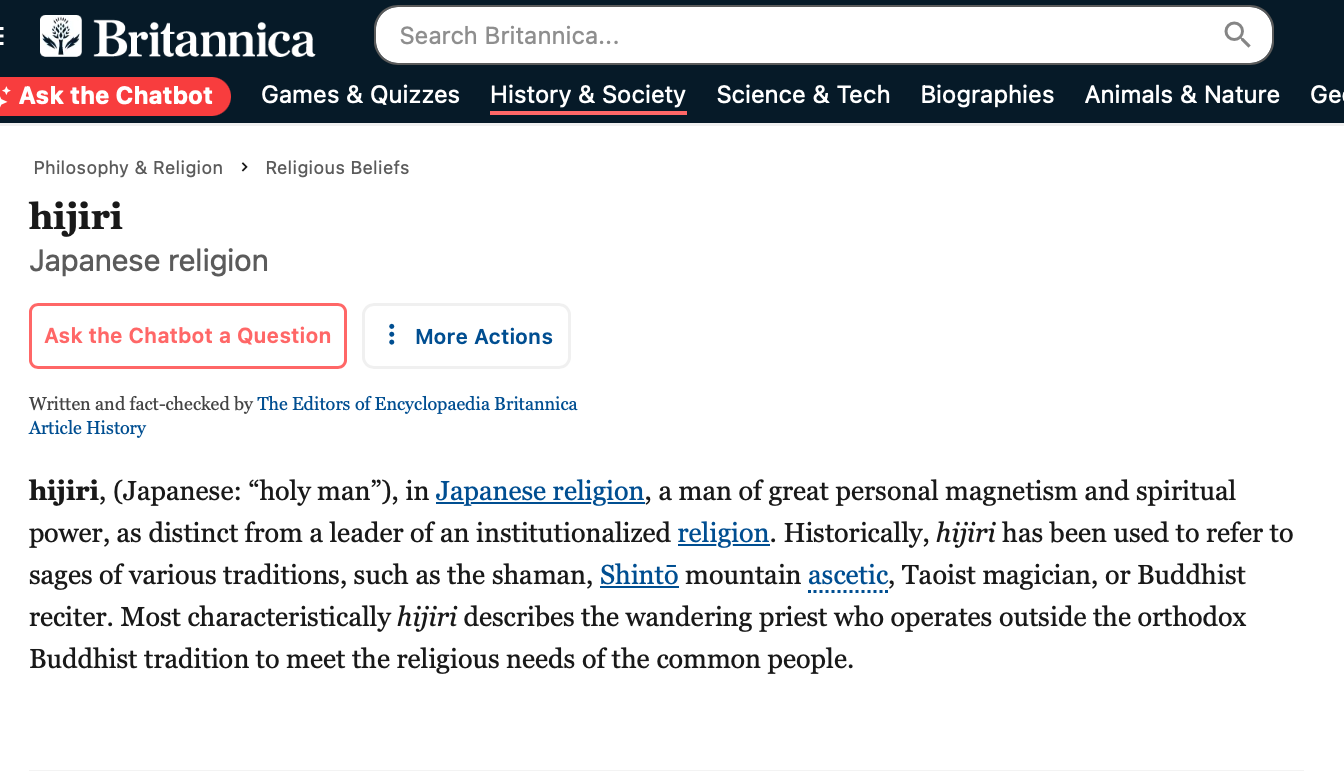 However, as a noun, “hijiri” is defined in Britannica as ” hijiri, (Japanese: “holy man”), in Japanese religion, a man of great personal magnetism and spiritual power, as distinct from a leader of an institutionalized religion. Historically, hijiri has been used to refer to sages of various traditions, such as the shaman, Shintō mountain ascetic, Taoist magician, or Buddhist reciter. Most characteristically hijiri describes the wandering priest who operates outside the orthodox Buddhist tradition to meet the religious needs of the common people.”
In the “Kodansha Encyclopedia of Japan” (1983), hijiri is defined as:
A holy man. Although the term dates from pre-Buddhist times and was even an appelcation of the emperor, it came to mean by the middle of the Heian period (794-1185) Buddhist holy men who led lives of itineracy or ascetic retreat. Some were ordained, others were not. Initially, they were independent of, and occasionally in opposition to, the official Buddhist institutions. Notable among these early hijiri was Kūya (also Kōya, 903-972), the “hijiri of the market,” who urged the common people to chant the name of the Buddha Amida. Many other hijiri were devoted to the Lotus Sutra.
In the 11th and 12th centers, hijiri were organized into formal groups chartered by the great Buddhis temples for purposes of fund-raising. Chief among these groups were several based at Mt. Kōya (K aoyasan). The hijiri of Mt. Kōya were responsible for the spread of legends about Kūkai, the founder of the temple complex on the mountain. Perhaps the most prestigious hijiri organization, however, was that founded by Chōgen (1121-1205), who was appointed in 1181 (Yōwa 1).
Hijiri thus became a permanent feature of medieval Japanese Buddhism and a major factor in the spread of Buddhism to the Japanese masses. From institutions usually called bessho (literally, “separate places”), which enjoyed a franchise granted by a parent temple, they traveled throughout the country preaching and raising funds. Their fund-raising, called kanjin, consisted of distributing talismans (fuda), having a Buddhist icon printed in the name of a believer, or having some other devotional act performed at the temple, all these in exchange for a contribution. Contributors’ names would then be enrolled in a register, which was kept at the temple or even placed within images built by such funds. In their preaching, the hijiri drew from legends of the temple they represented, often illustrating their talks with picture scrolls, as well as relying on dramatic and musical techniques. They were thus a major force in the establishment of popular literature and performing arts. Theses hijiri are also called bessho hijiri, kanjin hijiri, and yugyō (wayfaring) hijiri. Two Pure Land Buddhist groups, the Ji Sect and the Yūzū Nembutal Sect drew heavily on the traditions and techniques of hijiri.
In the 16th and 17th centuries, many hijiri settled in villages to minister to local congregations, and some hijiri groups evolved into craft or performance guilds.
Keep in mind that the character for hijiri (聖)is also used for the Japanese word for the Christian Bible (聖書).
This isn’t a contrast between Buddhism and Christianity, but of the nature of revenge versus forgiveness. Shakespeare’s “Hamlet” showed the parallel between three sons avenging their fathers: Hamlet, Laertes and Fortinbras. Perhaps that is the tradition of men among other men, but Hosoda takes that away when he replaces the son Hamlet with a daughter. While in Shakespeare’s “Hamlet,” Ophelia and Gertrude were innocent bystanders, not so for Hosoda’s Gertrude. There is an ill-fated romance, but one that might draw more from Tanabata than Shakespeare.
While it seems at first that Hijiri is ill-suited for this world where life and death co-exist across time, and violence is a daily danger, Scarlet learns what this world is meant to be and what life could be.
Besides bringing Shakespeare into an anime world, this animation also blends photorealistic CGI style with hand-drawn animation. The result is not always successful, but it does have moments of impact. Yet there are so many moments of anime melodrama, when Scarlet must cry and scream and sweat and more focus and time is allowed for that than would be in a live-action feature.
At a time when people in the political sphere seem to be focused on retaliation and vengeance, when so much time and tax dollars seem to be devoted to vindictive actions. “Scarlet” seems a timely cautionary tale about how being in the revenge game can be counter productive to love and a productive civilization.
While Hosoda noted through an interpreter that the film was really hot out of the oven–it won’t be theatrically released in Japan until November (21 November 2025), and it was making its West Coast premiere at Animation Is Film, the film made its world premiere at the Venice Film Festival in early September and its North American premiere the next week at the Toronto International Film Festival.
“Scarlet” made its US premiere at the New York Film Festival on 7 October 2025. So far, there is no scheduled release date for the US.
 Age of the Geek