
Although I do feel the Pedro Pascal is everyone’s favorite “dad” at the moment, I resisted seeing “Gladiator II” (styled “GLADIIATOR” in the beginning titles on screen). I had not watched the first film and wasn’t sure a sequel was necessary.
Sequels should either further the story and build depth upon the characters or expand the universe in a way that also expands the legacy. “Gladiator II” destroys much of the first film’s legacy and some of that is hinted at even in the trailers.
Let’s start with the original “Gladiator” which was not a Christmas/holiday blockbuster. It was released in May 2000 in the UK and the US by DreamWorks Pictures and Universal Pictures. The film was nominated for 12 Oscars and won five: Best Picture, Best Actor (Russell Crowe), Best Visual Effects, Best Sound and Best Costume Design.
Gladiator (2000) ⭐️ ⭐️ ⭐️
The film begins with a prologue:
At the height of its power, the Roman Empire was vast, stretching from the deserts of Africa to the borders of Northern England. Over one quarter of the world’s population lived and died under the rule of the caesars.
In the winter of 180 A.D., Emperor Marcus Aurelius’ twelve-year campaign against the Barbarian Tribes in Germany was drawing to an end. Just one final stronghold stands in the way of Roman Victory and the promise of peace throughout the empire.
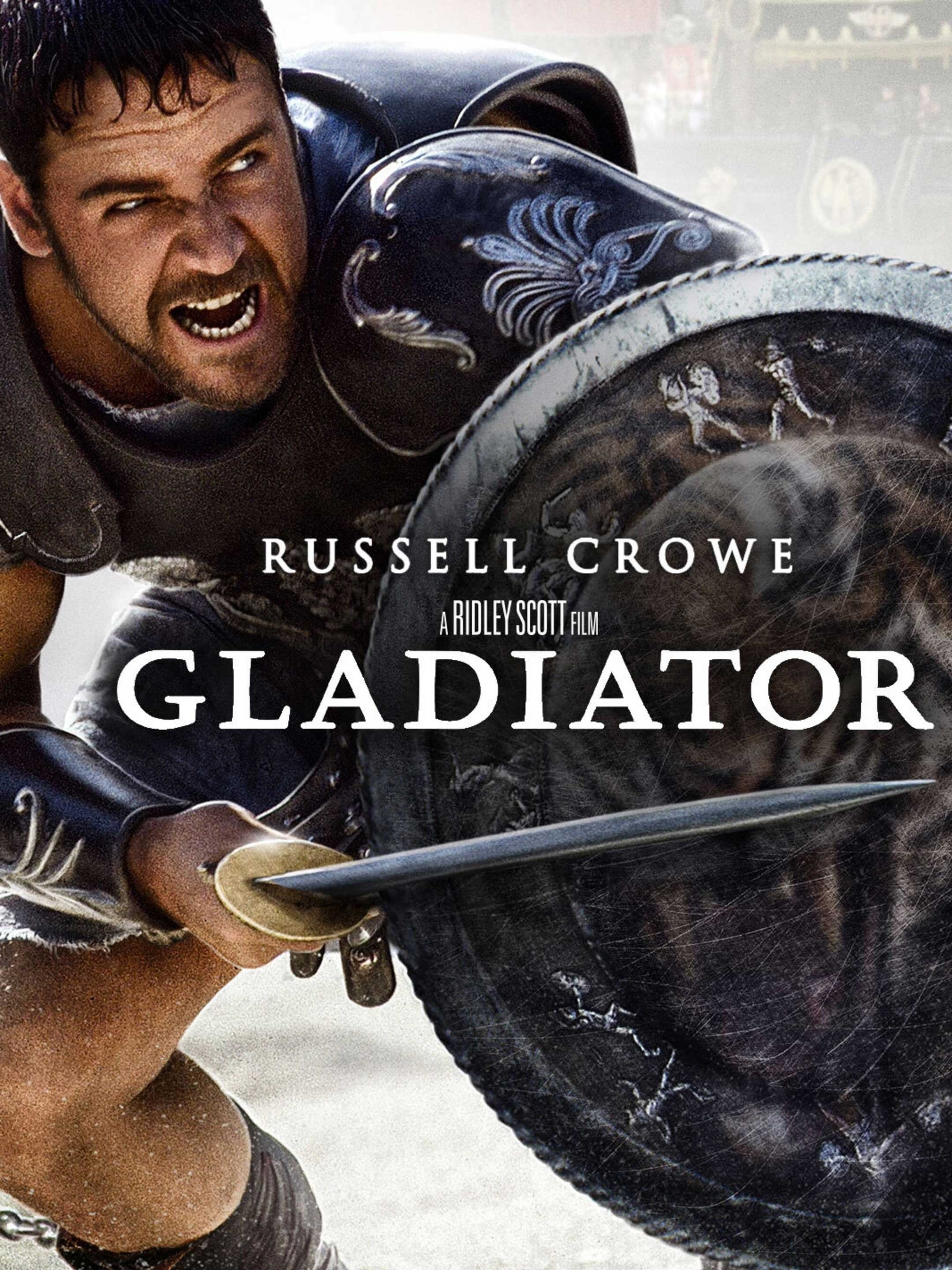 The first scene are just of a hand with one ring touching the grain in a sun-drenched field, but we aren’t really there. That’s the imagination of our hero, the fictional Roman general Maximus Decimus Meridius (Russell Crowe). He’s leading the Roman army against the Germanic barbarians near Vindobona, (present-day Vienna) for the now elderly Emperor Marcus Aurelius (Richard Harris).
They’ve sent a messenger to ask the barbarians to surrender. The Germanic tribes send him back, a headless corpse riding on a white horse. Then, the barbarians throw the man’s head. We don’t know what they’ve said, but the Romans get the message. Through the forest, Maximus rides with his trusty dog (a German Shepherd?). His breastplate bears the silver wolf head in the middle and two horses facing to mirror each other in the mid-section. I’m not sure what is in the middle, and I’m not sure the Romans had that technology in metal smithing at the time.
Maximus tells his soldiers:
Imagine where you will be and it will be so. Hold the line. Stay with me. If you find yourself alone, riding in green fields with the sun in your face, do not be troubled for your are in Elysium and you’re already dead.
What we do in life, echoes in eternity.
The battle scenes are filled with chaotic killing, but the Romans win. Although Maximus tells his emperor that he wishes to return home, having been away for nearly three years, the emperor wishes Maximus to succeed him, to be not the ruler, but a regent to guide the Roman Empire back to a republic. There are moments here where musical fans might recall that Harris once portrayed King Arthur in the 1967 musical film, “Camelot.”
The emperor has summoned his daughter, the widowed Lucilla (Connie Nielsen), and his son, Commodus (Joaquin Phoenix). Lucilla and Maximus have a history together which is not elucidated but they have something in common: 8-year-old sons.
The emperor unwisely spends time alone with his son and informs Commodus that Maximus will be regent. Commodus doesn’t take this news well. That father-son talk ends with the father dead and the son proclaiming himself the new emperor. Maximus suspecting murder, cannot swear loyalty to Commodus and that dooms him and his family.
While the guards fail to kill him, the men sent to kill his wife and child do not. Yes, the great general doesn’t have loyal guards, big dogs or even fortified walls around his home for protection. He was probably thinking about that while he was riding hard enough to kill two horses. Maximus arrives on foot to find his son and wife dead. Depressed and exhausted, Maximus is captured by slavers, befriended by a Black slave (Juba played by Dijon Hounsou) from Numidia, taken to Zuccabar in the Roman province of Mauretania Caesariensis (present-day Miliana, Algeria) and bought by a former gladiator Proximo (Oliver Reed). Proximo advises that his gladiators not to just win, but to find favor with the crowd.
Commodus hopes to win over his fellow Romans by staging 150 days of gladiatorial games in memory of his more popular father. Proximo decides to take his stable which includes the three amigos: Maximus the Spaniard, Juba from Carthage and Hagen (Ralf Möller) from Germania.
The film is beautifully shot and well-lit. The reconstructions are lavish although as someone who has dabbled in metal smithing, I wondered if the Romans had the metal smithing technology to produce the breastplates as represented. Sometimes I wondered why the script (initially by David Franzoni based on the 1958 Daniel P. Mannix book “Those About to Die,” and then worked on by John Logan and William Nicholson) didn’t include more allusions to the gods, Roman or otherwise, and the Fates. Both films do include references to things I thought were more Christian. “At my signal, unleash hell” is what Maximus says in “Gladiator,” and “devil’s breath” is the name given to an opiate treatment in “Gladiator II.”
 This is a film about men for men because we’re not really concerned about the women except in how they relate to men. The only female character of note is Lucilla who is the daughter of an emperor (Marcus Aurelius who wished she had been a man), the sister of the succeeding emperor (Commodus) and the former lover of the main character (Maximus).
Before their final confrontation, Commodus does taunt Maximus, saying that his wife was raped before she was murdered and moaned like a whore, but we never witness that kind of barbaric behavior by the soldiers from either side although anyone who has taken European art history knows how casual and frequent the depiction of rape is.
For women, the emotional pull is that a great man, Maximus, could be motivated not only by the love for his wife and their child but for a noble cause that would grant future generations greater freedom. That is obliterated by the sequel.
History
In real life, Marcus Aurelius dies in Vindobona (modern Vienna, Austria) and is succeeded by his son Commodus who is only 18. Commodus died at age 31, killed in 192. He was succeeded by Pertinax , then Didius Julianus, Pescennius Niger, Clodius Albinus and finally Septimius Severus, all in one year, 193 A.D. Septimius Severus died in 211 and is succeeded by his sons by his second wife (Julia Domna): Caracalla (188-217) and Geta (189-211).
Elsewhere, the Han Dynasty had already been established (206 BC to AD 220). The Great Wall of China (萬里長城) had already been started by the first emperor of China, Zin Shi Huang (220-206 BC) although the best known sections were built during the Ming Dynasty (1368-1644).
Tea was known by the time of Confucius and was growing in popularity during the Han Dynasty. By the Tang Dynasty, tea was popular beyond the court circles.
According to Britannica, papermaking can be traced back to China in AD 105. It reached Central Asia in 751 and the first paper made in Baghdad was in 793.
The Chinese discovered printing by the end of the 2nd century CE according to Britannica. The Chinese also had moveable type by the 11th century.
What the Chinese did not have was blood sports like the Romans. If you know different, LMK.
GLADIIATOR or Gladiator II ⭐️ ⭐️
Due to scheduling issues, I missed the press view that included a panel, but with a sudden opportunity to see it at the DGA, I decided to embrace the fishiness and find out more about this shark-jumping. I pulled on my shark sweater, my shark shirt and my shark jacket and socks.
I already knew there were no sharks brought into the Colosseum in Rome. How would they have transported them? I know what baboons look like. I know that rhinos are not for riding.
The beginning credits are a masterful painterly summation of the first film, but David Scarpa (“The Batman” and “Top Gun: Maverick”) and Peter Craig’s script (“Napoleon”) belligerently batters that legacy. It’s probably worth nothing that “Napoleon” wasn’t well received by the French.
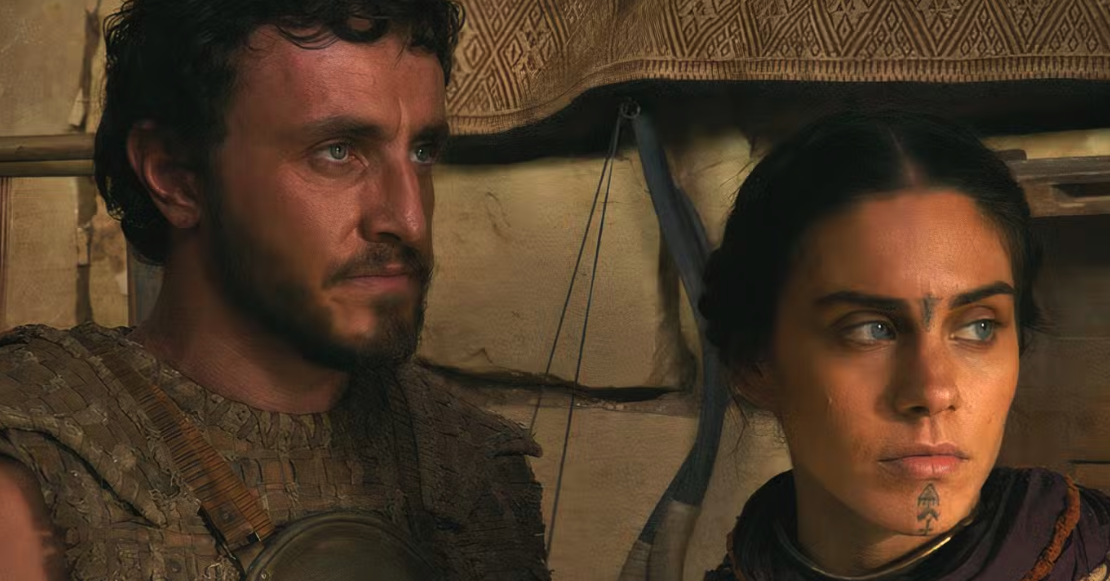 At the heart of this film is a man, Hanno (Paul Mescal), and wife Arishat (Yuval Gonen), living in the North African Numidia (Northeast Algeria). Their fortified city comes under attack by the Roman navy led by General Acacius (Pedro Pascal). Arishat and Hanno are both at the city walls during the battle. Arishat, an archer, shoots and fatally wounds a bestie of the general. Losing his cool, Acacius wrests a bow from one of his soldiers and shoots and kills Arishat, with one arrow. What are the odds amid hoards of other archers? This is eye-rolling plotting. In any case, the city is defeated by the Romans and a bitter Hanno rages to avenge his wife’s death.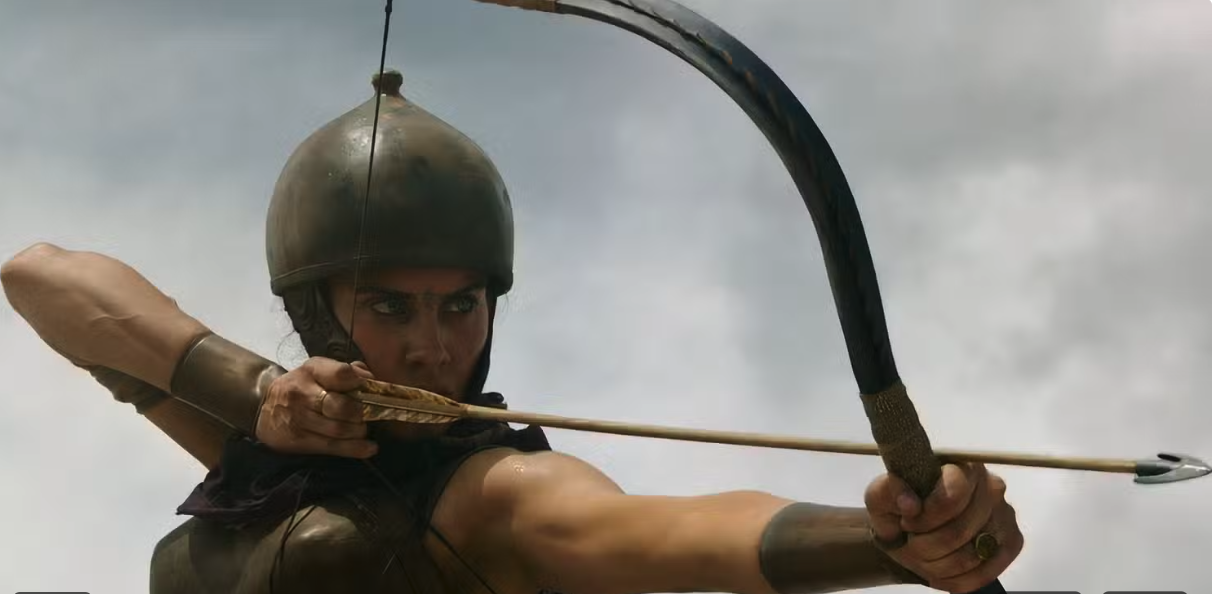
Taken to the Roman city of Ostia, Hanno impresses former gladiator Macrinus (Denzel Washington) by using his chains to strangle a baboon. Macrinus tells Hanno to embrace his rage and Macrinus will give Hanno a chance to kill Acacius. Of course, Hanno also picks up a Black bestie, Jugurtha (Peter Mensah).
Acacius returns to Rome a war hero, but he serves under a giggling pair of buffoons: brothers Caracalla (Fred Hechinger) and Geta (Joseph Quinn). This twosome are best at parties which feature an up-close-and-personal fight to the death or presiding over increasingly spectacular gladiator games. At one such party, Hanno bests his adversary, adding to the financial woes of the host, Senator Thraex (Tim McInnerny), and revealing his knowledge of Virgil’s “Aeneid.”
This is not exactly a set back for Macrinus who is as slithery as a snake looking at a fat mouse for lunch. Marcinus is based on historical figure Marcus Opellius Macrinus like Lucilla, Geta and Caracalla.
In Rome, we learn that Acacius is married to Lucilla (Connie Nielsen) and with the revelation that Hanno is really Lucius, the son of Lucilla and more importantly for this saga, the son of Maximus, we have Lucius hoping to kill the man who would be his stepfather who cannot kill him because of his love for Lucilla. Is that complicated enough? Of course not. Lucilla is disgusted by Caracalla and Geta, and plots with older senators like Senator Gracchus (Derek Jacobi) who remember her father, to bring down the two emperors.
I’ll admit it is hard for me to get over that a Roman emperor had the name of a shoe, but there was a real emperor by that name although the script mixes up the actual historical timelines.
For me, the film’s best part are the opening credits. The wild improbability of Arishat’s death was the beginning of the end of believability. Be assured, the sharks, the blood-thirsty rabid baboons, the rhino riding were not the only problems. The writers casually added a cafe scene which made me think they were drinking too much and too often at Starbucks. In addition, news is relayed by a newspaper. Rome did not have paper nor printing by moveable type. This seems like little more than lazy scripting. The screenplay of “Gladiator II” does moves history into the CGI alternative universe realm.
While for the first film I wasn’t sure about the historical accuracy of the metal smithing, in “Gladiator II” I also wondered about the extensive use of brocade. On the technical side, at times the lighting was questionable in the second film, “Gladiator II.” Some fill or reflected light would have helped some scenes.
As far as diversity goes, the casting of Washington is problematic. This isn’t the only time that movies have gone for simplistic Black and White. Consider the French language “The Intouchables” and the Hollywood remake “The Upside.” In both France and the US there is prejudice against North Africans and West Asians and erasing them from history certainly doesn’t help their representation.
In addition, we have a newly elucidated backstory between Lucilla and Maximus: Maximus got his wife and Lucilla pregnant during the same year. Is Maximus’ wife nothing more than a Penelope to his Odysseus, faithful despite her husband’s infidelities? If there was a “Gladiator III” would we find more Maximus offspring in the Colosseum? Is this the definition of a great man in the era of Donald Trump and Elon Musk and the man with a 1000 kids: mighty men should spread their sperm everywhere?
In conclusion, Denzel is delicious but no Berber, something that Washington admitted. Jacobi is wasted. A whole lot of sharks were jumped, and the sharks, babboons and the rhino riding unnecessarily expanded the budget without benefiting the story. Instead, an Oscar-winning legacy of a serious dramatic depiction of a time period was destroyed with an additional note that North African/West Asian erasure continues. I’ve previously called this “black out,” but the article in L’expression calls it “blackwashing.” Diversity in 2024 needs to go beyond Black and White and Black/African American performers should consider that as well.
“Gladiator II” premiered 30 October 2024 in Australia. It was released in the UK on 15 November 2024 and in the US on 22 November 2024.
 Age of the Geek