
Before I saw “Seven Samurai” on television for the first time, I watched Yul Brynner lead six men into a small Mexican village and help farmers rid themselves of the tyranny of bandits in the television version of “The Magnificent Seven.” My first viewing was on a black-and-white television so I didn’t get the full beauty of the film or the problematic makeup design.
By 1960 when “The Magnificent Seven” came out, director John Sturges (“Gunfight at the O.K. Corral,” 1957) had already directed what would become a classic Western and would go on to direct a classic World War II film, “The Great Escape,” in 1963. The screenplay was written by William Roberts along with uncredited writers Walter Bernstein and writer Walter Newman (“Cat Ballou,” 1965).
Like the “Seven Samurai,” the film begins with the bandits. Instead of looking at the village and deciding to wait until the crops are ready, they ride into the Mexican village for food and supplies. The leader, Calvera kills a villager. The villagers decide they will fight back and consulting with an elder, three village men take their few objects of value to a town in the United States, hoping to trade for guns.
At the town, they see a Cajun gunslinger, Chris Adams (Yum Brynner), joined by an adventurous stranger, Vin Tanner (Steve mcQueen), force the town to allow a Native American to be buried in the cemetery. Chris impresses the village trio and advises that “men are cheaper than guns.” Chris agrees to recruit gunslingers. Harry Luck (Brad Dexter) comes on board, believing that there must be some great bounty–a gold or silver mine or something. Irish Mexican Benardo O’Reilly (Charles Bronson) is a man who belongs neither among the already marginalized White Irish nor the Mexicans. He’s reduced to chopping wood for food and joins because he is broke. Britt (James Coburn) is a knife throwing expert who’s also handy with a gun. He’s the one who has a mock challenge that turns deadly. Lee (Robert Vaughn) is the well-dressed fast draw who is traumatized by killing and death, but still joins. Although set to be a group of six, the determined young Chico (Horst Buchholz) follows them and proves to be handy enough with fishing to be an asset, making them seven.
Before the men arrive, the villagers will hide the young women away, but while the gunslingers are preparing the villagers and the village for the battles ahead, Chico will discover that Petra (Rosendo Monteros) is a young woman and not a boy. The villagers and gunslingers begin to bond and Chico and Petra are falling in love. In the end, four of the seven will die for this village and the village will continue.
For romantics and Catholics, “The Magnificent Seven” has a happier ending. Where the elder dies in “Seven Samurai,” in this film he (played by Vladimir Sokoloff) survives.
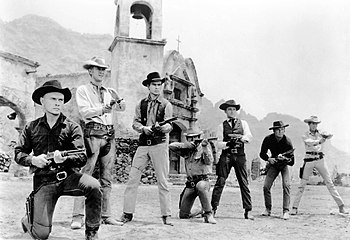 As an adult, “The Magnificent Seven” is a chaste version of the Wild West and even how tyranny works for poor people, particularly women. While the young women are hidden from the gunslingers for fear of rape, no rape is shown. Yet in the “Seven Samurai,” clearly rape and forced sexual slavery has occurred. The director choice of Akira Kurosawa objectifies the women of the village by focusing on a woman’s buttocks and yet never showing that woman’s face or giving her a name. Like “Seven Samurai,” “The Magnificent Seven” is a male-centric view of a village and the West. At no point do the women in “The Magnificent Seven” exact revenge nor gang up to kill an unseated bandit.
The Magnificent Seven and the White Saviour
You might be disturbed by the “brown” face makeup of the villagers in “The Magnificent Seven.” My husband asked if “The Magnificent Seven” is a White savior film. Some people feel it is so.
Yet remember, there is white and not white enough. The KKK felt that Catholics were not White enough and Latinos, including Mexicans, can also be White. White culture often means White Anglo-Saxon Protestant or WASP.
- The Death of WASP Culture (19 August 2008)
- When America Hated Catholics (23 September 2015)
- UCA Professor Writes Book on History of anti-Catholicism (19 September 2016)
- Being Catholic in the USA (4 July 2023)
There was a time when Whiteness was “a matter of degree, and Europeans fell into categories like ‘Anglo Saxon,’ ‘Celtic,’ ‘Hebrew’ and ‘Asiatic.‘
The Irish, like the French, Spanish and Mexicans are likely to be Christian, but not Protestant. The majority of Irish, French, Spanish and Mexicans are Catholic. As one might expect, Cajuns are also predominately Catholic.
The film was released on 12 October 1960. When Democratic Senator John F. Kennedy was elected president on 8 November 1960, it had been “widely anticipated that JFK would face high obstacles to attaining the presidency. In truth, his Catholicism proved a low obstacle that he overcame with unexpected ease.”
According to one professor, JFK’s presidency was “clearly the beginning of the demise of much of that anti-Catholicism.”
Of the seven gunslingers in “The Magnificent Seven,” three of the seven are likely Catholic: Chris Tanner, Bernardo O’Reilly and Chico. Bernardo and Chico are of Mexican descent which could mean White or could mean mestizo, but still part-White. The three are not White as in White Anglo-Saxon Protestant. Bernardo and Chico would have faced the kind of prejudice that Mexicans and Mexican Americans faced in the US.
Mexican Americans were subject to segregation in a way that was less clearcut than African Americans. In California, there was the case of Perez v. Sharp, where the Mexican American Andrea D. Perez was prevented from marrying an African American Sylvester S. Davis, Jr. and took her case to the state Supreme Court. In California:
Restaurants posted signs in their doors reading, “No dogs or Mexicans.” At movie theaters, Mexican Americans had to sit in the balcony, not the lower level. Public swimming pools had “Mexican Mondays” after which the pool was drained and cleaned before Anglo residents would step foot in it again.
The same de facto segregation existed in California public schools. By 1940, more than 80 percent of Mexican American students in California went to so-called “Mexican” schools, even though no California law mandated such a separation. (Legal segregation in California schools did exist for two other groups: Asian Americans and Native Americans.)
Segregation in California schools was struck down in 1946 (Mendez v. Westminster), before segregation was abolished nationally under Brown vs. Board of Education nine years later. With the decision on Mendez v. Westminster, then-governor Earl Warren outlawed public school segregation of any kind (including Asian Americans and Native Americans).
- ‘No Mexicans Allowed’: School Segregation in the Southwest (11 March 2016)
- The Mendez Family Fought School Segregation 8 Years Before Brown v. Board of Ed (2 August 2023 update; original 18 September 2019))
- Racial Segregation of Latino Students Continues with English-only Laws (29 September 2021)
- Blackwell School: A History of Latinx Segregation in Texas (28 February 2023)
In Texas, as in California, Latinos were considered “White” by law, but that didn’t stop racial exclusion. The Blackwell School is a reminder of the recent past, when schools in tthat area of Texas were only integrated in 1965.
Unlike African Americans, Latinx people in Texas were not subject to segregation by state laws. Instead, Texas school districts regularly established schools for Mexican Americans through de facto segregation. The Blackwell School is a tangible reminder of a time when the practice of “separate but equal” dominated education and social systems. Despite being categorized as “white” by Texas law, Mexican Americans were regularly excluded from commingling with Anglos at barbershops, restaurants, funeral homes, theaters, churches, and schools.
Segregation in schools also occurred in Arizona.
- Plessy to Brown: Education of Mexican Americans in Arizona Public Schools During the Era of Segregation
- The Untold Segregation Story: Arizona (19 February 2016)
- Forgotten History: Mexican American School Segregation in Arizona from 1900-1951 (2008)
- How George I. Sánchez Helped Dismantle Texas’ Segregated Schools for Latinos (7 October 2021)
For me, to label “The Magnificent Seven” as a White Saviour film, is to dismiss a history of prejudice against Catholics and Latinos, one that had not in public school entirely ended at the time the film came out in 1960. There is, however, the problem of casting non-Latino actors to play Latinos. Of the two characters who were supposed to be of Mexican descent, neither was. Charles Bronson (Bernardo O’Reilly) was Roman Catholic of Lithuanian descent. The Berlin-born Horst Buchholz (Chico) was of German descent by his mother. His biological father was unknown.
However, Brynner had, by 1960, played the king of Siam on stage and in film (“The King and I”) for which he won a Best Actor Oscar in 1956. The Russian-born actor was part Mongolian (Buryat). So I’m not sure if one can consider him White or White-enough as an actor.
The Sequels
As a kid, I also watched the 1966 “Return of the Seven” which also stars Brynner. The other sequels replaced Brynner with George Kennedy in the 1969 “Guns of the Magnificent Seven” and Lee Van Clef in the 1972 “The Magnificent Seven Ride!” I would only recommend the second sequel for Brynner and Robert Fuller’s performances.
The 1998-2000 TV series, “The Magnificent Seven,” has pretty faces and recurring appearances by Robert Vaughn as a judge, but none of the actors have the charisma of Brynner. The first episode of the “The Magnificent Seven” TV series is about gunslingers helping a village of Native Americans and African Americans and one of the gunslingers is African American.
“The Magnificent Seven” was updated in 2016 with a cast led by Denzel Washington for big action sequences, and too obvious attempts at political correctness. I did enjoy some of the action sequences, but I don’t think it was a total success as a film or depiction of the Wild West.
While the film Seven Samurai is a better film than the 1960 version of “The Magnificent Seven,” both are culturally influential films worth seeing. “The Magnificent Seven” was nominated for an Academy Award (original score by Elmer Bernstein and Bernstein would later win an Oscar for “Thoroughly Modern Millie” in 1967). Yul Brynner would later play a nameless Gunslinger that clearly resembled his Chris Adams for the science fiction films “Westworld” in 1973 and “Futureworld” in 1976. The two films are a good example of how one genre can influence another and how stories can change and evolve over time.
 Age of the Geek