
 After his disastrous 10-minute opening dialogue at the 81st Golden Globes (7 January 2024), Jo Koy’s name has likely become infamous enough to enter into the algorithm of autocorrect. What went wrong at The Beverly Hilton that night? Jo Koy didn’t take an analytical approach to this gig and didn’t study those who came before him. He can call the audience “marshmallows,” but that’s little better than blaming his team.
I’ve been covering the Golden Globes since 2015 for RogerEbert.com until 2020. I initially asked to cover the Golden Globes because I’ve always thought of the Golden Globes as the less formal, funner awards ceremony compared to the Oscars. This year, AsAm News requested that I review Jo Koy’s hosting. For my own blog, I wanted to do a comparative analysis.
You have, at best, five minutes to win over your audience. Every word matters. Consider the examples of Sandra Oh and Andy Samberg in 2019, Ricky Gervais in 2020 and Tina Fey and Amy Poehler in 2021.
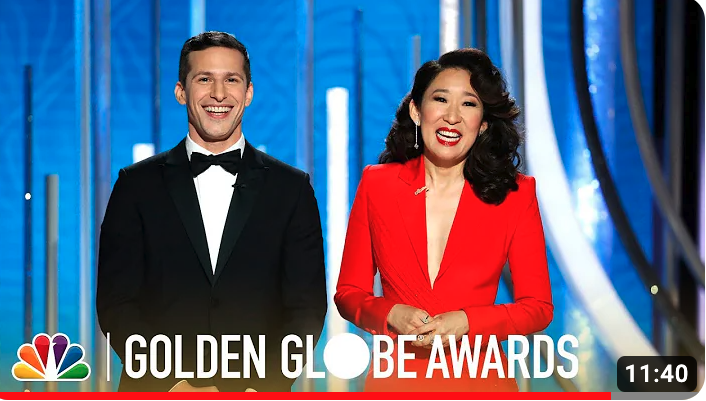 Samberg and Oh quickly set the tone: “We are gonna have some fun, give out some awards, and one lucky audience member, will host the Oscars.” The Oscars in 2019 went on without a host after comedian Kevin Hart was forced to step down when some old homophobic tweets resurfaced, causing a backlash. Samberg and Oh confess that the reason they are hosting is because “we’re the only two people left in Hollywood who haven’t gotten in trouble for saying something offensive.”
Samberg then launches into a “race” joke. The “worst race of people” are the “Hollywood Half Marathon.”
They quickly set up their next joke, saying with “Andy Samberg and Sandra Oh, the two nicest people in show biz” hosting, “This thing’s gonna be a snooze,” Samberg begins. Oh quickly comes in, “But not so fast, because you fools are all about to get roasted.”
How? Samberg exclaims, “Gervais style.”
The first name mentioned is Spike Lee (1:09) who directed Best Motion Picture – Drama nominee “BlacKkKlansman.” The film was also nominated for Best Actor (John David Washington), Best Supporting Actor (Adam Driver) and Best Director (Spike Lee). Samberg calls him, “Mr. ‘Do the Right Thing.'” Samberg continues, “Well, I’ll tell you who does the right things: You as a director. Lifetime fan.”
Oh calls out Bradley Cooper (1:29) who was nominated for Best Actor for “A Star Is Born” and characterizes him as “You are hot.” They give a mention to Gina Rodriguez (1:45) who was not nominated, but was presenting (Best Supporting Actor – Series, Miniseries or Television Film). Rodriguez received a Golden Globe Award in 2015 for “Jane the Virgin.” Oh says it is weird that Rodriguez is here “because last time I checked she resided in heaven.”
Oh and Samberg give themselves nicknames: “Sandra Oh-snap” and “Andy Slamsnerds.”
Then Oh, mentions Michael B. Jordan (2:07). Samberg then says, “More like Michael B. Buff A-F. You a snack, Michael.” Oh adds, “Your character’s name in ‘Creed’ is Adonis? And it is apt.” Samberg asks for the camera to cut to him crying because “I wanna get the meme.” When the camera cuts to Jordan, he first laughs and then pretends to cry.
Oh then mentions Amy Adams (2:34) “nominated for multiple Globes tonight.” Adams was nominated for Best Supporting Actress for “Vice” and Best Performance in a Miniseries or Television Film for HBO’s “Sharp Objects.” Oh finishes the comment, saying, “Hey, Amy, save some for the rest of us, you mega-talented piece of dog crap.”
Samberg then notes that Jeff Bridges (2:50), or “Mr. Cecil B. DeMille Awards himself” (2:57) is in the audience. “Hey, Jeff. I wish you were my dad.” Then there’s a reference to David Spade and “Bu Bye.” For further explanation, they call out Lorne (Michaels), creator and producer of “Saturday Night Live” who would understand. Spade was in a skit about Total Bastard Airlines. Samberg was a cast member and writer for SNL from 2005 to 2012.
Samberg then notes that “Black Panther” (3:17) was nominated for Best Picture Drama. Oh then says that it is the third highest grossing movie “which just goes to show people want more movies where the characters ride around on rhinoceroses like they’re horses. I’ve been saying this for years, Hollywood!”
Samberg mentions Ryan Coogler (3:47) as a fellow Bay Area native. “You know, if you told me as a kid growing up in the Bay, there’d be a movie called ‘Black Panther’ that starts off in Oakland, this is not what I would have imagined.” Samberg then asks if old Black Panthers were asking for an audition, but then adds he was kidding because “They were all framed and murdered for wanting justice and equality, the world is and always has been a nightmare. It just seems worse now because of our phones.”
Oh notes that “A Star Is Born” (4:17) is nominated for Best Motion Picture -Drama (4:21) and names the stars: Bradley Cooper and Lady Gaga. Then Oh seems serious when she says there could be 99 people in a room and if just one believes in you like Cooper that makes a difference and then, Samberg, acting like the totally unaware male chauvinist rephrases what she has just said. Lady Gaga reacted and the smiles from those Cooper and Lady Gaga were just beautiful.
Naturally, it is Oh, who mentions the nomination of “Crazy Rich Asians” (4:58) for Best Picture Musical or Comedy (5:00). A little past the 5 minute mark, she gives the zinger, “It’s the first studio film with an Asian American lead since ‘Ghost in the Shell’ and ‘Aloha.'” The joke being, Scarlett Johansson and Emma Stone were the female leads in that film.
In the first five minutes, Oh and Samberg were able to address recent issues (Kevin Hart), give nods to three of the five films nominated for Best Motion Picture – Drama (“Black Panther,” “BlacKkKlansman” and “A Star Is Born” but not “If Beale Street Could Talk” or the eventual winner “Bohemian Rhapsody” ) and two of the five films nominated for Best Motion Picture – Musical or Comedy (“Crazy Rich Asians” and “Vice” but not “The Favourite,” “Mary Poppins Returns” or the eventual winner “Green Book.”). The opening gives the first and last names of 13 names people (except for Lady Gaga whose real name isn’t used). They also address two important issues: historic violent racism toward the Black Panthers and Hollywood’s whitewashing. The full opening is 11 minutes and 39 seconds.
Later in the opening, they get some audience involvement with Oh sending over an oversized bottle of Pepcid AC for the “Crazy Rich Asians” table to prevent the “Asian Flush” (5:54) and Samberg recommends it for “The Kominsky Method” table, but they also call out Jim Carey for being in the film section and send him off to the TV section (8:00).
 Rickey Gervais hosted the Golden Globes five times. He quickly announces that “this is the last time, I don’t care any more. I’m joking I never did.” But he also notes that Kevin Hart fired from the Oscars and “Let’s have a laugh at your expense, we’re all going to die soon and there’s no sequel.”
His second name drop is another topical one: Felicity Huffman (1:07), but it is in connection with a recent scandal. He adds that her daughter incredibly embarrassed and that something considering her father (William H. Macy) was in “Wild Hogs” (1:23).
Huffman had previously been nominated for the Golden Globes for “Sports Night” (1999), “Desperate Housewives” (2004, 2005, 2006), “American Crime” (2015, 2016) and won a Golden Globe in 2005 for “Transamerica.” Macy was nominated for an Oscar and had previously had five nominations for the Golden Globes: “Door to Door” (2003), “Seabiscuit” (2004), “The Wool Cap” (2005) and “Shameless (2015, 2018).
Al Pacino and Robert De Niro (1:32) are mentioned and at the same table as “Baby Yoda” (1:41), who Gervais quickly explains is actually Joe Pesci (1:43).
Then Gervais notes that “in this room are some of the most important TV and film executives in the world, people form every background. But they all have one thing in common: they’re all terrified of Ronan Farrow (2:02) which is a unifying factor, but leads into a serious point. He states, “It was a big year of pedophile movies “(2:13), of which he names two: “Surviving R. Kelly” (2:15) and “Leaving Neverland.” Although neither of these movies were nominated for a Golden Globe, the next film he mentions was: “Two Popes” (2:18). That film is about Pope Francis (played by Jonathan Pryce) and Pope Benedict XVI (played by Anthony Hopkins). In the film, Pope Benedict does confess that he was aware of a certain priest’s sexual misconduct (Marcial Maciel), but he stayed silent.
- Money paved way for Maciel’s influence in the Vatican (6 April 2010)
- Catholic order to be overhauled after founder’s abuse (1 May 2010)
“Surviving R. Kelly” won a Critics’ Choice Real TV Award and a Peabody Award. “Leaving Neverland” won a Primetime Emmy for Outstanding Documentary or Nonfiction Special, International Documentary Association Best Multi-Part Documentary and a a PGA Award for Dan Reed for Outstanding Producer of Non-Fiction Television. So these were all noteworthy films of the year.
Even though he is White, Gervais noted, “Many talented people of color were snubbed in major categories” (2:28). He adds, the Hollywood Foreign Press are all very, very racist.” But he uses this to set up a joke. He says they meant to have an “in memoriam” but he cut it because it was “mostly White people and I thought, nah, not on my watch” (2:50). An “in memoriam” segment is not customary for the Golden Globes.
Gervais also pays tribute to Netflix (3:06), saying, “This show should just be me coming out going Well done, Netflix. You win everything. Good night. But no, no, we got to drag it out for three hours.”
Netflix produced the TV series “After Life” (3:20) which Ricky Gervais created and stars in. The series was never nominated for a Golden Globe.
Back to serious matters, Gervais mentions Jeffrey Epstein (3:37). Epstein had been found dead in his cell at the Metropolitan Correctional Center in NYC on 10 August 2019.
Gervais then mentions a possible sequel to “Sophie’s Choice” (3:58) and mentions Meryl Streep (4:00). Streep was nominated for HBO’s “Big Little Lies” but lost to Patricia Arquette in Hulu’s “The Act.” Gervais again mentions Netflix, but also HBO (4:13). He wonders if with all the superhero films, “Have we got an award for most ripped junkie?” (4:27) but this connects to his comment on Martin Scorsese (4:33) (Best Director nominee). Scorsese complained about the Marvel franchise (4:37), comparing them to amusement park rides. “He said they’re not real cinema and they remind him of theme parks.” But Gervais wonders what Scorsese is doing at such places because, “He’s not big enough to go on the rides, is he?”
Scorsese, Al Pacino and DeNiro were all there because of “The Irishman” (4:56) which Gervais mentions.
The total time for Gervais’ opening monologue was 10:45. In the first five minutes, he addressed cancel culture (Kevin Hart), the nationwide college entrance exam cheating scandal–Operation Varsity Blues, Martin Scorsese’s comments on the Marvel franchise, the Jeffrey Epstein scandal and Ronan Farrow’s reporting on Harvey Weinstein. The 77th Golden Globe Awards was held on 5 January 2020 (from The Beverly Hilton), but Weinstein had been found guilty of rape and a criminal sexual act in February 2020 and was sentenced in March 2020.
Of the Best Motion Pictures, he only mentions two: “The Irishman” and “The Two Popes.” “The Irishman” had five nominations and “The Two Popes” had four. None of the nominees were from Marvel franchise.
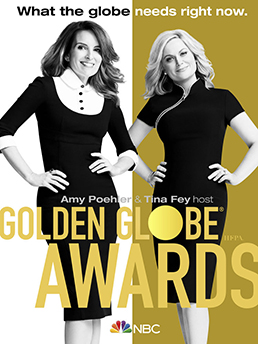
While Jo Koy had ten days to work on his Golden Globe hosting duties, Tina Fey and Amy Poehler faced unknown territory in 2021. The ceremony was postponed from early January to late February due to the impact of the COVID-19 pandemic. On 2 February 2021, it was announced that the ceremony would be bicoastal: NYC and Los Angeles.
Yet Fey was in the Rainbow Room in NYC while Poehler was at the Beverly Hilton in Los Angeles, but the two made the description funny. For NYC, it was where “indoor dining and outdoor muggings are back” but in Los Angeles, it was “the Beverly Hilton District 7 New Angeles” (0:10) for the “78th Annual Hunger Games” (0:14). Poehler and Fey quickly add, “Golden Globes.” The pandemic effects were alluded to with nonsensical titles such as “Parts of a Lady” (0:57), “Irish Goodnight,” “Mauricio’s Delve” (0:59), “Day Planner,” “Gronk,” and “Ali G. Goes to Chicago” (1:01) plus a few familiar binge-worth favorites: “The American Office” (1:11) and old “Columbo”s (1:13).
“The Hunger Games” was a 2012 film that was followed by “Catching Fire” in 2013 and Mockingjay – Part 1″ in 2014 and “Mockingjay – Part 2” in 2015. So in 2021, none of the films were nominated, but they were already available to stream online.
Instead of actors, producers, writers and directors in the audience, on both coasts, the audience members were “smoking hot” first responders and essential workers.
The first celebrity name mentioned is Meryl Streep ( 2:13) in a description of how the Golden Globes normally would go. “It’s usually, like Meryl Streep just hammered (2:08), can’t even remember what movie she’s there for (2:11),” Tina Fey comments.
Poehler then adds, “Brad Pitt’s always waving at me like ‘Amy! Amy!’ (2:16), and, I’m like, ‘Dude, I’m working.’ It’s like, ‘Not now'” (2:19).
At another table, Fey notes, “Oprah Winfrey just writing her name (2:21) all over the tablecloth in pen” and Poehler adds, “Quentin Tarantino crawling under the tables (2:25) just touching people’s feet.”
But the problems of the Hollywood Foreign Press Association aren’t ignored. Fey explains, “The Hollywood Foreign Press Association is made up (2:50) of around 90 international, no-Black journalists (2:52) who attend movie junkets each year (2:55) in search of a better life.”
There’s also the additional problem of the theaters being closed so how does one tell the theatrical movies apart from TV movies? The two go on to describe how one tells the TV movies from the theatrical movies. Poehler notes, “If British actors are playing British people, it’s TV. If they’re playing Americans, it’s a movie.”
Fey continues, “If you’re like, ‘Mario Lopez (3:50) is surprisingly good in this,’ that’s TV. ” Poehler adds, “And if it stars Matthew McConaughey (3:55) as a poetic drifter, it’s a car commercial.”
The first nominated film they mention is “Nomadland” which Fey describes as “a movie where Frances McDormand plays a lady (4:28) who travels across the desert in her van and poops in a bucket” (4:32). The next nominated film mentions is: “Mank” which they explain is short of Mankiewicz (4:41), the person who wrote “Citizen Kane.” “Nomadland” had four nominations; “Mank” had six. “Nomadland” went on to win Best Motion Picture – Drama and Best Director (Chloé Zhao).
The next nominee mentioned is the Netflix Limited Series, “The Queen’s Gambit” (4:49). Then, they mention James Corden and the film “The Prom” (4:50) and add Meryl Streep (5:03). “The Prom” and “The Queen’s Gambit” both had two nominations. “The Prom” was nominated for Best Motion Picture – Musical or Comedy (which went to “Borat Subsequent Moviefilm”) and Best Actor (James Corden) which went to Sacha Baron Cohen. “The Queen’s Gambit” won Best miniseries or Television Film and Best Performance by an Actress in a Miniseries or Television Film (Anya Taylor-Joy).
Fey and Poehler’s opening remarks total 8:33 minutes. In the first five minutes, they addressed the issues brought on by the pandemic including the two locations and the complicated issues of TV versus film as well as issues about the organization behind the awards. They mentioned three nominated films (“Nomadland,” “Mank,” and “The Prom”) and one nominated TV limited series (“The Queen’s Gambit”). They named two nominees: James Corden and Frances McDormand.
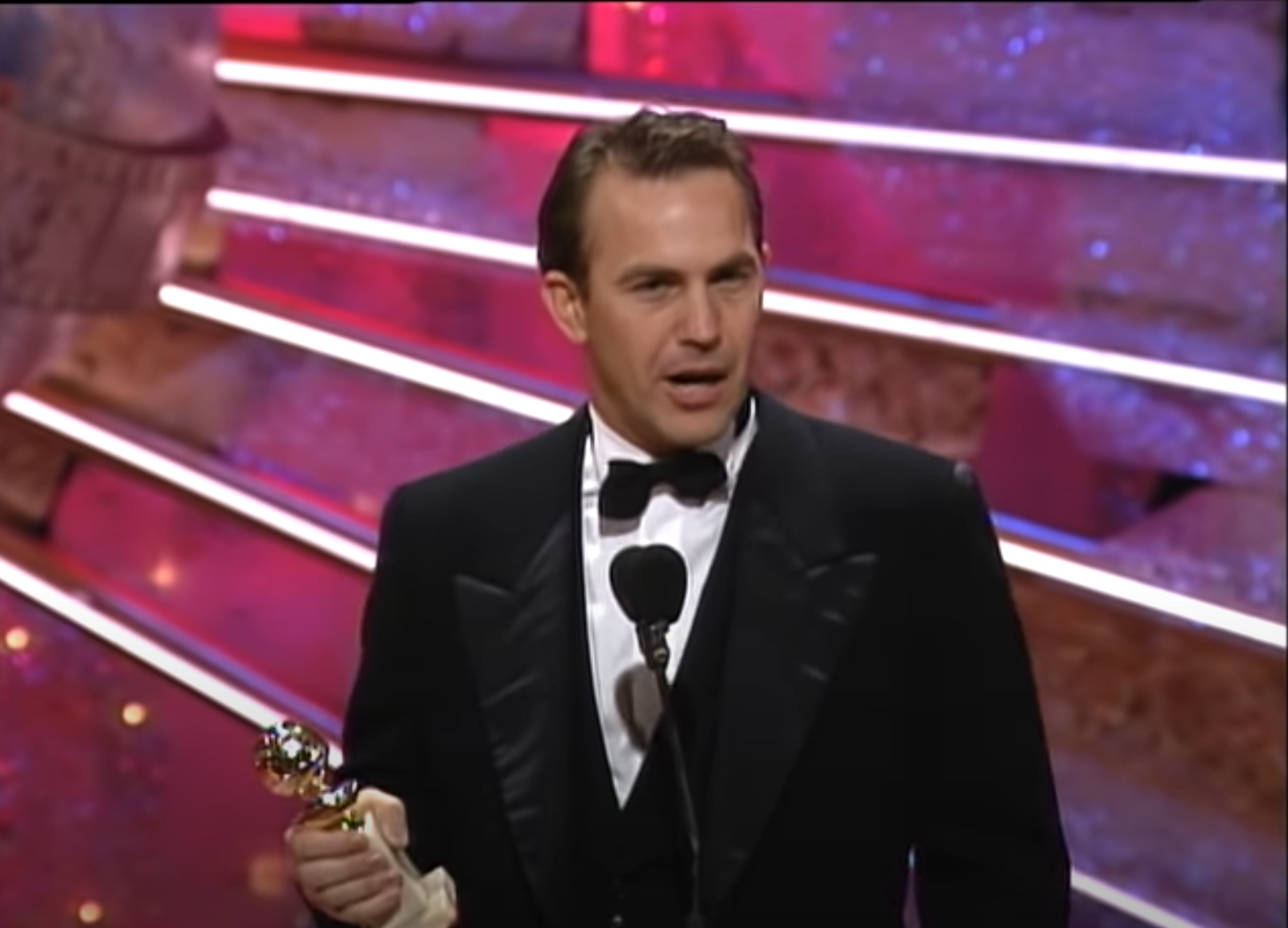
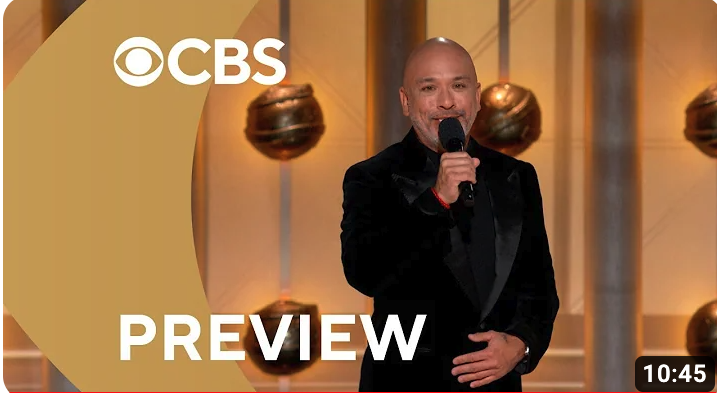 Jo Koy begins well with telling the audience what it is (81st annual Golden Globes) and who he is, but not where he is. Then he begins to talk about himself, “This is a dream come true” and adds, “not just for me, but for everybody in here.” He tells the audience, to look around. Then the first celebrity he mentions is Kevin Costner (0:26). This makes no sense, because for Costner, this isn’t a dream come true. He’s been there before and won. Jo Koy then makes a joke based on something that is untrue (that Costner never shows up), but missed a joke about commuting. Costner did attend at least two other Golden Globe ceremonies, but in 2023, he could not attend due to flooding.
 Jo Koy then mentions Don Cheadle (0:38) but it is simply name dropping with no clever remark attached. Being there on that night isn’t a dream come true for Cheadle either nor for Meryl Streep (0:54).
Although Jo Koy says his mother tells him that Streep always wins and he assures the audience this is true, it is not. Streep has lost more than she has won, about 75% of the time, Streep has lost.
Admitting that he hasn’t seen all of the nominees, Jo Koy then gives a shout out to “Beef” (1:19), but Jo Koy doesn’t describe what the limited series was about. He calls out Ali (Wong) (1:21), but not everyone in the audience knows who “Ali” is. She is not well known enough to go by just her first name and there’s also Mahershala Ali, Ali Khan (“A Haunting in Venice”), Muhammad Ali, Laila Ali and Ali MacGraw. Yes, none of those four were nominated, but she’s not the only Ali. Jo Koy should have mentioned her first and last name. Watching that was obligatory he says because Jo Koy is Asian American, but then what follows later shows how superficial that Asian American identity really is.
Instead of describing the Limited Series theme or giving a witty synopsis, or even telling us more about Wong’s character, Jo Koy says, “You killed it, Ali” (1:28). This comment doesn’t really tell the audience anything because all of the nominees are being recognized for their excellence.
Then Jo Koy mentions “Oppenheimer” (1:45) and takes time on this because he’s still talking about Oppenheimer at (2:14). The film supposedly answered the “life-long question”: “Yes. Scientists do get laid, as long as they look like Cillian Murphy” (2:25), and he also comments that it “needed another hour” and more “backstory.” Jo Koy says, “My New Year’s resolution for 2024 is to finish ‘Oppenheimer’ in 2025” (2:03). He doesn’t mention the controversy raised by some believers in Hinduism nor the criticism about the absence of Japanese or Asian Americans, particularly during a time when there was a massive forced immigration from both of the areas represented by UC Berkeley and Caltech.
Jo Koy does make a joke about stereotypical Barbie getting cellulite and bad breath (“or what casting directors call a character actor”), but no one is laughing.
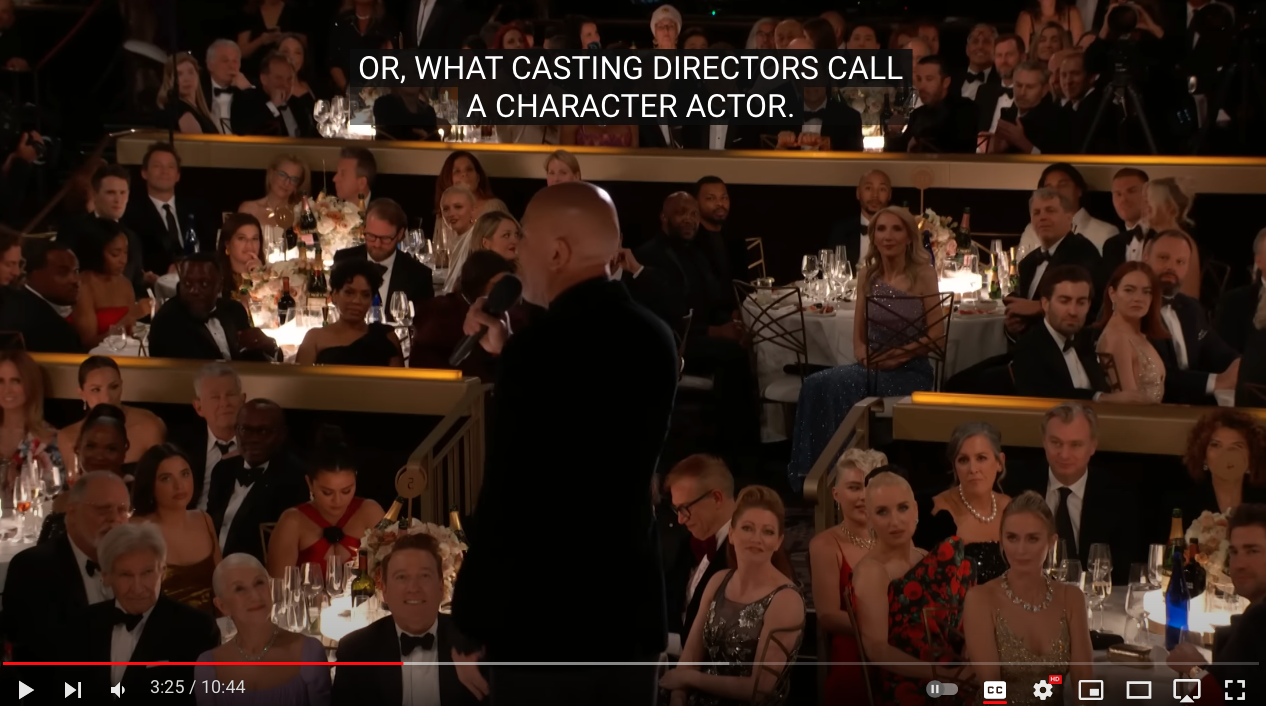
Making sex jokes is risky, but then making jokes about a doll’s breasts and a real man’s penis is barely disguised locker room humor and fails to recognize the achievement of the director and co-writer (with Noah Baumbach) Greta Gerwig whom he doesn’t name when talking about “Oppenheimer” and “Barbie” (2:31). To be fair, Jo Koy doesn’t name the director of “Oppenheimer” or “Killers of the Flower Moon.” Jo Koy does say, “‘Oppenheimer’ is based on a 721-page Pulitzer Prize-winning book” while Barbie is plastic doll (2:48) with big boobs. He references Ryan (Gosling) (3:04) and Margo (Robbie) (3:13). While Margot is an unusual name (shared with the late Margaux Hemingway and Margot Kidder), Ryan Gosling has been confused with Ryan Reynolds. The joke is about Gosling’s eyes, but no one is really laughing.
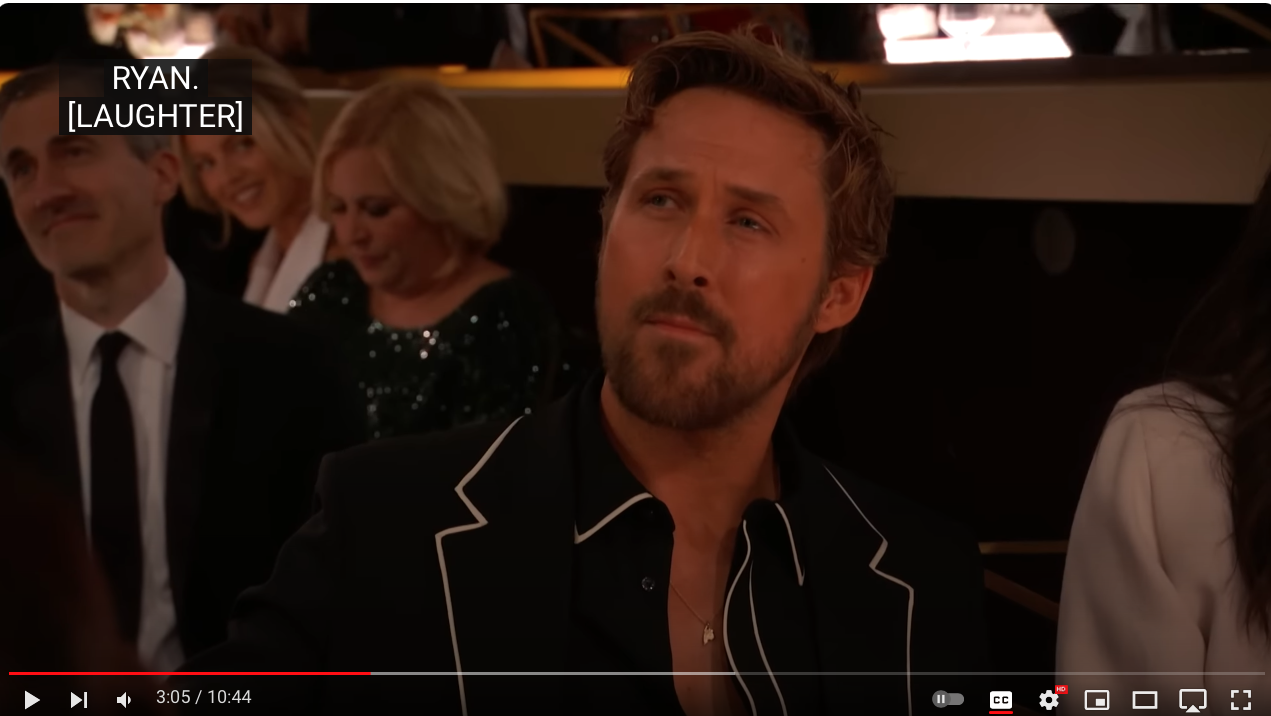
Some women were notably displeased and (3:31) Jo Koy says of his jokes, “Some I wrote, some other people wrote.” At 3:33, he begins by mentioning “Robert De Niro is here” again and then interrupts himself, saying, “Yo, I got the gig ten days ago (3:35) You want a perfect monologue? Yo shut up. Slow down. I wrote some of these and they’re the ones you’re laughing at” (3:47). Blaming your team is never a good move.
Then back on track, he says, “Robert De Niro‘s here. I’m sorry, I’m a fan” (3:53) and then says, “Your last performance has got to be your greatest performance, ever. How’d you get her pregnant at 80?” This makes De Niro laugh, but he could have spent the time honoring the nominees instead. Of course, De Niro was nominated for the film, “Killers of the Flower Moon” (4:32) and De Niro gets mentioned again in that capacity by his full name: Robert De Niro (4:38). In addition, cast mates Leonardo DiCaprio (4:41) and Lily Gladstone (4:43) are added. Jo Koy then says, they “crushed it. Crushed it” (4: 46). This comment gives the audience and the viewers nothing to go on just as the previous “killed it” means nothing. All of the nominees supposedly were the top five performers of the year in their categories.
The comment “White people stole everything” doesn’t give a good summation for what the movie “Killers of the Flower Moon” was about and the situation in Oklahoma is more complicated than White-versus-Non-White. Just consider the Confederate troops from that area included Native Americans. While Jo Koy comments that the room is perhaps too White to appreciate this joke, traditionally, the voting patterns of the Golden Globes has not been so “White” as in WASP. In 2016, when all the nominees for the acting awards for the Oscars were all White, even though some represented minorities (e.g. Michael Fassbender, Mark Ruffalo and Saoirse Ronan by being raised Catholic and Sly Stallone for his disability and being raised Catholic) and other under-represented categories (Charlotte Rampling by her age), that wasn’t true for the Golden Globes which nominated Will Smith (for “Concussion”) and Idris Elba (for “Bests of No Nation”) as well as women who would be considered under-represented due to age (e.g. Jane Fonda or Maggie Smith) and people who were raised Catholic (e.g. Sylvester Stallone who also has a disability). This was also true for the Golden Globes the previous year when “Selma” was nominated for Best Motion Picture – Drama, because David Oyelowo (for “Selma”), Quvenzhané Wallis (for “Annie”) and part Native American Edward Norton (for “Birdman”) were all nominated.
At the 5:00 minute mark for his Golden Globe opening monologue, Jo Koy was finishing his remarks on “Killers of the Flower Moon.”
Jo Koy’s comments go nowhere. Jo Koy says it is a dream to be there for everyone, but the first two people he mentions (Costner and Cheadle) are not first-timers there. The Cheadle reference is just name dropping. The comment about Meryl Streep isn’t clever or true. Streep has been nominated 33 times, but only won eight times. She lost again on that night and I wondered if it isn’t considered a jinx to talk about someone winning that night in a monologue.
Koy’s comments are predominately about sex and sex organs (“Is Barry Keoghan here? Where is he seated? Where is your penis seated, down?” (5:38)) and his praise tells the viewers almost nothing about the nominees. He doesn’t tell the audience anything about the miniseries “Beef” which has nothing to do with meat or being a carnivore.
Jo Koy mentions Robert De Niro more than once when he could have mentioned other nominees. Because he doesn’t note why Meryl Streep is at the Golden Globes, later in his opening, he circles back to comment on “Only Murders in the Building” (8:40). At that point, he mentions how many times Streep has been nominated, but not how many times she has won.
In the first five minutes, Jo Koy mentioned nominated films “Barbie,” “Killers of the Flower Moon” and “Oppenheimer” and one nominated limited series “Beef.” He gives a shout out to three people by their first names: Ali Wong, Margot Robbie and Ryan Gosling. He also names Cillian Murphy, Leonardo DiCaprio and Lily Gladstone by their full names. Yet Jo Koy never addresses the major changes in the Golden Globes nor the historic significance of “Barbie” or Lily Gladstone’s nomination.
How to Write a Good Golden Globe Monologue
What a good opening for the Golden Globes should include:
- A statement about what and where the event is.
- Gervais: “Hello and welcome to the 77th annual Golden Globe Awards, live from the Beverly Hilton Hotel in here in Los Angeles.”
- Poehler states she is at “the Beverly Hilton District 7 New Angeles” (0:10) for the “78th Annual Hunger Games” (0:14).
- Talk about the organization behind the awards and any pertinent information, especially to address any elephants in the room.
- Address important issues. Par
- Fey: “The Hollywood Foreign Press Association is made up (2:50) of around 90 international, no-Black journalists (2:52) who attend movie junkets each year (2:55) in search of a better life.”
- Gervais: “Many talented people of color were snubbed in major categories” but gives a twist about supposedly canceling of an “In Memoriam” because it was mostly White people.
- Mention people by their full name (given and surname) at least on the first reference within a segment unless it is someone like Cher, Madonna, Sting or Liberace. So mentioning a person by full name during the opening doesn’t mean one can just reference this person by their given name (or surname if it is too common) in the middle or the closing segments unless this is a running joke.
- Give a short, witty or impactful description of any movie or television program mentioned because not all of the viewers in the TV audience will have seen them.
- Samberg on “Black Panther” talks about the political group by the same name: “They were all framed and murdered for wanting justice and equality, the world is and always has been a nightmare. It just seems worse now because of our phones.”
- Oh on “Black Panther”: “Which just goes to show people want more movies where the characters ride around on rhinoceroses like they’re horses. I’ve been saying this for years, Hollywood!”
- Fey on “Nomadland,” as “a movie where Frances McDormand plays a lady (4:28) who travels across the desert in her van and poops in a bucket” (4:32).
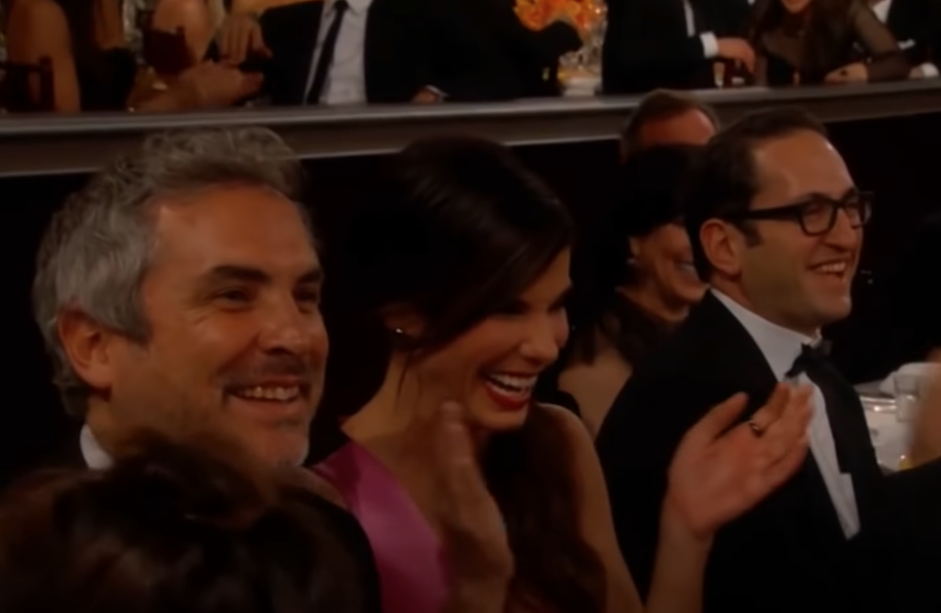
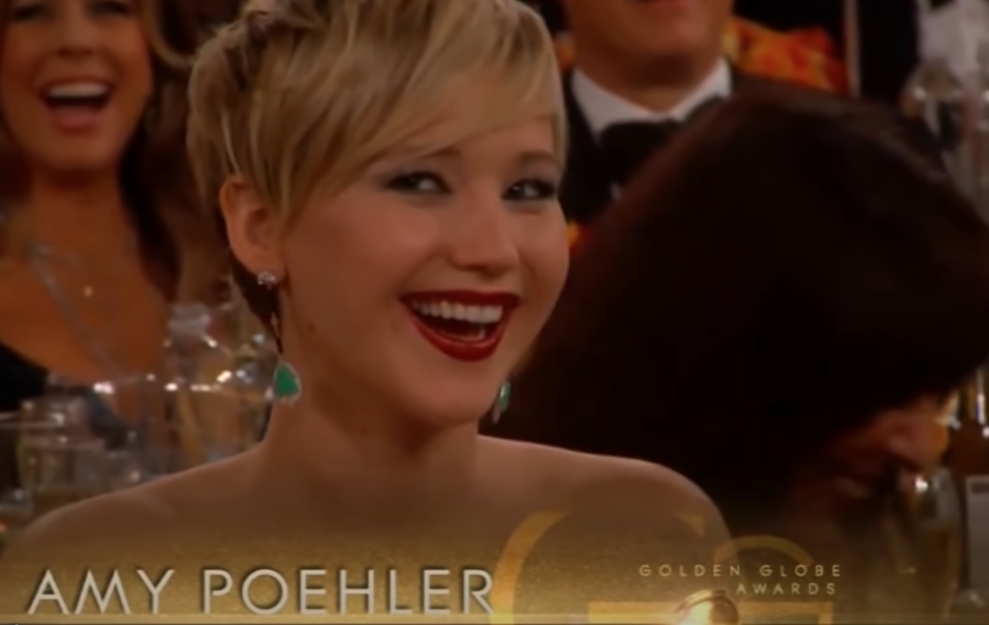 Remember in 2014 at the Golden Globes when Poehler was nominated and asked if the cameras could get a shot of her and instead of Poehler, the camera focused in on Jennifer Lawrence although the subtitle identified her as Amy Poehler. At the same awards ceremony, Fey described the nominated film “Gravity” as “the story about how George Clooney would rather float away into space and die than spend one more minute with a woman his own age.” The camera then cuts to a shot of a laughing Sandra Bullock, who was that woman.
Clooney was also the target of the opening comments in 2015 when Fey noted that he had married Amal Alamuddin that year. Fey then described Amal Clooney’s tremendous achievements as a human rights lawyer (worked on the Enron case, was an advisor to Kofi Annan and part of a three-person UN Commission investigating rules of war violations in the Gaza Strip), but that it was her husband George Clooney getting a lifetime achievement award (5:00-5:21). The camera then cuts to both Amal and George laughing.
In the second half, Fey and Poehler also talk about how there is no overlap in their taste in men and then play a game of “Would you rather…” and manage to mention more nominees and make them laugh with them.
When Jo Koy does mention a current contentions affair, it’s Daryl Hall and John Oates. This is the current event he chooses to use–not at all addressing the major changes in the Golden Globes that happened over the summer, the writers or actors strikes or the recent earthquake in Los Angeles (and the tsunami warnings and earthquake in Japan).
- Daryl Hall accuses John Oates of ‘ultimate partnership betrayal’ in plan to sell stake in business
- Golden Globes winner mistakenly thanks non-existent HFPA in acceptance speech; Composer Ludwig Göransson thanked the dissolved Hollywood Foreign Press Association for his work on “Oppenheimer.” (7 January 2024)
- First Golden Globes After Embattled Voting Body Disbanded Airs Sunday—Here’s What To Expect (5 January 2024)<
- Golden Globe Awards sold, Hollywood Foreign Press group shut down (13 June 2023)
Gervais tackled some tough topics that not only troubled Hollywood, but the nation and even, beyond the US borders. At times, Samberg pretended to be part of the problem. It’s not that one can’t take on their own status as a minority. Both Samberg and Oh did make jokes about their own minority groups.
Jo Koy gave us no idea of who is behind the Golden Globes now, how many people are voting and the events that lead to the disbanding of the Hollywood Foreign Press Association. There were some very vocal Asian American voices raised (mostly in relation to “Minari” in 2020) and allegations made against the HFPA in the past. If he had made this clear in his opening remarks, then some of the winners (and even some of the press) might not have made the mistake of acknowledging the HFPA.
 Age of the Geek