
 What happens to people who have no home country? For the former leaders, the fall to foreign refugee status must be particularly hard. Who better to portray a man without a country, living in exile than a man whose defection caused an international stir and brought ballet to the popular masses: Mikhail Baryshnikov.
Baryshnikov stars in a U.S. premiere of “In Paris” at The Broad Stage in Santa Monica which opened Wednesday, 11 April 2012.
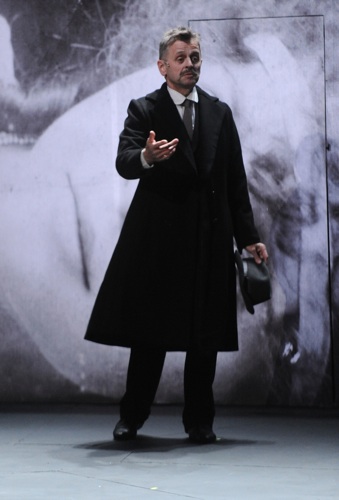
At 64, Baryshnikov no longer dances ballet, but originally from Riga, Latvia, he defected to Canada in 1974 and danced with the American Ballet Theatre. He was nominated for a Best Supporting Actor Academy Award for the 1977 ballet movie, “The Turning Point.” In 2005, he founded the Baryshnikov Arts Center in New York. Of course, Baryshnikov speaks Russian, but he also speaks French. Speaking little English when he first met actress Jessica Lange, they communicated in French. Lange and Baryshnikov had a daughter, but he has been in a long-term relationship with another ballet dancer, Lisa Rinehart.
Adapted from a short story, the 80-minute play “In Paris” is a co-production of Baryshnikov Arts Center, Dmitry Krymov Laboratory and the AG Foundation in association with the Korjaamo Culture Factory. The play is in French and Russian with no intermission. Don’t be afraid of the language barrier for director Dmitry Krymov makes the English subtitles part of the visual structure of the performance and the impact is stunning.
Ivan Bunin’s short story “In Paris,” is about a former general of the White Army. He fought in the Great War and the Civil War. Escaping to Constantinople, he is deserted by his wife and he begins a life of wandering. In Provence he attempts farming only to fail. Then to Paris he goes. Friendless, he endures life. “Patience is the medicine of the poor” but “the worst is the absolute loneliness” he tells us. The general meets a woman and after a short courtship, the two move in together. He still married to the wife that left him after two short years. She to a husband who also fought in the Civil War but who is in Yugoslavia.

Baryshnikov has the straight back and shoulders of a dancers or a former military man and with his body he can easily express defeat and loneliness. Baryshnikov’s father, whom he characterizes as an unpleasant man, was a lieutenant colonel, and he uses him as an inspiration for this character. As the woman he forms a shy attachment with, Anna Sinyakina is a woman on the edge of losing hope. Sometimes, there is no need for words, really such as when Sinyakina endearingly goes through the anxieties of a woman preparing for a date. Is this dress right? Am I pretty? Her woman is young and suddenly alive.
Most Americans will be unfamiliar with Ivan Bunin, the first Russian to win a Nobel Prize for literature . Born in 1870, Bunin was the youngest son to an established family of rural gentry in Central Russia. They were directly descended from a Polish nobleman. The family lost most of its fortune around the time Bunin was born due to gambling debt.
Yet there would be a much greater loss than a fall from family fortune. The Russian Civil War (25 October 1917 to October 1922) would pit the White Army and the Bolshevik Red Army against each other. Foreign armies such as the Allied Forces and pro-German armies would take the White Army’s side, but the Red Army would prevail in Ukraine and Siberia in 1919. The White Army would fail in Crimea and evacuate in 1920.
Those who could fled Russia. In his stories and autobiographical novel, Bunin became the heir to Tolstoy and Chekov, recording the lost youth and culture of the Russia before communism. True one can never really go home, but most of us can go where home once was and recognize some sights, sounds and smells. In this play, “In Paris” you can feel the intense loneliness and loss of the characters. The stark black and white of the simple set and the costumes (by set and costume designer Maria Tregubova) only offset by grays puts us both in the past of those old photos that are scattered about the stage, reproduced in hilariously large proportions. The music by Dmitry Volkov is beautifully haunting but there are a few surprises.
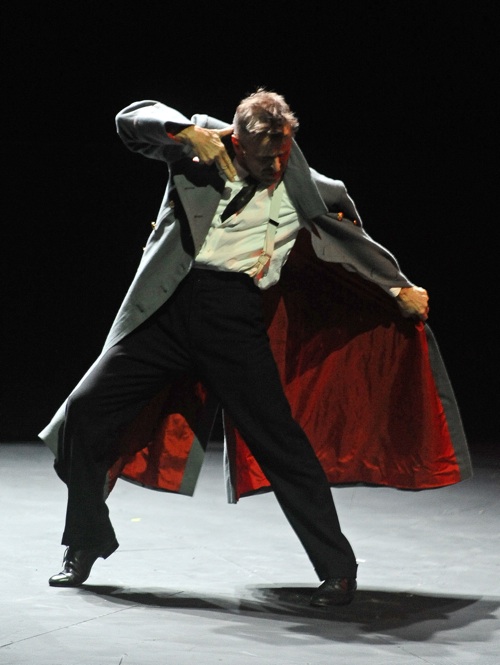
The full text of the short story is provided in the program. Reading it will make you think that this piece is dark and solemn. Yes, there is an air of poignancy permeating the piece. Yet there are unexpected moments of comedy. Krymov colludes with Tregubova to provide suspense with one particularly dramatic costume change and some surprising movements (Andrey Shchukin is credited as the movement coach). Even the props give us moments of suspense. And oddly enough, you’ll likely leave the theater humming one particular tune usually associated with bad romance (but not Lady Gaga). This time, though, the feeling was hopeful and even happy that two strangers found a little comfort in the city of lights so far away from the home they left and long for.
“In Paris” continues until 21 April 2012 at The Broad Stage, the Santa Monica College Performing Arts Center at 1310 11th Street in Santa Monica. For more information, visit their website or call (310) 434-3200.
Tickets: $50-175, available online at www.TheBroadStage.com, 310.434.3200. Parking is free.
Performance Dates and Times:
Wednesday 4-11-2012 7:30 PM
Thursday 4-12-2012 7:30 PM
Friday 4-13-2012 7:30 PM
Saturday 4-14-2012 2:00 PM
Saturday 4-14-2012 7:30 PM
Sunday 4-15-2012 2:00 PM
Monday 4-16-2012 7:30 PM
Wednesday 4-18-2012 2:00 PM
Thursday 4-19-2012 7:30 PM
Friday 4-20-2012 7:30 PM
Saturday 4-21-2012 2:00 PM
Saturday 4-21-2012 7:30 PM
Additional tour dates include: Berkeley Repertory Theatre, April 25-May 13, 2012; Spoleto Festival, Italy, June 30-July 1, 2012; and, Lincoln Center Festival, NY, August 1-August 5, 2012.
[Photos by Angela Weiss/Getty Images]
 Age of the Geek