
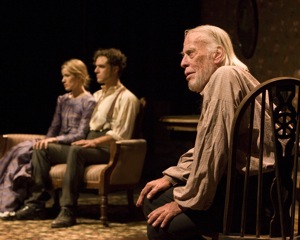
A Noise Within skillfully creates an atmosphere of desperate desire on the lonely farmlands in their production of Eugene O’Neill’s 1924 “Desire Under the Elms.” William Dennis Hunt, Jason Dechert and Monette Magrath form the tragic triangle of desire. This well-crafted production both recalls and diverges from the 1958 movie with Burl Ives, Anthony Perkins and Sophia Loren.
O’Neill took the myth of Phaedra, Hippolytus and Theseus and planted it in New England. Phaedra was the daughter of Minos and the second wife of Theseus. Theseus’ first wife was Hippolyta, queen of the Amazons and Hippolytus was her son by Theseus. Phaedra gave Theseus two more sons, but fell in love with her stepson. In her jealousy, Phaedra lied to Theseus claiming Hippolytus had raped her. Versions differ on who killed Hippolytus and if Phaedra also died.
Without the gods, we have to ask just what motivates these characters?
In O’Neill’s version, Ephraim Cabot (William Dennis Hunt) mysteriously leaves his farm for a few weeks. Before we actually see him, we hear about him from his sons, Simeon, Peter and Eben. Simeon (Christopher Fairbanks) and Peter (Stephen Rockwell) are older than Eben (Jason Dechert) and by a different mother.
The two older brothers long to escape the hardship of farm life and go to mine gold in California. Eben is determined to claim the farm that was deeded to his mother. He steals his fathers hidden savings and gives them to his brothers in exchange for them relinquishing their claim to the farm. The boys leave after getting a look at their father’s new young wife, Abbie (Monette Magrath).
Eben, of course, stays. Abbie makes it clear that she feels that this is her farm and means to claim it for her own, even if it means having a son by her husband as Ephraim has made it clear that only a son will inherit the farm (“mine ought to get mine”). When Ephraim fails to produce a child, Abbie turns to Eben.
Hunt somewhat resembles Burl Ives who played Ephraim in the movie. Hunt’s Ephraim is such a hard and humorless man that you feel sorry for all of his sons whom he treats as shiftless employees. Magrath is a slender blonde woman, not voluptuous like Sophia Loren. Yet physically, she seems a better match for Dechert’s Eben, more so than the Sophia Loren-Anthony Perkins casting. Where Loren was sultry and displayed angry and grasping greed, she seems almost a physical match for the men and more than a match for Perkins’ Eben.
Magrath’s Abbie begins with a calculating edge. We understand she’s had a difficult life and doesn’t expect love. She’s looking to survive and to insure her future, a home and land. Her physical slender build makes her seem vulnerable to even an old man like Hunt’s Eben. Perhaps her thawing seems to sudden. Does she love Eben when she first goes to his room or does she just need a sperm donor?
The play is dirtier and more desolate than the 1958 movie. The moral codes of the times resulted in some changes. Eben isn’t visiting the local madame so much as a lonely widow. In the play, Eben’s sowing his wild oats with the town prostitute who also serviced his brothers and father.
Loren’s character in the movie comes home to a house that needs cleaning, with dust and clutter, unwashed dishes scattered throughout. Perhaps that was also a sign of the times where women’s work was the keeping the house in order and having a man do that might be considered unmanly. So such fears in the A Noise Within production. The house (scenic design by John Iacovilli) is spare, worn down, but not a messy pigsty.
In the play, we never see Eben’s mother, as we do in the movie. That may have been a mistake in the movie.From just the description of her as weak, soft and being worked to death, we can imagine the poor woman. Seeing her in the movie allows us to make comparisons; she isn’t as beautiful or curvaceous as Loren’s character. In this play, we wonder if Ephraim has worked to death two lovely, hopeful women before Abbie. Ephraim calls Abbie “my Rose of Sharon” and we wonder if he also used this endearment toward his other wives or if this is the mutterings of a May-December romance.
As with the movie, there is much talk about God, but we see that Ephraim uses God to justify his selfishness. He sees kindness as softness and the coldness he feels in his home is the lack of love but he fails to comprehend this. He desires warmth, but gives none. Abbie and Eben ultimately choose warmth over their desire for a farm that has barren of love for too many years.
Under the direction of Dámaso Rodriguez, the emotional transformations of Abbie and Eben are carefully modulated and while we don’t come to love Ephraim, he’s human enough for pity. He has the farm he desired, but no one to share it with.
“Desire Under the Elms” plays in repertory with “Twelfth Night, Or What You Will.”
 Age of the Geek